The Enfield Poltergeist: Britain's Most Documented Haunting
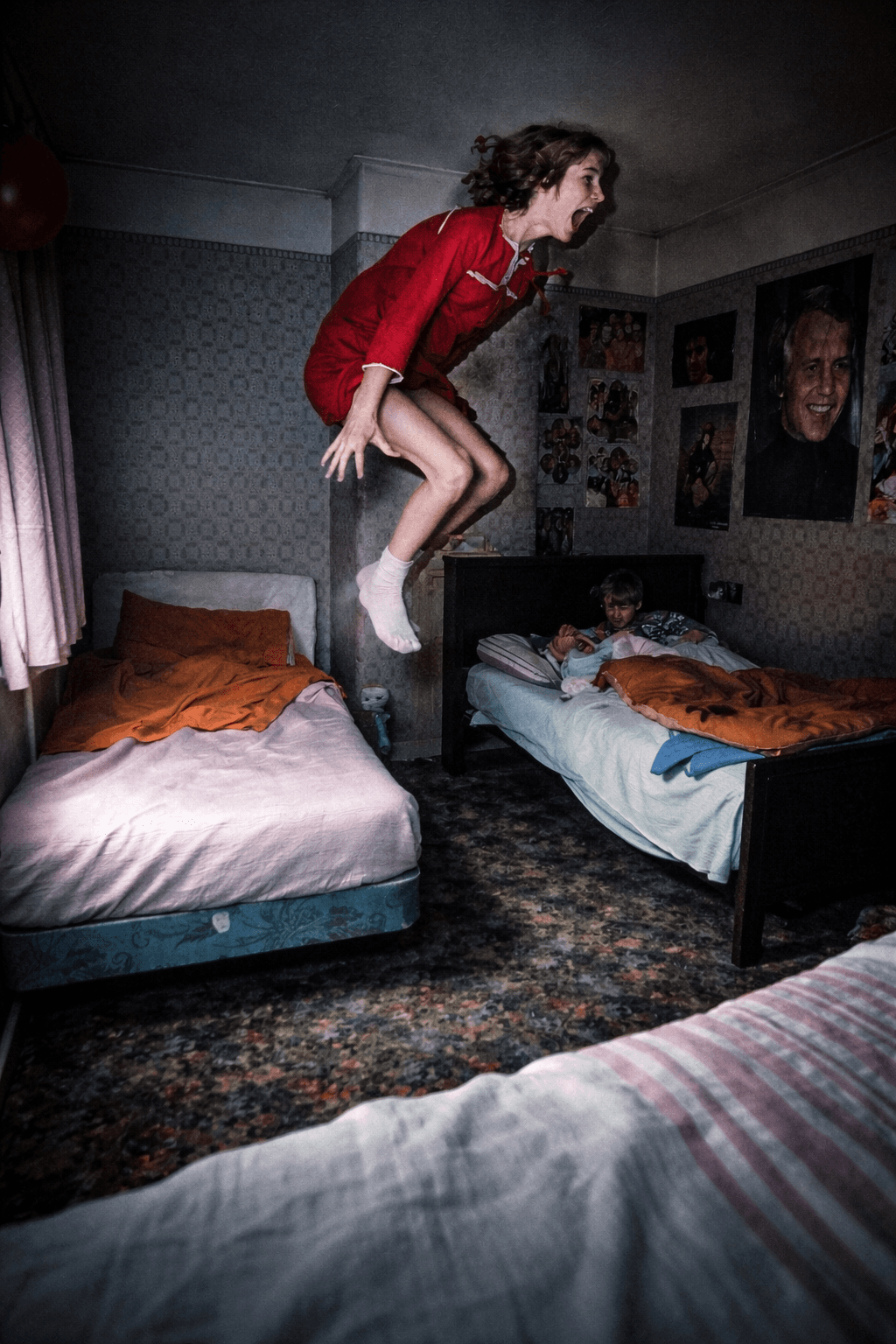
Violent paranormal activity terrorized a North London family for 18 months, witnessed by police and investigators.
From August 1977 to September 1978, the Hodgson family at 284 Green Street experienced what became Britain's most documented poltergeist case. Eleven-year-old Janet Hodgson became the focal point of phenomena that included furniture moving violently, objects flying across rooms, and most disturbingly, deep masculine voices emerging from the young girl. The case attracted Guy Lyon Playfair and Maurice Grosse from the Society for Psychical Research, who documented over 1,500 unexplained incidents. Police constable Carolyn Heeps witnessed a chair slide across the floor unaided, while Daily Mirror photographer Graham Morris claimed to be struck by flying objects. BBC radio recordings captured the alleged spirit voice of Bill Wilkins, a previous occupant who had died in the house. The phenomena included spontaneous fires, cold spots, and levitation events involving Janet, some of which were photographed in sequence. Despite extensive documentation, skeptics pointed to instances of admitted fakery by Janet, though investigators maintained that genuine phenomena occurred alongside the hoaxed events.
BBC Audio Recordings of Bill Wilkins Voice
Police Constable Witness Statement
Levitation Photographs
SPR Investigation Documentation
"I saw a chair move. It was not being pushed or pulled or anything. It moved. I checked all around the chair and underneath it to see if there were any tricks, but there weren't. I've no idea what caused it."
Constable Heeps was a serving Metropolitan Police officer with several years of experience responding to domestic disturbances and fraudulent claims. Her willingness to provide an official witness statement and allow her name to be used publicly demonstrated considerable professional courage, as paranormal claims were not typically welcomed by police administration. Her testimony proved crucial because it provided independent verification from a trained observer with no prior connection to the family. Heeps maintained her account consistently throughout the investigation and in subsequent interviews, despite potential career implications.
"In thirty years of investigation, I have never encountered a case with such a wide range of phenomena occurring over such an extended period. The sheer volume of incidents, many witnessed by multiple observers, defies conventional explanation."
Maurice Grosse was a veteran investigator with the Society for Psychical Research, bringing three decades of experience in paranormal investigation to the Enfield case. His background in electronics and engineering provided technical expertise for analyzing the phenomena, while his reputation for skeptical analysis within the SPR community lent credibility to his conclusions. Grosse documented the case meticulously, spending over 500 hours at the Hodgson house and maintaining detailed logs of every incident. His partnership with Guy Lyon Playfair created a two-investigator verification system that strengthened the evidentiary record.
SHOW 2 MORE WITNESS STATEMENTS
"People think we're nuts, but I know what I saw in my own home. No one can tell me those things didn't happen. My children couldn't have done all of it, not the way it happened."
Peggy Hodgson was a single mother of four children who became reluctant witnesses to phenomena that disrupted their lives for eighteen months. Recently separated from her husband, Peggy initially feared that reporting the incidents might result in social services removing her children or that she would be considered mentally unstable. Her decision to allow investigators and media into her home subjected her family to intense scrutiny and public ridicule. Despite the negative attention, Peggy consistently maintained her account of the events and defended her children against accusations of orchestrating an elaborate hoax.
"I was hit by flying objects on multiple occasions while photographing in that house. These weren't thrown by the children - I could see them clearly across the room when objects struck me from behind."
Graham Morris was a professional photographer for the Daily Mirror with extensive experience covering both routine and unusual news stories. His involvement brought technical photographic expertise to documenting the alleged phenomena, and his professional reputation was at stake in reporting extraordinary claims. Morris captured some of the most famous images associated with the case, including the sequential photographs of Janet's apparent levitation. His accounts of being physically struck by objects while maintaining visual contact with family members provided additional testimony of phenomena occurring beyond the children's immediate control.
Genuine Poltergeist Manifestation
Maurice Grosse and Guy Lyon Playfair, experienced investigators from the Society for Psychical Research, documented what they believed to be authentic psychokinetic phenomena centered around eleven-year-old Janet Hodgson. Their theory proposed that Janet's adolescent psychological stress, combined with the family's recent upheaval following her father's departure, created conditions for unconscious psychokinetic energy to manifest.
The investigators noted that 80% of documented poltergeist cases involve adolescents, particularly girls experiencing emotional turmoil. They pointed to phenomena that occurred when Janet was asleep or unconscious, instances where multiple witnesses observed simultaneous events across different rooms, and the consistent behavioral patterns matching historical poltergeist cases.
Critics argue this theory fails to explain the admitted instances of fakery or the convenient timing of many events when investigators were present. The mixing of genuine and hoaxed phenomena remains the theory's greatest challenge.
Elaborate Child Hoax Theory
Skeptical investigators, led by Anita Gregory and later supported by Joe Nickell, argued that the Enfield case represented an sophisticated deception orchestrated primarily by Janet Hodgson. They pointed to her admitted confession to faking some phenomena, video evidence showing her bending spoons when she thought no one was watching, and the theatrical timing of many events.
Gregory documented instances where hidden cameras revealed trickery, including Janet throwing objects and using ventriloquism techniques to create the Bill Wilkins voice. The theory suggests Janet's intelligence and creativity, combined with investigators' confirmation bias, created a feedback loop where initial pranks evolved into an elaborate ongoing deception.
However, this theory struggles to explain phenomena witnessed by police officers, events that occurred when Janet was physically restrained or unconscious, and the consistent voice recordings that some experts claim show characteristics impossible to fake through normal ventriloquism.
Psychological Contagion and Folie à Plusieurs
Psychiatrist Dr. John Beloff proposed that the Enfield case represented a form of mass hysteria or folie à plusieurs - a shared psychotic disorder where delusions are transmitted between individuals in close contact. This theory suggests that Janet's initial attention-seeking behavior infected family members, investigators, and witnesses with shared false beliefs.
The theory explains how seemingly credible witnesses like police officers and experienced investigators could genuinely believe they witnessed paranormal events. Under this model, the power of suggestion, combined with the emotional intensity of the situation, created a psychological environment where normal events were reinterpreted as supernatural and where witnesses unconsciously collaborated in maintaining the delusion.
While this explains the social dynamics of the case, it fails to account for physical evidence like the sequential photographs of levitation events and the audio recordings that captured phenomena when witnesses weren't present to influence each other's perceptions.
Geomagnetic and Infrasound Theory
Environmental scientist Dr. Michael Persinger and later researchers proposed that the Enfield phenomena resulted from geomagnetic anomalies and infrasound frequencies affecting the human brain. The theory suggests that electromagnetic fields generated by underground water sources, electrical installations, or geological stress in the London area created conditions that triggered temporal lobe instability.
Persinger's research demonstrated that low-frequency magnetic fields can induce hallucinations, sensations of presence, and even apparent psychokinetic effects through their influence on brain chemistry. The theory proposes that the Hodgson house sat in a geomagnetic hot spot that particularly affected Janet due to her adolescent brain development and possible electromagnetic sensitivity.
Skeptics of this theory note the lack of contemporary electromagnetic measurements at the Enfield location and question how geomagnetic fields could account for the specific interactive nature of the Bill Wilkins communications or the sequential timing of photographic evidence.
Interdimensional Bleed-Through Hypothesis
Quantum physicist Dr. Amit Goswami and consciousness researchers proposed that poltergeist phenomena like Enfield represent dimensional overlap events where parallel realities briefly intersect with our physical dimension. This theory suggests that quantum consciousness effects, particularly strong during adolescence, can create temporary rifts in spacetime fabric.
The hypothesis explains the random and chaotic nature of poltergeist events as consequences of quantum uncertainty principles operating at macro scales. Janet's role as focal point becomes that of an unwitting quantum observer, whose consciousness state influences which parallel reality aspects manifest in the physical world. The Bill Wilkins communications represent echo information from alternate timelines where he still inhabited the house.
This theory remains highly speculative and lacks testable predictions. Critics argue it represents quantum mysticism rather than legitimate science, though some researchers note that quantum mechanics interpretations involving consciousness remain unresolved in mainstream physics.
The Enfield case presents a complex mixture of genuine anomalies and admitted hoaxes. While skeptics highlight instances where Janet confessed to fakery and point to the theatrical nature of some manifestations, seasoned investigators documented phenomena that defied conventional explanation. The police witness testimony, contemporaneous audio recordings, and sequential photography of levitation events suggest something beyond simple trickery occurred. However, the contamination of genuine events with deliberate deception makes definitive conclusions impossible. The case remains Britain's most compelling poltergeist investigation precisely because it resists easy dismissal or confirmation.