'Oumuamua
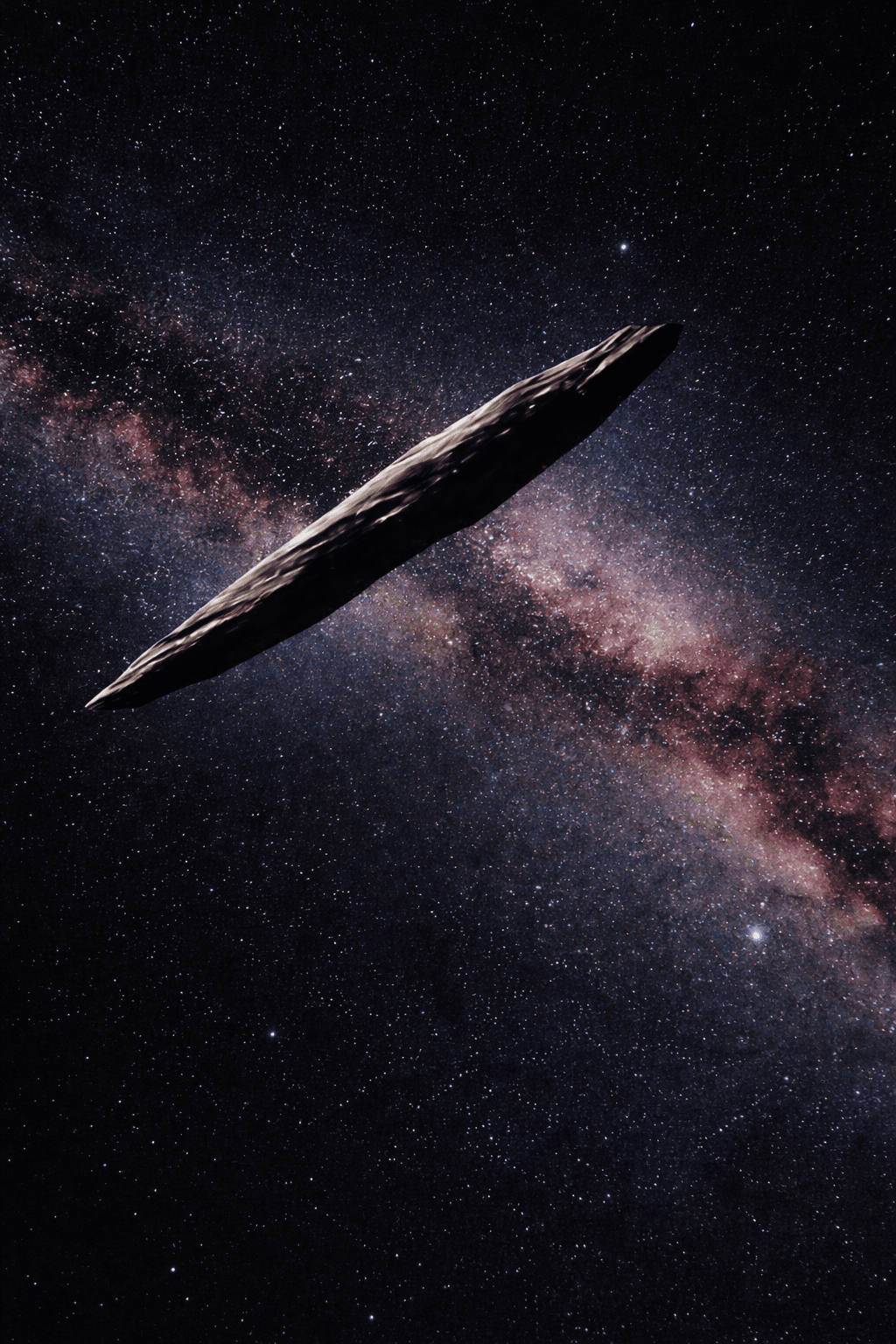
Harvard's top astronomer claims our first interstellar visitor wasn't a comet or asteroid, but potentially alien technology that accelerated without explanation.
In October 2017, astronomers detected humanity's first confirmed interstellar visitor - a cigar-shaped object traveling at approximately 196,000 mph through our solar system. Named 'Oumuamua (Hawaiian for "scout" or "messenger"), this anomaly estimated at up to 1,300 feet long defied classification. Unlike comets, it showed no visible tail or outgassing. Unlike asteroids, it accelerated inexplicably as it departed our solar system. Harvard astrophysicist Dr. Avi Loeb shocked the scientific community by proposing 'Oumuamua could be artificial alien technology - possibly a light sail or probe. The object's extreme elongation, ten times longer than wide, matched no known natural formation. Its reflective surface varied in brightness by a factor of ten as it tumbled. Most puzzling: the non-gravitational acceleration that couldn't be explained by solar radiation pressure alone. By the time scientists realized its significance, 'Oumuamua had already passed Earth and was racing toward interstellar space, leaving behind more questions than answers about our first documented visitor from the stars.
Pan-STARRS1 Discovery Images and Trajectory Data
Multi-Observatory Spectroscopic Analysis
Spitzer Space Telescope Non-Detection Results
Non-Gravitational Acceleration Measurements
"This is the most extreme orbit I have ever seen. It is really a weird object."
Dr. Robert Weryk of the University of Hawaii Institute for Astronomy was the astronomer who first identified 'Oumuamua in the Pan-STARRS1 survey images on October 19, 2017. As a postdoctoral researcher specializing in asteroid and comet discovery, Weryk immediately recognized the object's unusual trajectory indicated an interstellar origin. His initial observations and rapid follow-up measurements were crucial in determining 'Oumuamua's hyperbolic orbit before it disappeared from view. Weryk's expertise in orbital mechanics and years of experience identifying solar system objects lend significant credibility to his assessment of the object's unprecedented nature.
"We have discovered the first interstellar asteroid. It's a weird object and has us all really excited."
Dr. Alan Fitzsimmons of Queen's University Belfast was part of the European Southern Observatory team that conducted spectroscopic analysis of 'Oumuamua using the Very Large Telescope in Chile. As an expert in asteroid and comet composition, Fitzsimmons was among the first scientists to analyze the object's surface properties and color characteristics. His spectroscopic observations revealed 'Oumuamua's dark, reddish surface and lack of water ice or typical cometary materials. Fitzsimmons' decades of experience studying small solar system bodies and his direct involvement in the observational campaign make him a key witness to 'Oumuamua's unusual properties.
SHOW 2 MORE WITNESS STATEMENTS
"We think this is a tiny, weird object and we were surprised that it was accelerating."
Dr. Marco Micheli of the European Space Agency's Space Situational Awareness program led the team that discovered 'Oumuamua's non-gravitational acceleration. Using precise astrometric measurements from ground-based telescopes and the Hubble Space Telescope, Micheli tracked the object's motion and identified the unexplained acceleration that defied purely gravitational explanations. His mathematical analysis ruled out measurement errors and confirmed that some unknown force was pushing 'Oumuamua away from the Sun. As a specialist in orbit determination and space object tracking, Micheli's detection of this anomalous acceleration represents one of the most significant aspects of the 'Oumuamua mystery.
"The possibility that this is artificial doesn't mean that it's likely, but it means that we should take it seriously as one of the possibilities."
Dr. Avi Loeb, Frank B. Baird Jr. Professor of Science at Harvard University and former chair of the astronomy department, conducted theoretical analysis of 'Oumuamua's properties and proposed the controversial hypothesis that it could represent alien technology. As one of the world's leading astrophysicists and former director of the Institute for Theory and Computation at Harvard-Smithsonian Center for Astrophysics, Loeb examined the object's acceleration, shape, and reflective properties. His conclusion that 'Oumuamua's characteristics were more consistent with artificial technology than natural formation sparked intense scientific debate. Loeb's distinguished career studying black holes, cosmology, and extraterrestrial life gives significant weight to his analysis of humanity's first confirmed interstellar visitor.
Alien Light Sail Technology
Harvard's Dr. Avi Loeb proposed 'Oumuamua could be an artificial light sail - a thin, reflective sheet designed to harness stellar radiation for propulsion. This theory explains the object's extreme elongation, variable brightness, and mysterious acceleration without visible outgassing.
Loeb argues that 'Oumuamua's tumbling motion and reflective properties match theoretical alien technology better than any known natural object. The acceleration occurred precisely when solar radiation would be strongest, consistent with a light sail catching photons.
However, critics note that light sails would likely be much thinner and more fragile than 'Oumuamua appeared. The theory also requires accepting that alien civilizations would send probes through our solar system - a possibility that challenges our cosmic isolation assumptions.
Nitrogen Ice Fragment
Astronomers Alan Fitzsimmons and Michele Bannister proposed 'Oumuamua originated as a nitrogen ice fragment from a Pluto-like exoplanet. This theory suggests the object was carved away by impacts billions of years ago and sculpted during its interstellar journey.
Nitrogen sublimation could explain the non-gravitational acceleration without visible outgassing, as nitrogen gas would be nearly invisible. The extreme shape might result from preferential erosion during eons of travel through interstellar space.
Yet this theory faces significant challenges: nitrogen ice should be highly reflective, unlike 'Oumuamua's dark surface. The required mass loss through sublimation seems inconsistent with the object's observed acceleration pattern, and such fragile ice surviving interstellar conditions remains questionable.
Hydrogen Iceberg Hypothesis
Darryl Seligman of Yale University proposed 'Oumuamua was a hydrogen iceberg - a chunk of solid hydrogen formed in the cold depths of interstellar space. This exotic composition could explain both the acceleration and lack of visible outgassing.
Hydrogen sublimation would be nearly invisible to telescopes while providing sufficient thrust to match observed acceleration. The theory suggests such objects might be common in interstellar space but rarely survive passage through stellar systems due to rapid evaporation.
The hypothesis faces substantial skepticism: solid hydrogen has never been observed naturally in space and would require extraordinarily cold formation conditions. Critics argue that hydrogen ice would evaporate completely long before reaching our inner solar system, making this explanation scientifically implausible despite its mathematical elegance.
Comet Fragment Disguise
Some astronomers maintain 'Oumuamua was simply an unusual comet that had been stripped of volatile materials during previous stellar encounters. Dr. Robert Weryk, who discovered the object, initially classified it as a comet before reclassifying it as an asteroid.
This theory suggests 'Oumuamua's parent comet lost most of its ice and gases during earlier passages near other stars, leaving behind a rocky core with minimal outgassing capability. Small amounts of embedded volatiles could still provide thrust without creating a visible tail.
However, this explanation struggles with 'Oumuamua's extreme shape and acceleration profile. Traditional comets don't maintain such elongated structures, and the timing of acceleration doesn't match typical cometary behavior. The theory essentially requires 'Oumuamua to be an unprecedented type of comet unlike anything previously observed.
Tidal Disruption Debris
Zhang Yun and Douglas Lin proposed 'Oumuamua formed through tidal disruption - the violent stretching and shearing of a planetesimal as it passed too close to its parent star. This process could create the observed extreme elongation while ejecting the fragment into interstellar space.
Tidal forces would stretch the object like taffy, explaining its unusual 10:1 length-to-width ratio. The disruption event would also heat and process materials, potentially creating the observed surface properties and embedded volatiles responsible for acceleration.
While tidal disruption can create elongated objects, the theory requires very specific conditions to produce 'Oumuamua's exact characteristics. The probability of such a precisely shaped fragment traveling directly through our solar system raises questions about whether this explanation adequately accounts for the object's remarkable properties and convenient timing.
While 'Oumuamua's artificial origin remains scientifically unproven, its anomalous properties resist conventional explanation. The object's lack of cometary outgassing combined with unexplained acceleration creates a genuine puzzle. Dr. Loeb's alien technology hypothesis, though controversial, addresses observational data that traditional models struggle to explain. However, alternative natural explanations including nitrogen ice composition and hydrogen outgassing have been proposed. The brief observation window and object's current distance beyond detection range prevent definitive resolution. 'Oumuamua represents either an unprecedented natural phenomenon or humanity's first detection of extraterrestrial technology - both possibilities carry profound implications for our understanding of the cosmos.