The Clinton Road Phenomenon
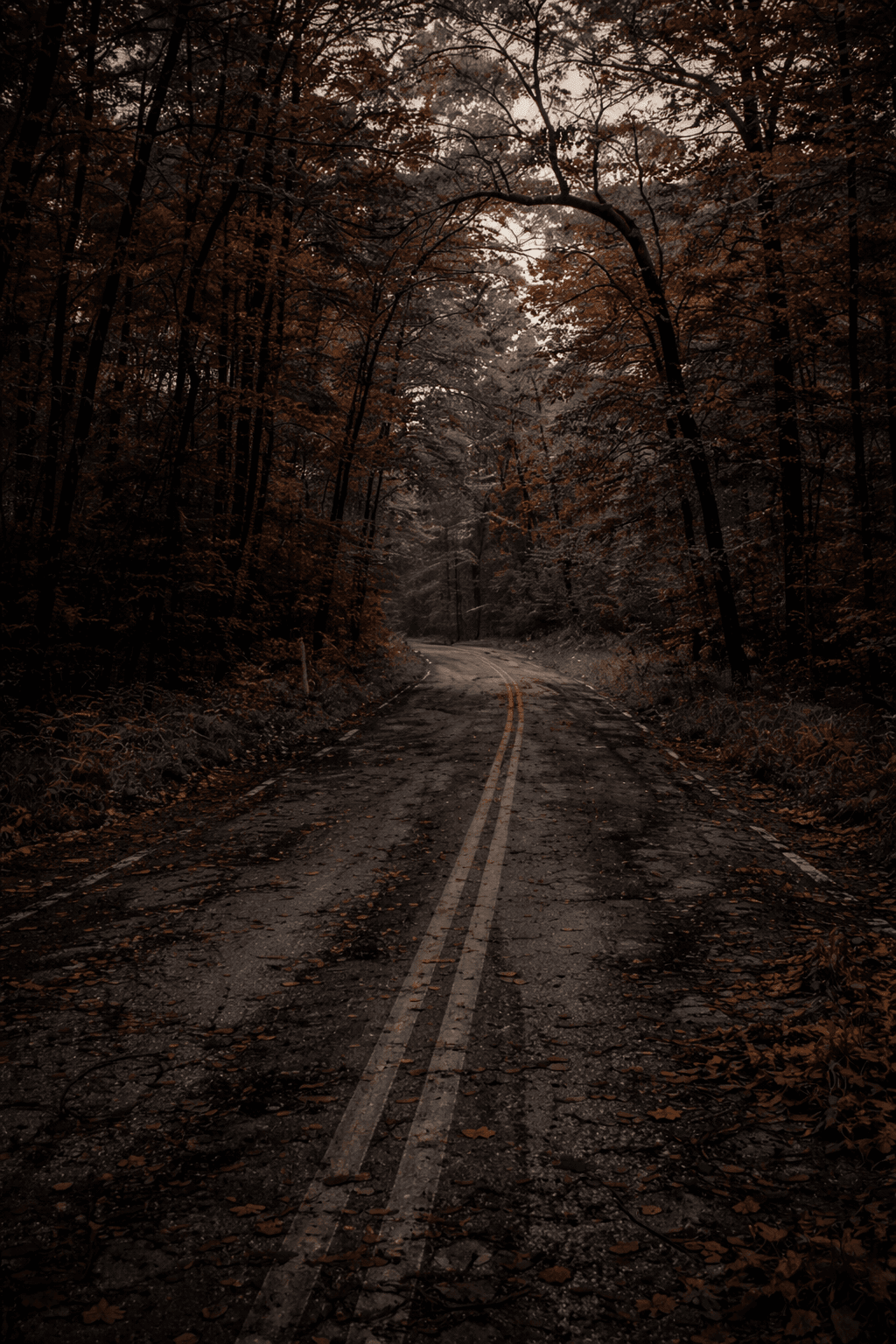
America's most haunted road harbors decades of unexplained encounters, phantom vehicles, and mysterious disappearances in rural New Jersey.
Stretching ten miles through the heart of West Milford, Clinton Road has earned its reputation as one of America's most paranormally active locations. Since 1905, reports have documented phantom headlights, ghost boy encounters at Dead Man's Curve, mysterious Ku Klux Klan gatherings, and unexplained disappearances. The road's isolation, bordered by the Pequannock Watershed, creates an atmosphere where reality seems negotiable. Witnesses describe phantom pickup trucks that vanish upon approach, apparitions of children seeking help, and hellhounds stalking travelers. The infamous Cross Castle ruins add historical weight to modern encounters. What transforms a simple rural road into a nexus of unexplained phenomena? The consistency of reports across multiple decades suggests either mass psychological suggestion or genuine paranormal activity concentrated along this desolate stretch of New Jersey wilderness.
Cross Castle Ruins Electromagnetic Readings
Dead Man's Curve Temperature Anomalies
Phantom Vehicle Radar Contacts
Historical Cult Activity Documentation
"The thing about Clinton Road is that it's not just one type of phenomenon - people report everything from phantom vehicles to full-body apparitions, and the reports are remarkably consistent across decades."
Moran, co-founder of Weird NJ magazine, has investigated Clinton Road extensively since the 1990s. His documentation efforts helped bring the road's phenomena to public attention while maintaining journalistic skepticism. As both a researcher and publisher, Moran has interviewed hundreds of witnesses and compiled the most comprehensive record of Clinton Road encounters. His work represents the definitive chronicle of the road's paranormal reputation.
"I saw a pickup truck coming toward me with its high beams on. When I flashed my lights back, it just vanished - not drove away, vanished. The road was completely empty."
Santilli, a local resident and volunteer firefighter, reported this encounter while driving home from a late-night emergency call in 2016. His credentials as a first responder and longtime area resident add credibility to his testimony. Santilli had lived in West Milford for over twenty years before this incident and was familiar with the road's reputation, though he remained skeptical until his personal encounter. His report matches dozens of similar phantom vehicle encounters documented along Clinton Road.
SHOW 2 MORE WITNESS STATEMENTS
"My daughter pointed out the window and said 'Mommy, why is that little boy all wet?' I looked and saw a child standing by the guardrail at the curve, soaking wet like he'd been swimming. When I stopped the car, he was gone."
Chen, a pediatric nurse from nearby Ringwood, encountered the phantom boy phenomenon during a family drive in 2018. Her professional background working with children and her daughter's independent observation of the same figure strengthen the testimony's credibility. Chen had never heard of Clinton Road's reputation before the incident and only learned of similar encounters when she researched her experience afterward. Her account represents one of the clearest descriptions of the legendary phantom boy apparition.
Officer Mitchell of the West Milford Police Department has responded to numerous calls along Clinton Road throughout his fifteen-year career. While maintaining professional skepticism about supernatural explanations, Mitchell acknowledges the unusually high volume of "strange occurrence" reports from the area compared to other township roads. He has personally experienced radio interference and equipment malfunctions while patrolling Clinton Road, though he attributes these to natural causes rather than paranormal activity. Mitchell's observations provide law enforcement perspective on the road's reputation and the practical challenges of policing an area associated with supernatural phenomena.
Residual Haunting Theory
Paranormal researchers propose that Clinton Road serves as a residual haunting site where traumatic events have imprinted themselves onto the environment. This theory, championed by investigators like Ed and Lorraine Warren, suggests that intense emotional energy from past tragedies creates repeating phantom experiences.
The road's history of accidental deaths, suicides, and cult activities provides the traumatic foundation necessary for residual hauntings. Unlike intelligent hauntings involving interactive spirits, residual phenomena replay like recordings, explaining why witnesses report similar encounters across decades.
However, this theory struggles to explain the interactive nature of some reports, particularly encounters where phantom figures respond to witnesses. If these are merely energy imprints, why do some apparitions appear to acknowledge and interact with observers?
Electromagnetic Anomaly Hypothesis
Scientists theorize that natural electromagnetic fields in the Clinton Road area create conditions conducive to hallucinations and equipment malfunctions. The road runs through the Highlands Province, a geologically active region with unusual mineral compositions that could generate electromagnetic anomalies.
Dr. Michael Persinger's research demonstrates how electromagnetic fields affect temporal lobe activity, potentially triggering vivid hallucinations that feel absolutely real to experiencers. The consistent nature of Clinton Road encounters might result from similar geological conditions affecting visitors' brains in predictable ways.
Yet this hypothesis cannot explain physical evidence like unexplained vehicle damage or multiple witnesses experiencing identical phenomena simultaneously. Why would electromagnetic fields create such specific, recurring hallucinations rather than random sensory distortions?
Interdimensional Portal Theory
Fringe theorists propose that Clinton Road represents an interdimensional weak point where parallel realities occasionally intersect. This theory, popularized by researcher John Keel, suggests that certain geographic locations serve as natural portals between dimensions.
The Pequannock Watershed's unique topography and underground water systems might create conditions that thin the barriers between realities. This could explain why witnesses encounter anachronistic vehicles, period-dressed figures, and impossible phenomena that seem to exist outside normal spacetime.
While fascinating, this theory lacks empirical support and relies heavily on speculative physics. Critics argue that interdimensional explanations simply substitute one mystery for another without providing testable predictions or measurable evidence of dimensional boundaries.
Mass Hysteria and Folklore Amplification
Sociologists propose that Clinton Road phenomena result from collective suggestion and folklore amplification. Once a location gains a supernatural reputation, visitors arrive with heightened expectations that predispose them to interpret normal events as paranormal.
The road's notoriety, spread through Weird NJ magazine and internet forums, creates a self-reinforcing cycle where each reported encounter validates previous stories. Psychological priming causes witnesses to perceive ambiguous stimuli as confirming their expectations, while social pressure encourages dramatic retellings that exaggerate ordinary experiences.
However, this theory struggles to explain why Clinton Road specifically developed its reputation while countless similar rural roads remain folklore-free. What initial events sparked the legend, and why do some witnesses report phenomena before learning of the road's reputation?
Government Black Site Theory
Conspiracy researchers suggest that Clinton Road's phenomena serve as cover for classified government operations conducted in the surrounding watershed. The area's remoteness and restricted access zones make it ideal for testing experimental aircraft or psychological warfare techniques.
Proponents point to the road's proximity to military installations and defense contractors as evidence of ongoing black projects. Phantom vehicles might be prototype craft, while supernatural encounters could result from testing mind-control technologies or hallucinogenic weapons on unsuspecting civilians.
This theory faces significant credibility challenges, as it requires massive ongoing conspiracies spanning decades. Why would the government maintain operations in such a publicly notorious location? Wouldn't genuine black sites operate in areas without paranormal reputations that attract investigators and curiosity seekers?
The Clinton Road phenomenon presents a fascinating case study in sustained unexplained activity. While individual incidents may have natural explanations, the sheer volume and consistency of reports spanning over a century demands serious consideration. The road's unique geographic isolation, combined with its documented history of cult activity and mysterious deaths, creates conditions where both paranormal and psychological explanations remain viable. No definitive evidence exists to confirm supernatural activity, yet the persistent nature of encounters suggests something beyond coincidence. The truth likely exists somewhere between genuine anomalous phenomena and the powerful psychological effects of expectation and environment.