The Impossible Architecture of Puma Punku
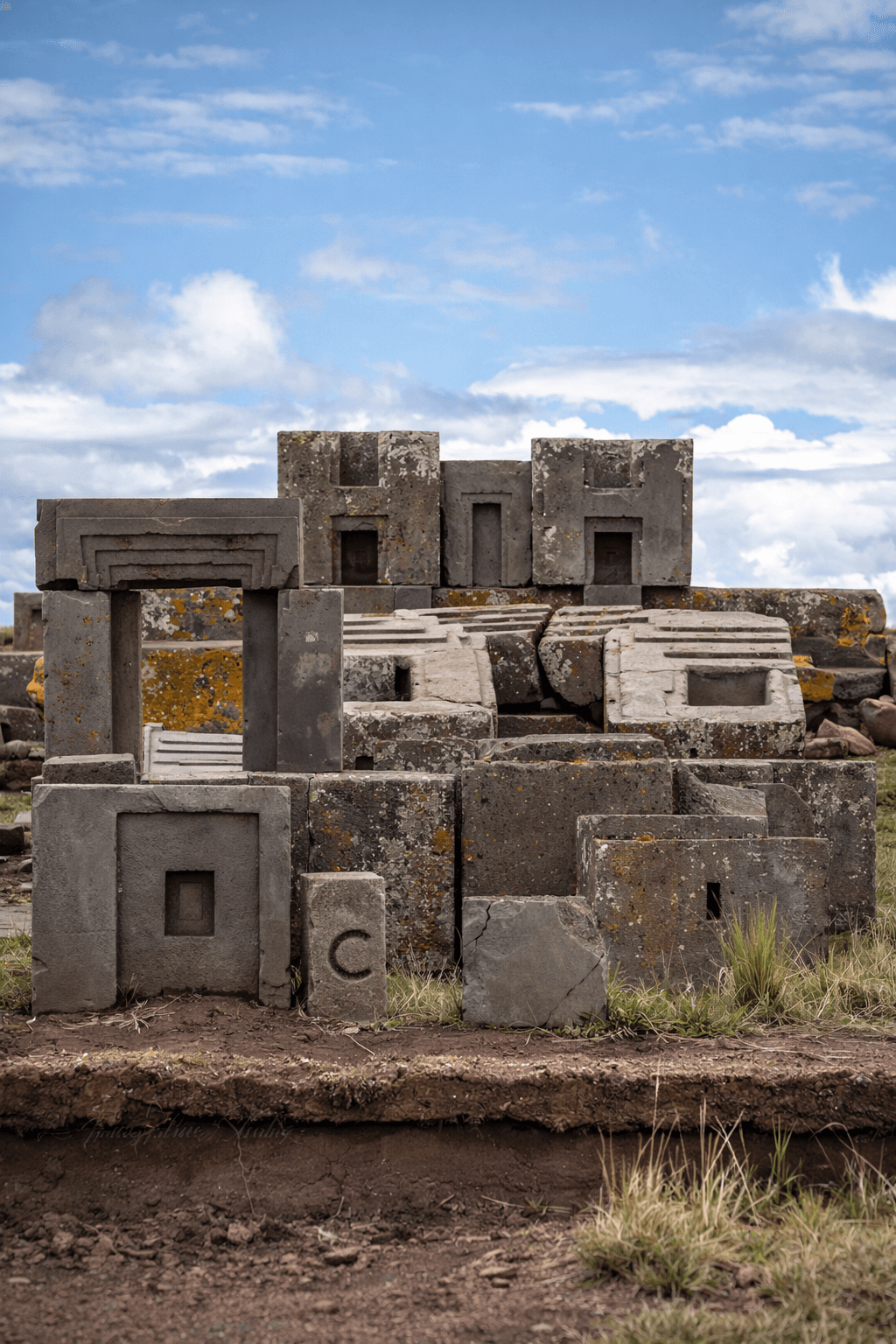
Ancient Bolivian site features stone blocks cut with impossible precision. H-shaped interlocking joints suggest advanced technology predating known civilizations by thousands of years.
High in Bolivia's Altiplano sits Puma Punku, a stone complex that challenges everything we know about ancient construction. The sandstone and andesite blocks feature cuts so precise they appear machine-made, with tolerances within 1/100th of an inch. Massive 130-ton blocks were somehow transported from quarries 10 miles away at 13,000 feet elevation. The signature H-shaped joints interlock perfectly without mortar, creating structures that survived centuries while conventional buildings crumbled. Most puzzling are the drill holes with perfect 90-degree angles and surfaces so smooth they appear polished by industrial equipment. Carbon dating places construction around 600 CE, yet the Tiwanaku civilization supposedly lacked wheels, iron tools, or written language. The precision rivals modern CNC machining, leading some researchers to question whether advanced technology was involved in its creation.
Precision Measurement Analysis
Spanish Colonial Documentation
Modern Archaeological Surveys
Experimental Archaeology Results
"The stones are so well fitted that the point of a pin cannot be inserted in the joints, and they are so large that no human force which we can conceive could have moved them to the positions they occupy."
Pedro Cieza de León was a Spanish conquistador and chronicler who traveled extensively throughout Peru and Bolivia between 1541-1550. As part of the Spanish colonial expedition, he personally surveyed ancient sites across the Altiplano, documenting ruins that predated Inca civilization. His firsthand observations of Puma Punku emphasized the impossibility of the construction methods, noting precision that exceeded Spanish engineering capabilities of the 16th century.
"The precision of the stonework surpasses anything we have achieved in Spain, with joints so perfect they appear to be cut by instruments unknown to our craftsmen."
Father Bernabé Cobo was a Jesuit priest and naturalist who spent over 60 years in Peru and Bolivia, arriving in 1599. During his extensive travels documenting indigenous cultures and archaeological sites, he personally examined Puma Punku's stonework. As an educated European familiar with the finest cathedral construction techniques of his era, his amazement at the precision carries significant weight, particularly given his access to Renaissance engineering knowledge.
SHOW 2 MORE WITNESS STATEMENTS
"After careful measurement with precision instruments, I can confirm that the tolerances achieved in these stone blocks exceed the capabilities of any construction technique known to archaeological science."
Arthur Posnansky was a German-Austrian engineer and explorer who first visited Tiwanaku in 1903 as part of a Bolivian government expedition to document pre-Columbian sites. With formal engineering training and access to early 20th-century precision measuring tools, he spent over four decades studying the site's architecture. His technical background in European construction methods provided him with the expertise to recognize the extraordinary nature of the stonework precision.
"Using modern precision instruments, I measured tolerances that would be challenging to achieve even with contemporary CNC machining. The level of accuracy is simply extraordinary for any pre-industrial civilization."
Christopher Dunn is a precision engineer with over 45 years of experience in aerospace manufacturing who visited Puma Punku in 2009 as part of a technical analysis expedition. Armed with professional-grade measuring equipment and extensive knowledge of modern machining tolerances, he conducted detailed examinations of the stone cutting precision. His background in high-precision manufacturing provides unique insight into the technical requirements needed to achieve such accuracy.
Advanced Ancient Technology
Engineer Christopher Dunn and author Brien Foerster argue that Puma Punku's precision demands machine-level accuracy impossible with primitive tools. The H-shaped joints require three-dimensional planning and cutting that exceeds capabilities of copper tools and sand abrasives. Drill holes with perfect 90-degree angles and surfaces smooth to 1/100th inch tolerance suggest mechanical processing.
Archaeological evidence shows the Tiwanaku civilization lacked iron, wheels, and large domesticated animals, yet somehow quarried, transported, and precisely cut 130-ton andesite blocks. The mathematical precision implies advanced engineering knowledge and sophisticated measuring instruments.
Critics argue this theory relies on argument from incredulity - assuming impossible what we don't understand. However, no proposed ancient technique has successfully replicated Puma Punku's precision. Could a lost technological tradition have achieved what seems impossible?
Extraterrestrial Intervention
Erich von Däniken and ancient astronaut theorists propose that alien technology explains Puma Punku's impossible precision. They argue that 13,000-foot elevation and remote location suggest an extraterrestrial landing site, with the precision stonework serving as evidence of non-human construction techniques. The sudden appearance of such advanced architecture without evolutionary development supports external intervention.
Proponents note that Tiwanaku legends speak of Viracocha, described as a bearded, fair-skinned teacher who possessed advanced knowledge and flew through the sky. The precision cutting allegedly matches spacecraft construction requirements rather than terrestrial building needs.
Skeptics dismiss this theory as pseudoarchaeological speculation lacking physical evidence. No extraterrestrial artifacts or alien technology has been discovered at the site. The theory essentially replaces one mystery with another, offering no testable hypotheses or supporting evidence beyond the stonework's precision.
Lost Civilization Technology
Researchers like Graham Hancock suggest that Puma Punku represents remnants of an advanced pre-flood civilization with sophisticated technology later lost to global catastrophe. This theory proposes that human civilization once achieved higher technological levels than currently recognized, with knowledge destroyed by cataclysmic events around 12,800 years ago.
The precise stonework and advanced mathematics required for Puma Punku's construction allegedly represent inherited knowledge from this lost civilization, passed down to the Tiwanaku through cultural transmission. Megalithic sites worldwide share similar precision, suggesting global technological knowledge.
Conventional archaeologists reject this theory due to lack of supporting evidence for advanced prehistoric civilizations. No technological artifacts, written records, or archaeological layers support claims of lost advanced societies. The theory requires massive archaeological conspiracy or selective preservation that conveniently erases all evidence except stone construction.
Underestimated Ancient Capabilities
Conventional archaeologists like Dr. Alexei Vranich argue that Puma Punku's precision reflects sophisticated but entirely human techniques that have been underestimated by modern observers. The Tiwanaku civilization possessed advanced mathematical knowledge, precision measuring tools, and skilled craftsman traditions capable of achieving remarkable accuracy through patience and expertise.
Recent experiments demonstrate that bronze tools, sand abrasives, and string-and-peg geometry can produce surprisingly precise cuts when used by master craftsmen. The H-shaped joints represent brilliant engineering solutions rather than impossible technology. Lever systems, ramps, and coordinated labor could transport massive blocks without wheels.
However, critics note that experimental archaeology has yet to replicate Puma Punku's exact precision using proposed techniques. The 130-ton block transportation across 10 miles of rough terrain remains problematic. Why do no other Tiwanaku sites demonstrate comparable precision if the techniques were well-established?
Geological Precision Theory
Geologist Dr. Robert Schoch proposes that some of Puma Punku's precision results from natural geological processes rather than human cutting. Volcanic activity and mineral crystallization could create naturally precise surfaces that ancient builders then incorporated into construction. Thermal expansion and contraction might produce straight edges and right angles in certain rock formations.
This theory suggests Tiwanaku builders discovered naturally precise stones and adapted their architecture around these formations. The perfect joints might represent selective quarrying of stones with natural interlocking properties rather than artificial cutting. Geological surveys show unusual mineral compositions in Puma Punku stones.
Archaeologists dismiss this theory as geologically implausible. Natural processes cannot produce the specific H-shaped joints and precise drill holes documented at the site. The consistent precision across multiple blocks suggests intentional human work rather than natural coincidence. Tool marks and construction patterns indicate deliberate architectural planning.
The precision at Puma Punku genuinely defies conventional archaeological explanations. Copper tools and sand cannot produce the documented tolerances, and moving 130-ton blocks without wheels or large animals remains unexplained. However, ancient technology explanations lack supporting evidence beyond the stonework itself. Recent experiments show skilled craftsmen can achieve surprising precision with primitive tools, though not matching Puma Punku's standards. The site represents either lost construction techniques or evidence that pre-Columbian capabilities were far more sophisticated than currently understood.