The Nazca Lines: Ancient Runway or Celestial Calendar?
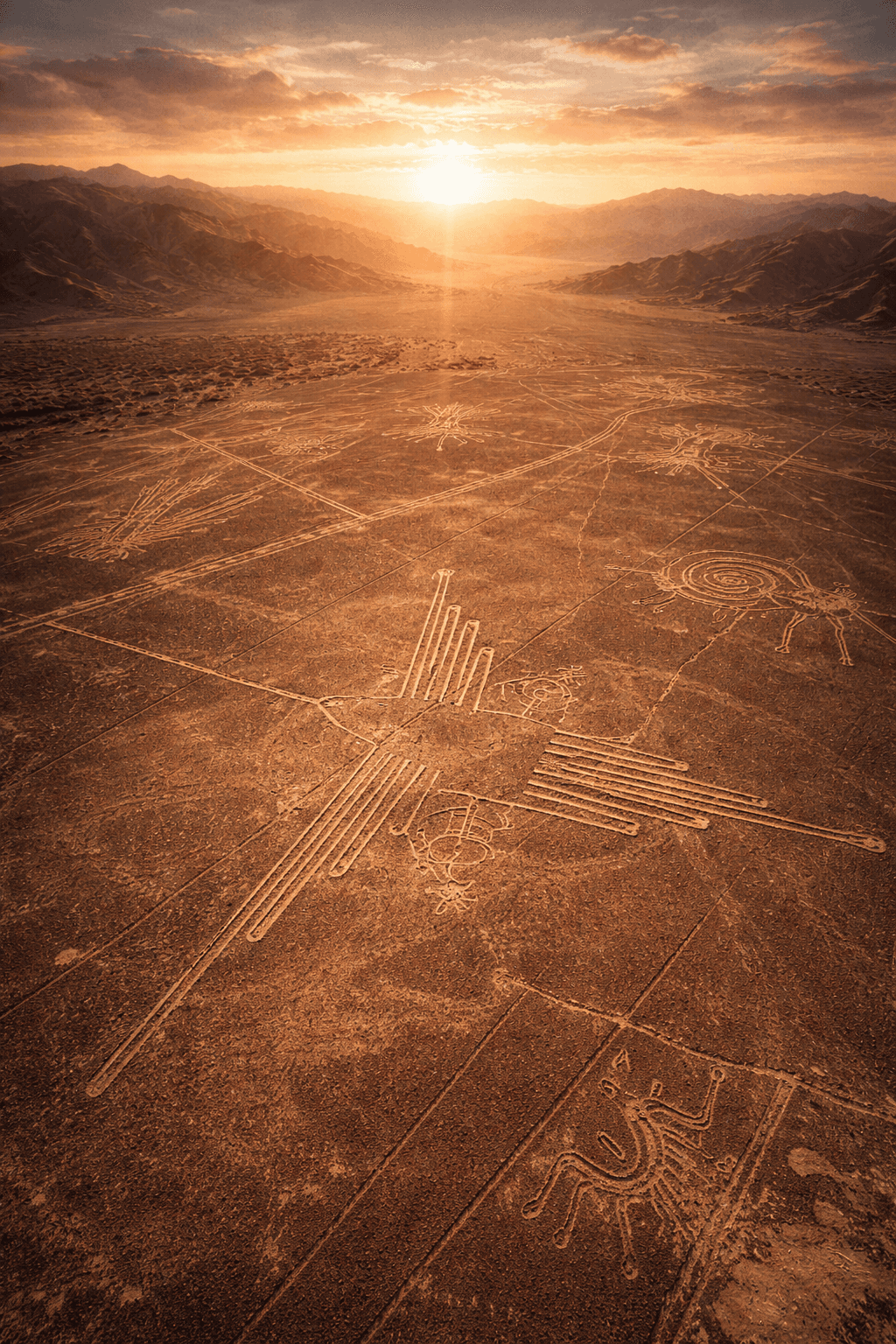
Massive geoglyphs in Peru's desert visible only from sky. Created 2,000 years ago by vanished civilization.
Between 100-700 CE, the Nazca people created over 800 straight lines and 300 geometric shapes spanning 450 square kilometers of Peruvian desert. These massive geoglyphs - including a spider, hummingbird, and monkey each hundreds of meters long - are virtually invisible from ground level but perfectly detailed when viewed from 500 feet above. The lines were created by removing dark surface stones to reveal lighter soil beneath, preserved by the region's bone-dry climate. Commercial pilot Paul Kosok rediscovered them in 1927, calling them "the largest astronomy book in the world." Swiss author Erich von Däniken later proposed they were ancient airstrips for extraterrestrial visitors. Modern laser scanning has revealed over 25,000 individual lines, many pointing to astronomical alignments. The precision and scale remain an engineering mystery.
Aerial Survey Documentation and Mapping
Satellite and LIDAR Discovery Data
Archaeological Dating and Construction Analysis
Experimental Balloon Flight Documentation
"I could hardly believe my eyes... When the sun set exactly on one of the lines, I realized this was the largest astronomy book in the world."
Paul Kosok, a historian from Long Island University, made this observation during his December 22, 1939 solstice flight over the Nazca plateau. As the first academic to systematically study the lines from aircraft, Kosok's documentation established their astronomical significance and brought them to international attention. His aerial photographs revealed the true scope and precision of the geoglyphs, launching decades of scientific investigation.
"The ancient Peruvians must have had instruments and a knowledge of mathematics and geometry which we can hardly credit them with having possessed."
Maria Reiche, the German mathematician who devoted over 50 years to studying the Nazca Lines, made this statement after completing detailed ground surveys of the geoglyphs. Her meticulous measurements revealed mathematical precision that challenged conventional understanding of ancient Nazca capabilities. Reiche lived in a small house near the lines from 1946 until her death in 1998, becoming the foremost authority on their construction and possible astronomical alignments.
SHOW 2 MORE WITNESS STATEMENTS
"The Nazca Lines represent one of the most extraordinary achievements of pre-Columbian civilization, demonstrating planning and execution capabilities that exceed our current understanding of ancient Andean cultures."
Giuseppe Orefici, the Italian archaeologist who directed the Nazca Project from 1982-2012, made this assessment after conducting the most comprehensive archaeological investigation of the lines. His excavations revealed multi-layered construction phases and sophisticated engineering techniques that suggest the Nazca possessed advanced surveying and planning capabilities. Orefici's work established definitive carbon-14 dating and uncovered evidence of ritual activities associated with line construction.
"AI technology is revealing that the Nazca Lines are far more extensive and complex than we ever imagined. We are still discovering new geoglyphs that have remained hidden for nearly 2,000 years."
Masato Sakai, professor at Yamagata University and leader of the Japanese Nazca research team, made this statement following the 2019-2020 discovery of 143 new geoglyphs using artificial intelligence analysis of satellite imagery. His team's use of IBM Watson AI revolutionized Nazca research by identifying patterns invisible to human observers. Sakai's discoveries doubled the known number of figurative geoglyphs and revealed previously unknown construction techniques that suggest the lines represent an even more sophisticated ancient project than previously understood.
Ancient Astronaut Landing Strips
Swiss author Erich von Däniken proposed in his 1968 bestseller *Chariots of the Gods?* that the Nazca Lines served as landing strips for ancient alien spacecraft. He argued that the perfectly straight lines, some extending for miles across rugged terrain, could only be appreciated from an aerial perspective - suggesting their creators had access to flight technology.
Von Däniken pointed to the mathematical precision and the fact that many lines converge at specific points, resembling modern airport runway configurations. He questioned how a civilization without written language could execute such geometrically perfect constructions across vast distances without aerial surveying capabilities.
Critics note that the lines are actually too narrow for spacecraft and that the soft desert floor would be unsuitable for landings. Yet the theory persists because it addresses the fundamental question: why create massive artworks only visible from the sky?
Astronomical Calendar System
Astronomer Gerald Hawkins and mathematician Maria Reiche dedicated decades to proving the lines function as a massive astronomical observatory. Reiche, known as the "Lady of the Lines," discovered that many straight lines align with solstices, equinoxes, and rising positions of important stars and constellations as they appeared 1,500-2,000 years ago.
The theory suggests the Nazca people used the lines to predict seasonal changes crucial for agriculture in the harsh desert environment. Specific animal geoglyphs may represent constellation maps, with the spider possibly depicting the constellation Orion. Computer analysis has confirmed numerous astronomical alignments, though not all lines correspond to celestial events.
However, critics argue that with so many lines pointing in different directions, some astronomical alignments are statistically inevitable. The challenge remains explaining why such an elaborate system was necessary when simpler methods existed.
Sacred Water Ceremony Pathways
Anthropologist Johan Reinhard proposed that the lines served as sacred walking paths for water ceremonies, connecting the desert plateau to mountain water sources. In this theory, the Nazca people created the lines as ritual pathways to honor mountain and water deities during times of drought, which were frequent in the region.
Reinhard's research revealed that many lines point directly toward mountain peaks and water sources, while the animal figures represent creatures associated with water and fertility in Andean mythology. The hummingbird, for instance, was considered a messenger to the gods. Archaeological evidence shows pottery and textiles with similar motifs were used in water-related ceremonies.
This theory explains the human-scale foot paths that run alongside many of the major lines, suggesting they were meant to be walked rather than viewed from above. Yet it doesn't fully account for the precision and massive scale that seems to require aerial perspective for appreciation.
Ancient Hot Air Balloon Navigation
Experimental archaeologist Jim Woodman proposed that the Nazca people possessed hot air balloon technology, allowing them to view and direct the construction of the lines from above. In 1975, Woodman and balloon expert Julian Nott successfully flew a balloon constructed entirely from materials available to the ancient Nazca - cotton fabric and reeds.
Woodman pointed to textile fragments found in Nazca tombs that showed evidence of intense burning patterns inconsistent with normal fires, suggesting exposure to hot air balloon flames. He also noted mysterious cleared rectangular areas near the lines that could have served as balloon launch sites. Local legends speak of flying shamans, which Woodman interprets as cultural memories of balloon flights.
Skeptics argue that no definitive balloon artifacts have been found, and that the burn patterns could result from cremation practices. However, the theory elegantly explains how the Nazca could achieve the aerial perspective necessary to create and appreciate these massive ground drawings.
Advanced Lost Civilization Technology
Some researchers propose that the Nazca Lines represent evidence of a technologically advanced pre-Columbian civilization whose capabilities have been systematically underestimated by mainstream archaeology. This theory suggests the Nazca possessed sophisticated surveying instruments and possibly aerial observation technology that was lost when their civilization collapsed.
Proponents point to the mathematical precision of the lines, some of which deviate less than 9 feet over 9 miles - accuracy that challenges conventional understanding of ancient surveying capabilities. Recent LIDAR scanning has revealed the lines are part of an even larger network of geometric patterns suggesting systematic territorial planning on a massive scale.
The theory gains credibility from ongoing discoveries of advanced ancient technologies worldwide, from the Antikythera mechanism to Roman concrete formulas. However, it requires accepting that a significant technological tradition completely vanished without leaving conventional archaeological evidence - raising questions about what else we might have lost from human history.
The Nazca Lines are undeniably real and represent remarkable ancient engineering. However, their true purpose remains hotly debated. While astronomical alignments suggest a ceremonial calendar function, the aerial perspective requirement raises uncomfortable questions about ancient capabilities. The precision and scale exceed what should be possible with known Nazca technology. Recent discoveries of new lines using satellite imagery prove we're still uncovering their full extent. Whether they're sacred pathways, star maps, or something else entirely - the mystery endures.