The Jersey Devil
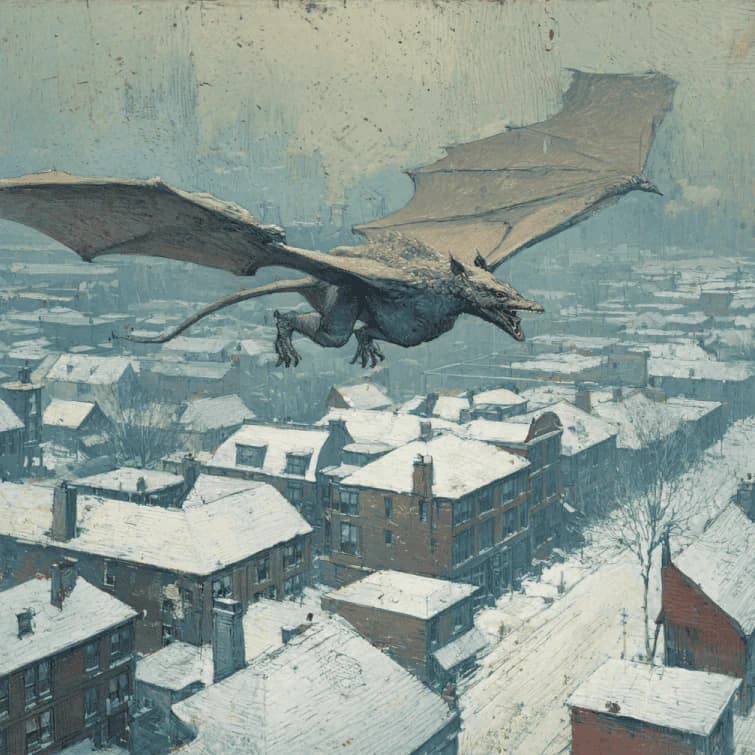
Legendary creature terrorizing New Jersey's Pine Barrens for over 280 years. Described as winged beast with horse head and hooves.
The Jersey Devil originated in 1735 when Mother Leeds allegedly gave birth to her cursed 13th child in the Pine Barrens. The creature reportedly transformed into a winged beast and vanished up the chimney.
The most significant outbreak occurred during "Devil Week" in January 1909, when hundreds of residents across South Jersey and Philadelphia reported encounters with a horse-headed, bat-winged creature standing 3-4 feet tall with glowing red eyes and emitting piercing screams.
Witnesses described hoofprints in snow leading across rooftops, over fences, and disappearing into thin air. The creature allegedly attacked a trolley car in Haddon Heights and was spotted by a Camden police officer. Schools closed, workers refused night shifts, and armed posses formed to hunt the beast.
Sightings continue sporadically, with over 2,000 reported encounters documented since 1735, making it one of America's most enduring cryptid mysteries.
1909 Hoofprint Photographs
Police Incident Reports
Trolley Attack Damage Report
Screaming Sounds
Historical Verification of Leeds Family Existence
Trail Camera Footage
"I saw it plainly - it was about three feet and half high, with a head like a collie dog and a face like a horse."
Officer Lowden encountered the creature during his night patrol in Bristol, Pennsylvania, during the height of the 1909 outbreak. His detailed police report described the creature as having bat-like wings, a long neck, and making a horrible screaming sound. As a trained law enforcement officer, Lowden's testimony carried significant weight and helped legitimize other civilian sightings during the mass hysteria period.
"It was three feet and a half high, had a head like a collie dog and a face like a horse. It had a long neck, wings about two feet long, and its back legs were like those of a crane."
Mrs. White observed the creature in her backyard in Riverside, New Jersey, during the January 1909 outbreak. She watched it for several minutes before it flew away with a piercing shriek. Her calm, detailed description became one of the most frequently cited eyewitness accounts, particularly notable for its specificity regarding the creature's anatomy and behavior.
SHOW 3 MORE WITNESS STATEMENTS
"It was about three feet and a half high, with a head like a collie dog and a face like a horse. It had a long neck, wings about two feet long, and its back legs were like those of a crane, and it had horse's hooves."
Evans and his wife both witnessed the Jersey Devil on their property in Gloucester City. They observed the creature for over ten minutes as it walked around their yard, occasionally spreading its wings. Evans noted that despite its bizarre appearance, the creature seemed curious rather than aggressive, investigating various objects in their garden before eventually taking flight.
"I saw the thing very plainly. It looked like a large crane, but much larger."
Councilman Weeden spotted the creature near the Trenton waterfront during his evening walk. As an elected official, his public testimony lent credibility to the growing number of sightings. He described the creature as moving with an awkward gait on the ground but graceful once airborne. Weeden's report was particularly significant because it came from a respected public figure with no apparent motive for fabrication.
"I've lived in these woods for forty years, and I've never seen anything like it before. It had glowing red eyes and made a sound like nothing I've ever heard."
Black, an experienced woodsman and hunting guide, encountered the creature while checking trap lines in 1993. His intimate knowledge of Pine Barrens wildlife made his inability to identify the creature particularly compelling. He reported that his hunting dogs refused to track the scent trail and seemed terrified by whatever had passed through the area, behavior he had never observed in decades of guiding hunters through the region.
Mother Leeds Curse
Deborah Leeds cursed her 13th child in 1735, causing demonic transformation. The supernatural origin explains the creature's longevity and otherworldly abilities. Historical records show Leeds family existed in Pine Barrens, lending credibility to the foundational legend.
Misidentified Sandhill Crane
Large migratory birds match witness descriptions - 6-foot wingspan, red crown, and harsh calls. Ornithologist explanations suggest injured or lost cranes behaving unusually could account for ground encounters and aggressive behavior during mating season.
Surviving Pterosaur
Relict population of prehistoric flying reptiles surviving in remote Pine Barrens. Pteranodon-like features match descriptions: elongated skull, membranous wings, bipedal stance. Cryptozoologists argue isolated ecosystems could harbor living fossils.
Mass Hysteria Phenomenon
1909 outbreak represents classic collective delusion fueled by newspaper sensationalism. Social contagion spread fear, causing misinterpretation of normal sounds and shadows. Psychological studies show how suggestible populations create shared hallucinations during stress periods.
Hoax and Media Creation
Philadelphia museums staged fake Jersey Devil exhibits in 1909 using modified kangaroo with fake wings. Newspaper circulation wars motivated sensational coverage. Publicity stunt theory suggests organized deception created lasting legend for tourism profit.
Unknown Bat Species
Undiscovered large bat species native to Pine Barrens caves. Flying fox specimens reach 4-foot wingspans in tropical regions. Evolutionary isolation could produce horse-faced features and unusual vocalizations in temperate climate adaptation.
Interdimensional Entity
Paranormal researchers propose otherworldly being phasing between dimensions. Electromagnetic anomalies in Pine Barrens could create portal conditions. Witness reports of creature vanishing instantly support supernatural manifestation theory rather than biological explanation.
The Jersey Devil phenomenon defies simple explanation. While mass hysteria likely explains the 1909 outbreak's intensity, the consistency of descriptions across centuries and physical evidence like unexplained tracks suggest something beyond folklore.
Misidentified wildlife remains plausible - sandhill cranes match size and behavior patterns, while injured bats could explain wing descriptions. However, multiple police witnesses and daylight sightings challenge easy dismissal.
The 280-year timeline predating modern media influence adds credibility, as does the concentration in sparsely populated Pine Barrens where unknown species could theoretically survive undetected.