COINTELPRO: The FBI's Secret War on American Citizens
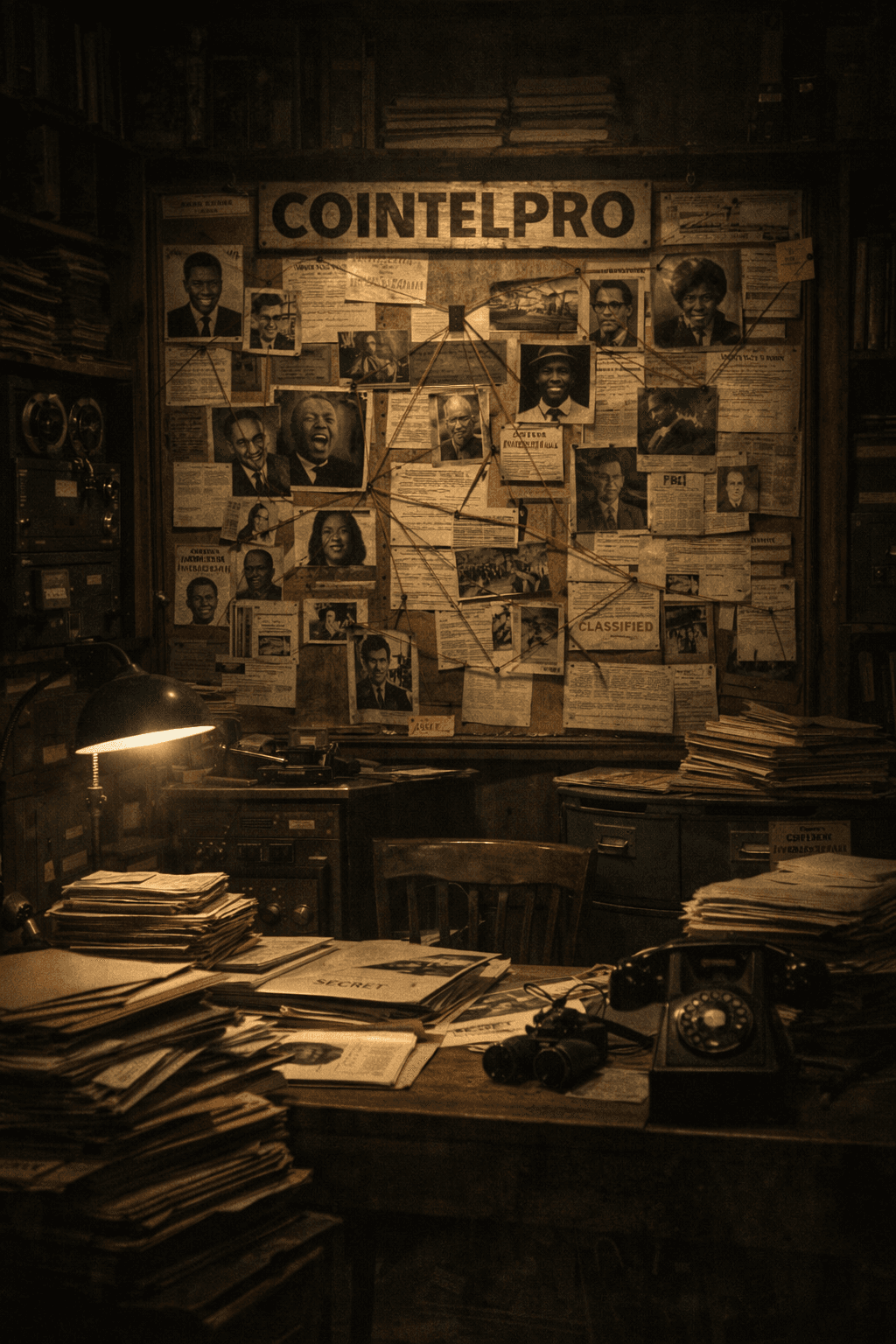
FBI's covert program to infiltrate, disrupt, and destroy domestic political organizations from 1956-1971. Exposed through stolen documents.
COINTELPRO (Counter Intelligence Program) was the FBI's most ambitious domestic surveillance operation, targeting American citizens whose only crime was political dissent. From 1956 to 1971, FBI Director J. Edgar Hoover orchestrated a shadow war against civil rights leaders, anti-war protesters, feminist organizations, and anyone deemed "subversive." The program employed forged documents, agent provocateurs, illegal surveillance, and psychological warfare to destroy lives and movements from within. Martin Luther King Jr. was subjected to relentless harassment, including attempts to drive him to suicide. The Black Panthers were systematically dismantled through assassinations and frame-ups. The program's existence remained hidden until March 8, 1971, when a group calling themselves the Citizens' Commission to Investigate the FBI burglarized an FBI office in Media, Pennsylvania, stealing classified documents that exposed the entire operation. The revelations sparked congressional investigations and reforms, but questions remain about what similar programs might still exist today.
The Media, Pennsylvania Burglary Documents
FBI Surveillance Files on Martin Luther King Jr.
Church Committee Investigation Reports
Black Panther Party Infiltration Records
"We were just ordinary parents who were horrified by what our government was doing. We felt we had to act."
Bonnie Raines was one of the eight members of the Citizens' Commission to Investigate the FBI who burglarized the Media, Pennsylvania FBI office in 1971. A mother of three and daycare center operator, she posed as a Swarthmore College student doing research on prison reform to case the FBI office weeks before the break-in. Her role remained secret for 43 years until the group revealed their identities in 2014. Raines and her husband John were motivated by FBI harassment of anti-war protesters and civil rights activists in their community.
"We did things that were clearly unconstitutional. We burglarized, we wire-tapped, we did black bag jobs. It was justified in the name of national security."
Former FBI Special Agent M. Wesley Swearingen served 25 years with the bureau (1951-1977) and participated in numerous COINTELPRO operations in Chicago and Los Angeles. After retirement, he became a whistleblower, testifying before Congress and in court cases about illegal FBI activities. Swearingen detailed specific operations including break-ins, mail theft, and surveillance of civil rights leaders. His testimony was crucial in lawsuits filed by COINTELPRO targets seeking compensation for constitutional violations.
SHOW 2 MORE WITNESS STATEMENTS
"COINTELPRO represented the most sustained assault on civil liberties in American history since the Alien and Sedition Acts."
Professor Athan Theoharis of Marquette University was the leading academic expert on FBI surveillance programs and COINTELPRO. A historian specializing in intelligence agencies, he filed hundreds of Freedom of Information Act requests and authored over 15 books on FBI operations. Theoharis served as an expert witness in court cases involving COINTELPRO victims and helped establish the documentary record of the program's scope and methods. His research revealed the systematic nature of constitutional violations and the lack of oversight that enabled the program's 15-year operation.
"The burglary changed everything. Without it, we might never have known about COINTELPRO."
Washington Post reporter Betty Medsger was the first journalist to receive and publish the stolen FBI documents from the Media, Pennsylvania break-in. Despite FBI pressure and threats of prosecution, Medsger and Post editor Ben Bradlee decided to publish the documents in March 1971, exposing COINTELPRO to the public for the first time. Medsger spent decades investigating the story, eventually tracking down and interviewing the anonymous burglars. Her reporting earned a Polk Award and helped trigger congressional investigations that led to intelligence oversight reforms.
The Hoover Empire Theory
This theory positions J. Edgar Hoover as operating an independent intelligence empire within the U.S. government, using COINTELPRO as his personal weapon against perceived enemies. Proponents argue Hoover accumulated secret files on presidents, congressmen, and Supreme Court justices to maintain power and immunity from oversight for nearly five decades.
Evidence includes Hoover's survival through eight presidents despite controversial methods, his ability to expand FBI budgets and authority, and documented instances of blackmail against political figures. The theory suggests COINTELPRO wasn't just about national security - it was about preserving Hoover's untouchable status.
However, this view may oversimplify institutional complicity. Presidents Nixon, Johnson, and others actively encouraged domestic surveillance. Was Hoover a rogue actor, or merely the visible face of a broader authoritarian consensus within the American power structure?
The Assassination Connection
Some researchers connect COINTELPRO to the assassinations of prominent civil rights and political leaders in the 1960s. This theory suggests the program's disruption tactics escalated to murder when other methods failed to neutralize targets like Martin Luther King Jr., Malcolm X, and Fred Hampton.
The theory gained credibility after the 1999 civil trial *King v. Jowers*, where a Memphis jury found government agencies liable for MLK's death. Hampton's 1969 killing involved a drugged security chief and pre-dawn FBI raid that looked more like an execution than a shootout. The FBI's documented hatred of these figures, combined with suspicious circumstances surrounding their deaths, fuels ongoing speculation.
Yet correlation isn't causation. Can a pattern of harassment and surveillance be definitively linked to orchestrated murders, or do these connections reflect the natural paranoia that COINTELPRO was designed to create?
The Corporate Partnership Theory
This theory argues COINTELPRO represented a public-private partnership between the FBI and major corporations to suppress labor movements and protect business interests. Researchers point to the program's focus on socialist organizations, union leaders, and anti-corporate activists as evidence of Wall Street influence on federal law enforcement.
Documents reveal FBI cooperation with companies like General Motors and Ford Motor Company in monitoring union activities. The program's targeting of environmental activists and anti-nuclear protesters aligned perfectly with corporate interests. Some theorists suggest modern corporate surveillance and "security consulting" firms are COINTELPRO's direct descendants.
But this theory may overstate corporate control while understating genuine Cold War fears. Was the FBI serving capitalism, or did business interests simply align with broader anti-communist ideology? The distinction matters for understanding whether similar programs today serve corporate masters or national security imperatives.
The Continuation Theory
Despite official termination in 1971, many researchers believe COINTELPRO never truly ended - it simply went deeper underground and adopted new names. They point to post-9/11 surveillance programs, NSA domestic spying, and FBI monitoring of Muslim communities, environmental groups, and Black Lives Matter as evidence of continuing operations.
The PATRIOT Act, FISA courts, and revelations from whistleblowers like Edward Snowden suggest surveillance capabilities that dwarf anything Hoover imagined. Modern "terrorism prevention" provides the same blank check that "communist infiltration" offered during COINTELPRO's heyday. The methods have evolved - digital surveillance, social media manipulation, and algorithmic targeting - but the goal remains unchanged.
Skeptics argue that comparing modern counterterrorism to COINTELPRO minimizes crucial legal and oversight differences. But given the program's 15-year secrecy, how would we know if similar operations exist today? The absence of evidence isn't evidence of absence.
The Social Control Experiment
Some scholars view COINTELPRO as a behavioral science experiment designed to test methods of social control and population management. This theory suggests the program served as a laboratory for psychological warfare techniques later exported globally through CIA operations and military interventions.
The FBI's collaboration with academic researchers, use of psychological profiles, and emphasis on creating paranoia and mistrust within target groups mirrors documented CIA programs like MKULTRA. COINTELPRO's focus on disrupting families, destroying marriages, and isolating individuals suggests sophisticated understanding of social psychology and group dynamics.
Evidence includes the program's meticulous documentation of psychological effects on targets and the recruitment of social scientists as consultants. But was this scientific rigor or simply bureaucratic thoroughness? The theory raises disturbing questions about whether American citizens were unwitting test subjects in a vast experiment in authoritarian control.
COINTELPRO is not a theory - it's documented historical fact. Thousands of declassified FBI documents, congressional testimony, and court records prove the program's existence and illegal activities. The Church Committee's 1975 Senate investigation confirmed systematic constitutional violations. While the official program ended in 1971, critics argue similar surveillance and disruption tactics continue under different names. The program's legacy raises fundamental questions about the balance between national security and civil liberties in American democracy.