Seeds of Life: The Panspermia Files
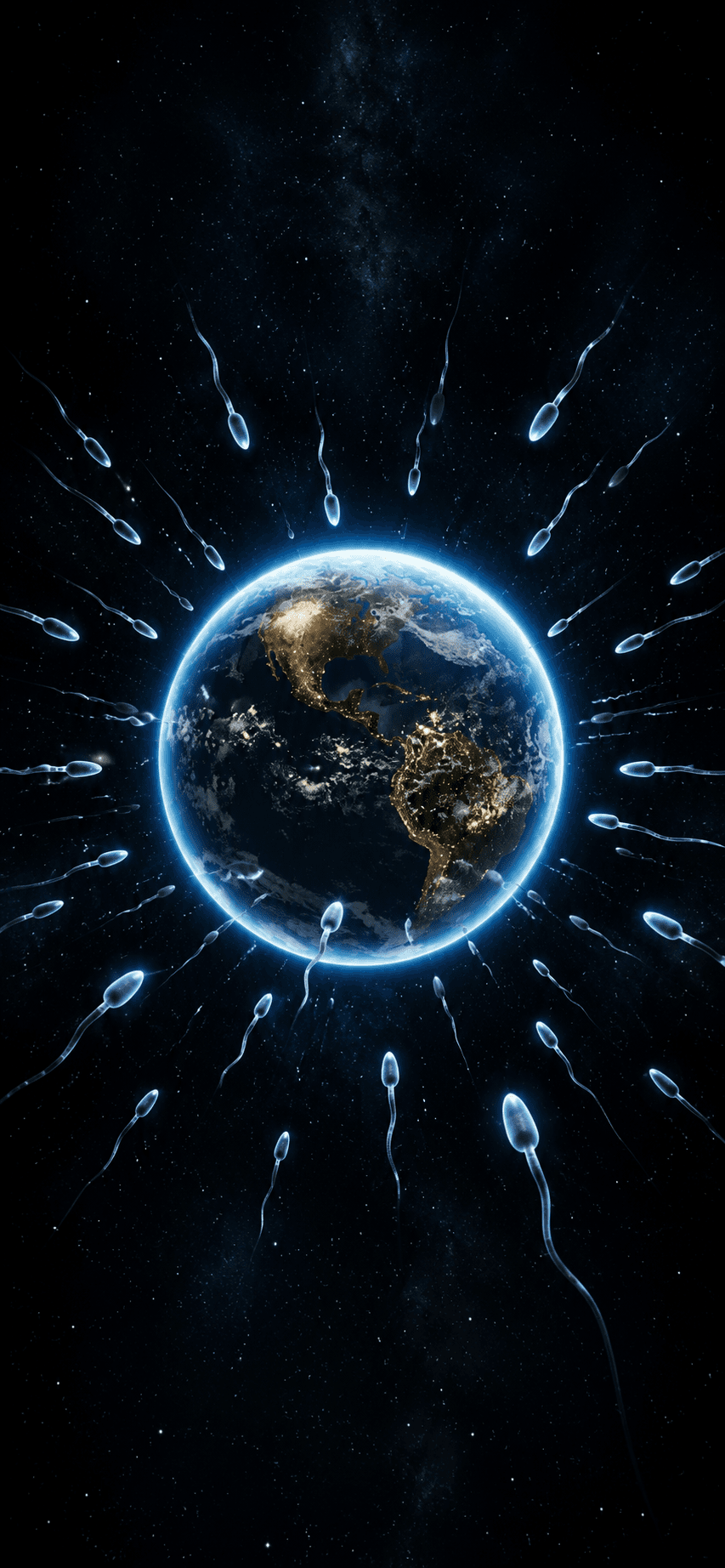
A fireball exploded over rural Australia in 1969, scattering roughly 100 kilograms of rock loaded with amino acids — and, embedded within it, presolar grains older than the Sun. Panspermia argues life did not begin on Earth at all — it arrived here, hitchhiking on rocks, comets, and dust.
On 28 September 1969, residents around Murchison, Victoria watched a brilliant fireball split into three fragments and heard a tremor roll across the paddocks. What fell was a carbonaceous chondrite — and inside it, scientists found more than 90 amino acids, only 19 of which are used by life on Earth. Later work identified nucleobases, sugars, and grains of silicon carbide older than the Sun itself.
That is the beating heart of panspermia: the idea that life, or at least life's chemistry, is distributed across the cosmos and that Earth was seeded rather than self-started. The concept dates to the Greek philosopher Anaxagoras, was formalized by Swedish chemist Svante Arrhenius in 1903, and was pushed to its extreme by Fred Hoyle and Chandra Wickramasinghe, who argued that comets deliver not just molecules but microbes — and possibly epidemics.
Mainstream science accepts the soft version: space delivers organic building blocks. The hard version — that living cells rode a rock across interplanetary or interstellar space and took root here — remains unproven. But no experiment has ruled it out, and several have shown that microbes can survive the trip.
Organic Compound Analysis of the Murchison Meteorite
NASA Findings on Martian Meteorite ALH84001
Surveyor 3 Camera Recovery and the Streptococcus Claim
Tanpopo Orbital Exposure Experiment Results
Crick and Orgel's Published Directed Panspermia Paper
Interstellar Visitors: Observational Record of 1I/'Oumuamua and 2I/Borisov
"I always thought the most significant thing that we ever found on the whole goddamn Moon was that little bacteria who came back and lived and nobody ever said anything about it."
Conrad commanded Apollo 12 and, on 20 November 1969, walked to the Surveyor 3 probe with lunar module pilot Alan Bean and personally cut away components including the television camera for return to Earth. A Navy test pilot and one of only twelve humans to walk on the Moon, Conrad was reacting to laboratory reports that Streptococcus mitis had been cultured from inside the camera housing after 31 months on the lunar surface. This remark is widely reproduced in NASA histories and secondary accounts of the mission, though it was made in a later interview and the exact date and setting of the statement are not firmly documented. Later reviewers concluded contamination during handling was the more probable explanation.
Score was a member of the Antarctic Search for Meteorites field party working the Allan Hills ice field during the 1984-85 austral summer. On 27 December 1984, riding a snowmobile across blue ice, she spotted a greenish-tinted rock that stood out sharply from the typical black fusion-crusted specimens the team collected. She flagged and bagged it under standard sterile field protocol. The specimen was catalogued as ALH84001 and initially misclassified as a diogenite; it sat in NASA's meteorite collection for nearly a decade before reanalysis identified it as Martian. Score's direct observation and recovery of the sample under contamination-controlled conditions is a key reason the 1996 biogenic claims were taken seriously at all.
SHOW 1 MORE WITNESS STATEMENT
On the morning of 28 September 1969, residents across the Goulburn Valley district of Victoria reported a brilliant fireball with a blue-white leading edge that broke into three fragments as it descended, followed by a low rumbling sound and a lingering smoke trail. Farmers and townspeople subsequently located dark, crumbly stones scattered across an area of roughly 13 square kilometres, some smelling strongly of methylated spirits — an odour later attributed to volatile organic compounds within the rock. Local residents, including staff and students at the Murchison school, collected fragments and passed them to Australian authorities and to the Smithsonian Institution. Their rapid recovery, before extensive rainfall, is why Murchison remains among the least contaminated carbonaceous chondrites ever studied.
Radiopanspermia: Spores on Starlight
Swedish physical chemist Svante Arrhenius, who would win the Nobel Prize in Chemistry in 1903, proposed that year that microscopic spores could be pushed between star systems by radiation pressure — the gentle but relentless shove of sunlight on very small particles. No rocket required. Just be small enough, and the light itself becomes your engine.
The math works for particles under about a micron. Arrhenius calculated that a spore leaving our solar system could reach the nearest stars in thousands of years. Later researchers refined the escape velocities and found the mechanism physically viable.
The problem is the journey, not the departure. Unshielded spores drifting through open space face cosmic radiation and ultraviolet flux that shred DNA over decades, not millennia. Arrhenius wrote before anyone understood the radiation environment beyond the atmosphere. Radiopanspermia survives today mostly as a historical foundation — unless clumping, dust shielding, or ice coating can protect the passengers.
Lithopanspermia: Life Rides the Rocks
The version most planetary scientists take seriously. When a large asteroid strikes a planet, it ejects surface rock at speeds exceeding escape velocity. Some of that debris eventually intercepts another world. We know this happens because hundreds of Martian meteorites — more than 300 catalogued specimens, many of them paired fragments of the same falls — have been recovered on Earth, physical proof that material routinely moves between planets.
Modeling by researchers including Jay Melosh showed that a fraction of ejected rock experiences surprisingly gentle acceleration and never exceeds temperatures lethal to embedded microorganisms. Interior portions of a meteoroid can stay cool even as the exterior fuses into a glassy crust.
The implication is uncomfortable and fascinating: if life arose on Mars first — a smaller planet that cooled faster and had liquid water early — Earth may have been infected by it. We might all be Martians. The gap remains that no meteorite has ever delivered a verified living organism, and detecting one without terrestrial contamination may be technically impossible.
Directed Panspermia: Somebody Sent Us
In 1973, Francis Crick — co-discoverer of the structure of DNA — and biochemist Leslie Orgel published a paper in the journal *Icarus* titled "Directed Panspermia." Their argument: life may have been deliberately dispatched to Earth by an advanced civilization aboard an unmanned spacecraft carrying microorganisms.
They were not joking, and they offered a testable hook. Crick and Orgel pointed to the near-universality of the genetic code and the biological importance of molybdenum, an element rare in Earth's crust but potentially abundant elsewhere, as suggestive anomalies worth explaining.
Crick himself later softened, calling the paper more thought experiment than conviction. Critics note that molybdenum's role is adequately explained by ocean chemistry and that a universal genetic code is what you would expect from a single common ancestor regardless of origin. Still, directed panspermia is the only origin hypothesis that predicts a message could be encoded in biology itself — and a handful of researchers have gone looking.
Cometary Panspermia and the Hoyle-Wickramasinghe Heresy
Astronomer Sir Fred Hoyle — who coined the term Big Bang while arguing against it — and his collaborator Chandra Wickramasinghe spent decades arguing that interstellar dust is not silicate grains but freeze-dried bacteria. They pointed to the infrared absorption spectrum of galactic dust, which they said matched dried microbial material better than any mineral model.
They went further in books including *Diseases from Space* (1979), proposing that comets periodically deliver new viruses to Earth and that influenza pandemics correlate with cometary activity. That claim made them scientific outcasts.
The spectral argument was largely answered by polycyclic aromatic hydrocarbons, ordinary organic molecules that produce similar signatures without requiring cells. Epidemiological claims never survived scrutiny. Yet Hoyle and Wickramasinghe were right about one enormous thing decades before it was fashionable: space is filthy with complex organic chemistry. Being wrong about the mechanism does not mean they were wrong about the direction.
Pseudo-Panspermia: Only the Ingredients Traveled
The conservative and increasingly dominant position. Nobody disputes that space delivers organics — the Murchison meteorite settled that in the 1970s, and NASA's OSIRIS-REx returned samples from asteroid Bennu in 2023 containing amino acids and nucleobases. What is disputed is whether anything alive ever made the trip.
Under pseudo-panspermia, meteorites and comets acted as a cosmic delivery service for prebiotic feedstock — amino acids, sugars, phosphorus compounds — which then assembled into life *here*, in Earth's hydrothermal vents or warm little ponds. The origin event is terrestrial. The raw material is not.
This version explains the meteorite evidence without requiring surviving organisms or an infinite regress of alien biospheres. Its weakness is that it explains everything and predicts nothing new: it is compatible with any future discovery. And it leaves the hardest question exactly where it started — how does non-living chemistry become self-replicating biology, anywhere, ever?
Split the theory in two and the verdict changes. Pseudo-panspermia — the delivery of organic chemistry by meteorites and comets — is effectively confirmed, written in the amino acids of Murchison. Biological panspermia, the arrival of living organisms, is plausible but unproven. Experiments show spores survive years in orbit; models show Mars rocks reach Earth intact. What is missing is a single unambiguous specimen. Every candidate — ALH84001's nanofossils, Hoover's meteorite filaments — dissolves under contamination scrutiny. Panspermia also dodges the real question: it relocates the origin of life without explaining it.