The Kumburgaz Tapes: Turkey's Impossible Close-Up
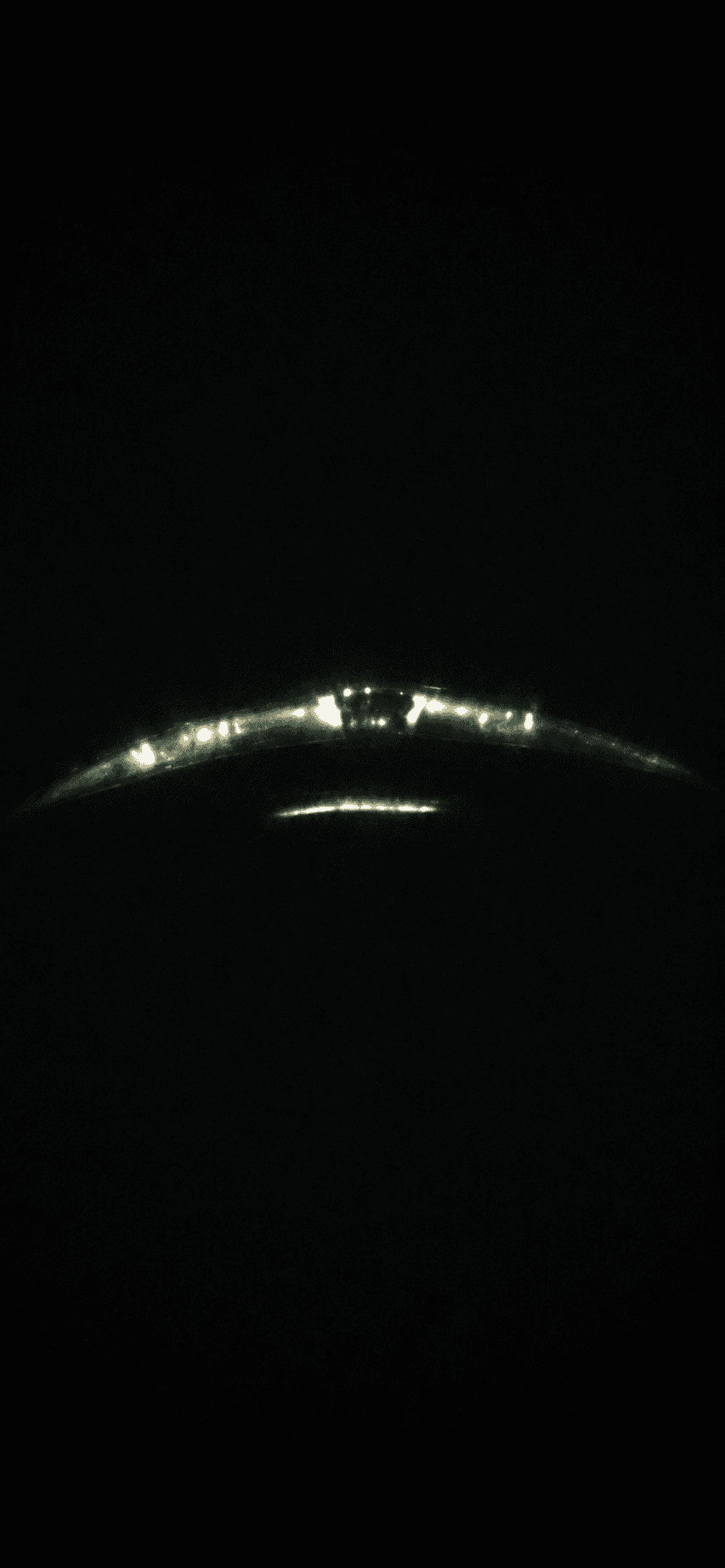
Between 2007 and 2009, a night watchman on Turkey's Marmara coast filmed hours of footage of a hovering object that appears to show humanoid figures behind glowing panels. Hailed as the clearest UFO video ever recorded, it remains fiercely contested.
In the summer of 2007, a night watchman named Yalçın Yalman at the Yeni Kent Compound in Kumburgaz — a resort suburb west of Istanbul on the Sea of Marmara — grabbed a consumer camcorder and pointed it at something hovering low over the water. He kept filming, on and off, for the next two years.
What he captured is unlike almost anything else in the UFO canon. Instead of the usual pale dot, the tapes show a dark, saucer-shaped structure with a row of brilliant lights and — in the most argued-over frames — what look like two or three dark humanoid heads and shoulders silhouetted behind a lit aperture. Residents of the compound reportedly watched alongside him.
The footage was publicized by the Istanbul-based Sirius UFO Space Sciences Research Center, whose director Haktan Akdoğan promoted it as the most important UFO video in history and screened it internationally. Skeptics counter that the object never moves relative to the horizon in a way that proves distance, that the extreme telephoto zoom through layers of sea haze mangles any small object into pseudo-detail, and that a model floating or suspended near the camera would look exactly like this. The tapes are public. The verdict is not.
The 2008 Kumburgaz Close-Up Footage
Sirius UFO Center's Public Analysis and Press Presentations
Corroborating Statements From Yeni Kent Compound Residents
Independent Skeptical Frame Analyses of the Footage
The 2009 Follow-Up Recordings
Yalman was employed as a night watchman at the Yeni Kent Compound in Kumburgaz, on the Marmara coast west of Istanbul, when he reported first noticing a luminous object hovering low over the sea in the summer of 2007. Rather than reporting it and moving on, he retrieved a consumer camcorder and began recording — and continued doing so intermittently across the summers of 2008 and 2009, accumulating hours of material. He described the object as returning repeatedly to the same stretch of water on clear nights, remaining visible long enough for other residents to be alerted and to watch alongside him. His footage became the entire foundation of the case. No verified direct quotations from Yalman are available in reliably archived English-language sources; his statements survive mainly in Turkish-language media reports that have not been systematically preserved.
Residents of the Yeni Kent Compound — a seaside apartment and holiday complex in Kumburgaz — were reported in Turkish media coverage in 2008 as saying they had watched the object with the naked eye from balconies and the shoreline, sometimes for several minutes at a time. Their accounts describe a bright, elongated light sitting low above the water, described as distinct in appearance from the fishing boats and ferry traffic seen nightly on the Sea of Marmara. These residents were described in press accounts as ordinary vacationers and tenants rather than UFO researchers, though this cannot be independently confirmed. Their claim of unaided visual observation is the strongest counter to purely in-camera explanations — but their interviews were never systematically recorded or archived, and most spoke without being publicly named.
SHOW 1 MORE WITNESS STATEMENT
A second member of the compound's security staff is described in compilations by UFO researchers as having been among those who observed the object during the recording period, though no details of their duties, vantage point, or shift pattern are independently documented. Night security personnel at a coastal property would ordinarily be familiar with the normal appearance of the waterfront after dark — fishing lamps, cargo traffic, and passing ferries — which is why a reported inability to reconcile the object with ordinary marine or air traffic has been treated as notable. No verified direct quotation from this individual has been published in an accessible source, and the account survives only as a secondhand summary, meaning the testimony cannot be independently evaluated.
A Genuine Structured Craft With Occupants
The maximalist reading, championed by Haktan Akdoğan of the Sirius UFO Space Sciences Research Center, is that the tapes show exactly what they appear to show: a metallic disc-shaped vehicle hovering over the Sea of Marmara with living occupants visible through an illuminated aperture.
Supporters point to the sheer duration — hours of material across three summers — and to the consistency of the object's structure between clips filmed weeks apart. They also cite compound residents who claim to have watched the object with the naked eye, which would rule out a purely optical artifact inside the camera.
The hole is fundamental: not one frame establishes range. Without a foreground reference at known distance, an object two meters away and an object two kilometers away are photographically identical. If this really is the best UFO video ever recorded, why has no independent university imaging lab published a peer-reviewed analysis of the original tapes?
A Model Filmed Close to the Camera
The most common skeptical explanation is deceptively simple: a small model — floated on the water, mounted on a pole, or suspended from a line — filmed at long focal length so that the background collapses into featureless haze.
Analysts note that the object's apparent size fluctuates with focus rather than with any convincing flight behavior, that it never occludes or is occluded by anything at known distance, and that the alleged occupants are static shapes rather than figures that shift position meaningfully across sequences. A cheap saucer with an LED strip and a smoked window would reproduce the imagery almost exactly.
The counterargument is logistical rather than optical: Yalman was a night watchman, not a visual effects artist, and multiple residents claim independent naked-eye observation. A close-range model would be trivially visible to anyone standing nearby — so either the witnesses are mistaken about what they saw, or complicit.
Distant Vessel Distorted by Thermal Inversion
The Sea of Marmara in summer is a textbook environment for atmospheric refraction. Warm air over cooler water creates inversion layers that stretch, mirror, compress and duplicate distant objects — the same physics behind the classic Fata Morgana mirage that turns ships into floating castles.
Under this theory, the Kumburgaz object is a fishing boat, ferry, or lit platform several kilometers offshore. Its superstructure lights get smeared into a horizontal band; the inversion mirrors the hull into a dark saucer profile; and heat shimmer produces the writhing, biological-looking motion inside the bright aperture that observers interpret as heads and shoulders.
This elegantly explains why the object clings to the horizon and why detail dissolves as the camera zooms. The weakness: witnesses describe the object changing altitude and departing upward, which mirages do not do. Unless, of course, the inversion layer itself was shifting.
Pixel Pareidolia: The Camera Invented the Aliens
Even if Yalman filmed something genuinely unidentified, the occupants may be a pure artifact of the imaging chain. A 2007-era consumer camcorder pushed to maximum optical plus digital zoom produces heavy interpolation, compression blocking, and chroma smearing. Bright light against dark structure generates blooming and dark halos that the eye readily resolves into head-and-shoulder silhouettes.
This is pareidolia operating at the pixel level — the same mechanism that finds faces in Martian rock formations and toast. Critically, the alleged figures appear only in the most degraded, most heavily magnified frames. Genuine detail improves with better data; artifacts multiply as data quality drops.
The implication cuts both ways. It means the case's headline claim — visible aliens — is likely worthless. But it does not resolve what the original luminous object over the water actually was, which is the question everyone stopped asking once the humanoids appeared.
A Promotional Hoax Built for an Audience
Follow the incentives. The footage was not released through a news agency or a university — it was released and marketed by a private UFO research organization in Istanbul that produced media, held press conferences, and toured the material internationally as the most important UFO evidence ever obtained.
Proponents of this theory argue the case has the structure of a constructed media property: an appealingly humble witness, an extraordinarily long-running supply of new footage each summer, escalating detail with each release, and a single gatekeeper controlling access to the original tapes. Turkish media coverage was reportedly extensive, and the area is said to have attracted sky-watchers.
But motive is not proof. No participant has confessed, no props have surfaced, and dismissing witnesses as paid actors requires its own conspiracy. The honest position: the chain of custody on the original media is too weak to authenticate — and that weakness alone is disqualifying, whatever the truth is.
The footage is real footage of something — the question is scale. Everything hinges on distance, and nothing in the frames establishes it. Extreme zoom through marine haze is notorious for inventing structure, and the alleged occupants sit right at the pixel threshold where the human brain manufactures faces. That the tapes were promoted by an organization with a commercial and ideological stake, and that the original camera media has never been independently forensically examined, does the case no favors. Doubtful — but the compound residents who say they watched it with their own eyes keep this file open.