The Dodleston Messages: Transmissions Across Time
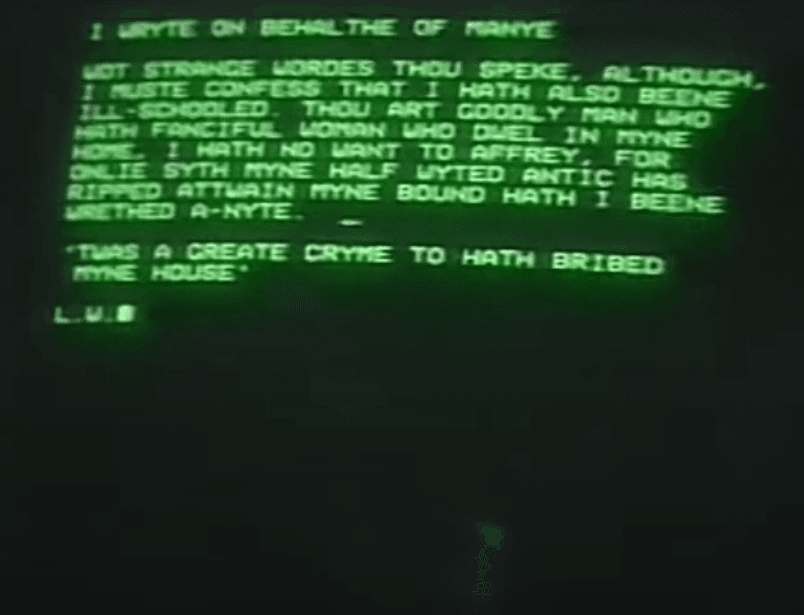
In 1984, a schoolteacher in rural England began receiving messages on his BBC Micro computer—written in 16th-century English—from someone claiming to live during the reign of Henry VIII. The computer wasn't connected to any network. Then a third party joined the conversation: someone claiming to be from the year 2109.
In the autumn of 1984, economics teacher Ken Webster was renovating Meadow Cottage, an 18th-century brick dwelling in the quiet village of Dodleston, Cheshire—just four miles from the Welsh border. He lived there with his girlfriend Debbie and their lodger Nicola Bagguley. What began as routine home improvement would become one of the strangest paranormal cases of the 20th century.
The disturbances started small. Six-toed footprints appeared in construction dust, seemingly walking up the walls. When painted over, they returned the next day. Tins of cat food were found stacked in perfect pyramids. Cold drafts swept through rooms with no source. A presence made itself felt.
Then came the computer.
Webster had borrowed a BBC Micro Model B from his school so Nicola could write comedy sketches using the EDWORD word processor. One evening, after returning from the local pub, they discovered a glowing green message on the screen. The cryptic text referenced them by name: "Ken, Deb, Nic / True are the nightmares of a person that fears..."
No one had been home. The computer wasn't connected to any network—this was years before the internet. There was no way to send external messages to a standalone BBC Micro in 1984.
More messages followed, written in archaic English and signed "L.W." The writer accused Webster of stealing his house and making "lights which the devil makes." Linguistic analysis by Oxford-educated scholar Peter Trinder determined the vocabulary was authentic to the 1540s—the reign of Henry VIII and Catherine Parr.
The correspondent eventually revealed himself as Tomas Harden (alias Lukas Wainman), a farmer living on the same land in 1546. He claimed to see Webster's world through a "leems boyste"—a "box of lights"—given to him by someone from the future. That's when things got stranger: a third party entered the conversation, identifying themselves only as "2109."
Over 18 months, approximately 300 messages were exchanged. The Society for Psychical Research investigated three times but witnessed nothing—the phenomena refused to perform on command. Thomas Harden was eventually arrested for witchcraft in his own time (they learned through Debbie's visions), then released after pressure. He claimed he would write a book about their correspondence and hide it to be found centuries later.
That book has never been found.
The EDWORD Computer Messages
Six-Toed Footprints
Historical Records - Thomas Harden
Linguistic Analysis by Peter Trinder
SPR Investigation Records (Incomplete)
"What a prospect! Either he was dead and we were alive or he was alive and we were more than 400 years from the dates of our conceptions."
Trinder, a fellow teacher with an Oxford degree in English, analyzed the messages using the Oxford English Dictionary and found that "the checkable vocabulary was authentic to or before the 1540s, though the grammar was sometimes idiosyncratic." He considered the messages genuine and provided an appendix to Webster's book with his findings.
SHOW 2 MORE WITNESS STATEMENTS
"I write on behalf of many – What strange words you speak – You are a worthy man who has a fanciful woman, and you dwell in my home – with lights which the devil makes – It was a great crime to have stolen my house."
"Try to understand that you three have a purpose that shall in your life time change the face of history, we, 2109, must not affect your thoughts directly but give you some sort of guidance that will allow room for your own destiny. All we can say is that we are all part of the same god, whatever he is (?), is."
Genuine Cross-Temporal Communication
Believers argue that the Dodleston case represents authentic communication across time, facilitated by unknown technology from the year 2109. The poltergeist activity (footprints, stacked objects, cold spots) represented a "thinning" of temporal barriers, with the computer serving as an interface. Instrumental Trans-Communication researchers like Ernst Senkowski took the case seriously, noting that spirits have historically adapted to available technology—from table-rapping to radio static to computers.
Elaborate Literary Hoax
Skeptics contend Ken Webster fabricated the entire story to sell a science fiction novel marketed as "based on true events." The 1996 BBC investigation featured Dr. Richard Wiseman, who conducted linguistic analysis showing similarities between the archaic messages and Webster's own writing style. The increasingly complex narrative—complete with Tudor intrigue, witchcraft trials, and mysterious time manipulators—reads more like fiction than authentic paranormal encounter. The convenient "2109's poor spelling" explained away why future English wouldn't look different.
Poltergeist Activity with Computer Interface
Some researchers suggest genuine poltergeist activity—triggered perhaps by the renovations disturbing the land, or by the presence of a young person (Nicola, age 19)—manifested through the most available communication device: the computer. Poltergeists have historically been associated with adolescents and young adults. The entity may not have been Thomas Harden at all, but an intelligence that adopted a persona to communicate, drawing on local history it could access through unknown means.
Third-Party Prankster with Historical Knowledge
A sophisticated prankster with access to the cottage, deep knowledge of 16th-century English dialects, and understanding of BBC Micro technology could theoretically have created the messages. However, this would require: access to the cottage without detection, knowledge of when Webster would check the computer, and extraordinary commitment over 18 months. Webster borrowed computers from a rotating pool at his school, making it impossible to rig them all. Messages sometimes appeared when residents were briefly away—suggesting someone watching the house.
Psychological/Dissociative Episode
A psychological interpretation suggests Webster (or another household member) may have written the messages in a dissociative state, with no memory of doing so. Stress from renovations, sleep deprivation, and the suggestive environment of an old cottage could have triggered fugue-like episodes. The "2109" entity, with its grandiose claims about time experiments and higher purposes, resembles the kind of elaborate mythology sometimes constructed by individuals experiencing dissociative phenomena.
The Dodleston Messages present an almost impossibly strange scenario. The technical limitations of 1984 BBC Micro computers make external tampering nearly impossible—there was no network, no internet, and the machine couldn't retain data when powered off. Yet the elaborate nature of the messages, spanning three timelines and featuring increasingly complex plotlines involving Tudor intrigue and time manipulation experiments, strains credulity. The linguistic authenticity impressed scholars, but errors in historical details (such as incorrect references to Oxford colleges) undermine claims of genuine 16th-century origin. The 2109 entity's convenient excuse of "poor spelling to account for future language drift" feels like a writer covering their tracks. Ken Webster published his account as "The Vertical Plane" in 1989—was this paranormal documentation or creative marketing for a sci-fi novel? The truth may lie somewhere in the intersection of genuine poltergeist activity, elaborate hoax, and a teacher's imaginative storytelling. The promised book from Thomas Harden—allegedly hidden for centuries—remains the ultimate test. Until someone finds it, the case stays open.