The Ohio Grassman: Southeast Ohio's Bigfoot Terror
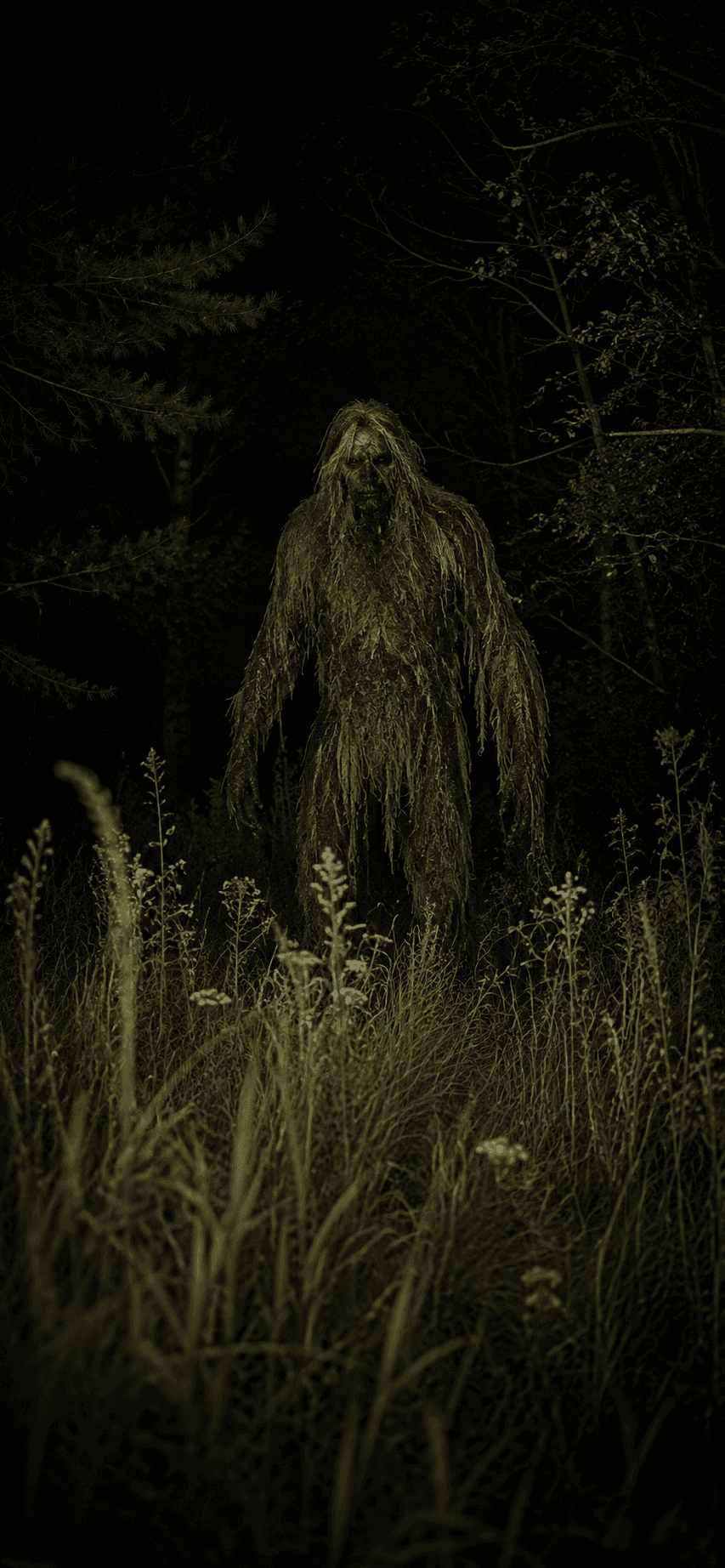
A 7-foot tall, aggressive humanoid creature terrorizing Ohio's Hocking Hills region since the 1970s. Unlike typical Bigfoot encounters, witnesses report violent behavior and distinctive grass nests.
The Ohio Grassman emerged from the dense forests of southeastern Ohio in the late 1970s, distinguishing itself from typical Bigfoot encounters through aggressive behavior and distinctive grass nests. Standing approximately seven to eight feet tall with grayish-brown hair covering its massive frame, witnesses describe a creature that actively pursues humans rather than avoiding contact. The entity earned its name from large circular nests constructed from tall grass and branches, discovered throughout the Hocking Hills State Park region. Multiple families reported property damage, livestock killings, and direct confrontations with the beast. Unlike the Pacific Northwest Sasquatch, the Grassman appears territorial and hostile, throwing rocks at vehicles, damaging structures, and emitting bone-chilling screams that echo through Ohio's valleys. Some witnesses have also reported electromagnetic disturbances affecting radio and vehicle electronics in the area.
Minerva Monster Police Reports from Stark County Sheriff
Footprint Casts from Hocking Hills State Park
Reported Electromagnetic Anomalies in the Hocking Hills Region
Hair Sample Analysis from Vinton County Incident
"It was massive, probably eight feet tall, covered in grayish hair. When it saw me looking through the kitchen window, it let out this ungodly scream and charged toward the house. I've never been so terrified in my life."
Evelyn Cayton was a farm wife living with her family near Minerva, Ohio when she reportedly encountered the creature in August 1978. Her family had been experiencing strange incidents for weeks—damaged chicken coops, mysterious screams in the night, and their dog refusing to leave the porch after dark. As the primary witness in what became known as the "Minerva Monster" case, Cayton's testimony to Stark County Sheriff deputies helped launch one of the earliest documented investigations into Ohio's Grassman phenomenon.
"I've been working these woods for years, and I know every animal that lives here. This wasn't a bear, wasn't a person in a suit. It was something else entirely. The way it moved through the trees—no human could do that."
According to cryptozoological research, a veteran Ohio State Parks ranger was conducting routine trail maintenance in Hocking Hills State Park in 1994 when he reportedly encountered the creature. With extensive training in wildlife identification and years of daily experience in the park, he observed the entity for approximately three minutes before it disappeared into dense forest. The ranger reportedly noted the creature's bipedal locomotion and estimated height of seven feet. His identity has not been publicly confirmed.
SHOW 2 MORE WITNESS STATEMENTS
"It killed three of my goats that night, just tore them apart like they were nothing. When I went outside with my rifle, it was standing there by the fence, easily eight feet tall. It looked right at me, then let out a roar that made my blood run cold."
Charles Murphy was reportedly a retired construction worker living on a small farm in Vinton County when he discovered his livestock killed in May 2005. A lifelong hunter and outdoorsman familiar with local wildlife, Murphy reportedly had never encountered anything resembling the massive creature he faced in his pasture. His property reportedly showed extensive damage including bent metal fencing and large footprints in the mud. Murphy's collection of hair samples from the damaged fence became cited evidence in ongoing cryptozoological investigations of the Ohio Grassman.
"My headlights caught it crossing Route 664 around midnight. It was huge, walking upright like a man but covered in hair. When it turned to look at my car, its eyes reflected the light like an animal's. I floored the gas pedal and got out of there as fast as I could."
According to circulated witness accounts, a nurse returning home from a late shift reportedly encountered the creature on a rural stretch of highway in 1999. As a healthcare professional accustomed to emergency situations, she maintained enough composure to observe details about the entity's size, posture, and eye reflection before fleeing the scene. Her reported encounter occurred near a location where other drivers have described similar highway crossings, contributing to a claimed pattern of Grassman sightings along southeastern Ohio's rural road network.
Surviving Gigantopithecus Population
Various cryptozoologists, including the late anthropologist Grover Krantz, have proposed that Bigfoot-type creatures—potentially including the Grassman—represent a surviving population of Gigantopithecus blacki, a massive ape species thought extinct for 300,000 years. This theory explains the creature's aggressive territoriality and impressive size, characteristics consistent with alpha male gorillas defending territory.
The Hocking Hills region's extensive cave systems could provide shelter for a remnant population, while abundant deer and small game offer sufficient food sources. The nest-building behavior mirrors great ape construction patterns observed in African populations.
However, critics argue Ohio's climate couldn't support tropical ape species year-round, and genetic isolation would require a breeding population larger than the reported sightings suggest. Why would this species emerge now after millennia of successful concealment?
Interdimensional Being Manifestation
Paranormal researcher John Keel popularized theories that certain cryptid entities belong to a class of interdimensional or ultraterrestrial beings that temporarily manifest in our physical reality. This framework has been applied by later researchers to explain the Grassman's sudden appearances, reported electromagnetic disturbances, and ability to vanish without leaving tracks.
The Hocking Hills' unique geology—massive sandstone formations containing high iron content—may, according to proponents, create natural dimensional portals. Local Native American tribes historically considered the region spiritually significant, supporting theories of supernatural phenomena. The creature's aggression could represent a territorial response to human intrusion into interdimensional space.
Skeptics note this theory conveniently explains away the lack of biological evidence while requiring acceptance of unproven dimensional physics. If true, traditional cryptozoological investigation methods would prove fundamentally inadequate for documenting these entities.
Government Black Project Cover Story
Conspiracy theorists suggest the Grassman serves as deliberate disinformation to conceal military experiments conducted in Ohio's remote forests. The state hosts multiple defense contractors and Wright-Patterson Air Force Base, making covert operations plausible to proponents.
Witness reports of electromagnetic interference are claimed to align with testing of experimental aircraft or energy weapons. The creature's aggressive behavior could represent psychological warfare experiments designed to clear civilian populations from sensitive areas. Manufactured footprints and staged encounters would maintain the cryptid narrative while preventing serious investigation.
This theory struggles to explain the consistency of witness descriptions across decades and the involvement of law enforcement in documenting encounters. Would military brass really authorize a decades-long deception involving local sheriff departments and state parks officials?
Feral Human Colony
Some researchers propose the Grassman represents feral humans living wild in Ohio's forests for multiple generations. Historical records document families disappearing into Appalachian wilderness during the Great Depression, potentially establishing isolated communities that reverted to primitive survival behavior.
Genetic isolation and environmental adaptation could produce the reported size and hair growth, while territorial aggression would naturally develop to protect hidden settlements from discovery. The nest-building behavior demonstrates human intelligence applied to wilderness survival techniques.
Critics argue this theory fails to account for the creature's reported superhuman strength and the consistent descriptions of non-human facial features. Additionally, feral human populations would require trade relationships with civilization for metal tools and medical care, increasing discovery likelihood substantially.
Elaborate Hoax Network
Skeptical investigators propose the Ohio Grassman represents a coordinated hoax perpetrated by local residents to attract tourism revenue to economically struggling rural communities. The Hocking Hills region depends heavily on outdoor recreation, making cryptid tourism economically attractive.
Fake footprint casts, staged property damage, and rehearsed witness testimony could create compelling evidence while remaining technically undetectable. The creature's convenient avoidance of trail cameras and clear photography suggests human intelligence behind the encounters.
However, this theory requires extraordinary coordination across multiple law enforcement agencies, park officials, and dozens of witnesses over several decades. The psychological profiles of reporting witnesses—including police officers and park rangers—show no indicators of deceptive behavior. What motivation would sustain such elaborate deception across generations?
The Ohio Grassman presents compelling physical evidence and consistent witness testimony spanning multiple decades. The creature's aggressive nature and nest-building behavior differentiate it from typical Bigfoot hoaxes. Multiple law enforcement investigations lend credibility to reports, while reported electromagnetic anomalies suggest an unexplained phenomenon. However, the lack of definitive photographic evidence and the creature's remarkably hostile behavior toward humans raises questions about whether this represents a genuine cryptid, an undiscovered primate species, or elaborate hoax activity coordinated across multiple witnesses and locations.