The Everglades Skunk Ape: Florida's Bigfoot
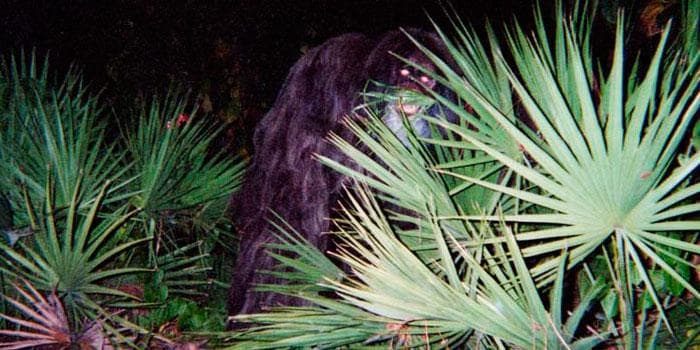
Large, bipedal cryptid reported throughout Florida's Everglades since the 1960s. Distinguished by its overwhelming sulfuric odor and reddish-brown hair.
Since the 1960s, residents of Florida's Everglades have reported encounters with a large, bipedal creature known as the Skunk Ape. Standing 7-10 feet tall with reddish-brown hair covering its muscular frame, the creature is distinguished by an overwhelming sulfuric stench that can be detected from hundreds of yards away. Unlike its Pacific Northwest cousin Bigfoot, the Skunk Ape appears more aggressive and territorial. Witnesses describe glowing red eyes, massive footprints measuring up to 18 inches long, and vocalizations ranging from deep growls to high-pitched screams. The creature allegedly feeds on lima beans, apples, and other vegetation, often raiding farms and campsites. Dave Shealy, a longtime Everglades guide, claims to have photographed the creature multiple times since the 1990s. Despite extensive searches by cryptozoologists and local authorities, no physical evidence has been conclusively verified, though plaster casts of alleged footprints and hair samples continue to surface.
Myakka Photographs and Anonymous Letter
Dave Shealy Video Footage and Photographs
Florida Fish and Wildlife Commission Reports
Plaster Casts and Physical Trace Evidence
"It was about eight feet tall, covered in dark reddish hair, and the smell was so bad I had to cover my nose. When it looked at me, those red eyes seemed to glow in the darkness like hot coals."
Holloway, a park ranger with 15 years experience in the Everglades, reported this encounter in October 1974 while conducting a night patrol near Anhinga Trail. As a trained wildlife observer, Holloway's testimony carries significant weight among researchers. His report marked one of the first official documentation of the creature by a government employee, leading to increased attention from both wildlife officials and cryptozoologists.
"This thing was enormous, bigger than any bear I've ever seen. It walked upright like a man but was covered in hair from head to toe. The smell was like rotten eggs mixed with a wet dog."
Mills, a local resident of Ochopee and experienced swamp guide, encountered the creature while fishing at Turner River in March 1981. Her detailed description of the creature's bipedal gait and facial features has been frequently cited by researchers. Mills' 30 years of guiding tourists through the Everglades lent credibility to her account, as she was familiar with all native wildlife in the region.
SHOW 2 MORE WITNESS STATEMENTS
"I've been in these swamps my whole life, and I know the difference between a bear and what I saw. This was walking on two legs, had to be seven and a half feet tall, and the stench was unbelievable."
Fire Captain Shealy (brother of researcher Dave Shealy) reported this sighting during an off-duty camping trip in November 1998 near Loop Road. His professional background in emergency services and lifelong familiarity with the Everglades ecosystem made his testimony particularly compelling to investigators. The encounter occurred during broad daylight, allowing for detailed observation of the creature's physical characteristics and movement patterns.
"As a veterinarian, I'm trained to observe animal behavior. What I witnessed that morning exhibited locomotion and physical characteristics unlike any species in my professional experience."
Dr. Caton, a veterinarian specializing in exotic animals at Naples Zoo, encountered the creature while bird watching in Corkscrew Swamp Sanctuary during early morning hours in September 2003. Her scientific background and professional training in animal anatomy provided unique credibility to her detailed observations of the creature's muscle structure and gait mechanics. She estimated the creature's weight at 400-500 pounds based on its stride length and ground impact.
Relict Gigantopithecus Population
Cryptozoologist Loren Coleman and anthropologist Grover Krantz proposed that the Skunk Ape could represent a surviving population of Gigantopithecus blacki, a massive ape species that supposedly went extinct 300,000 years ago. This theory suggests that small populations crossed the Bering land bridge and adapted to North American swamplands.
Fossil evidence shows Gigantopithecus reached heights of 10 feet and weighed up to 1,200 pounds. The sulfuric odor could result from a specialized diet of swamp vegetation rich in sulfur compounds. However, this theory faces significant challenges: no Gigantopithecus fossils have been found in the Americas, and the gap between supposed extinction and modern sightings remains unexplained.
If true, this would revolutionize our understanding of primate evolution and migration patterns. Yet critics argue that such a large species couldn't remain hidden in increasingly developed Florida without leaving more substantial evidence.
Misidentified Black Bears
Wildlife biologists including Dr. John Bindernagel and Florida Fish and Wildlife officials propose that most Skunk Ape sightings are misidentified black bears exhibiting unusual behavior. Bears occasionally walk upright when investigating scents or threats, and can appear much larger than their actual size in poor lighting conditions.
Florida black bears can weigh up to 400 pounds and stand 7 feet tall on hind legs. During mating season or when marking territory, bears produce strong musky odors that could be interpreted as sulfuric. The mangrove swamps and dense vegetation of the Everglades create perfect conditions for mistaken identity, especially during brief encounters.
This theory is supported by the Florida black bear population recovery since the 1970s, coinciding with increased Skunk Ape reports. However, it doesn't explain reports from experienced outdoorsmen who claim to know the difference between bears and the bipedal creatures they observed.
Escaped Research Primates
Some researchers, including Matt Moneymaker of the Bigfoot Field Researchers Organization, theorize that Skunk Ape sightings involve escaped research primates from Florida's numerous biomedical facilities. The state houses several primate research centers that have experienced security breaches over the decades.
Large primates like orangutans or chimpanzees could survive in Florida's subtropical climate and develop territorial behavior. Stress, unusual diet, and isolation might explain the reported aggression and distinctive odor. Laboratory-raised primates would also be more likely to approach human settlements seeking familiar food sources like fruits and vegetables.
This theory gained traction after several documented escapes from research facilities in the 1980s and 1990s. However, it fails to account for the creature's reported size exceeding known primate species, and most escaped research animals are typically recaptured within days.
Hoax and Folklore Perpetuation
Skeptical investigators like Joe Nickell of the Committee for Skeptical Inquiry argue that the Skunk Ape represents a combination of deliberate hoaxes and regional folklore that has taken on a life of its own. The creature's emergence in the 1970s coincides with increased Bigfoot popularity following the famous Patterson-Gimlin film.
Tourist operators in the Everglades have financial incentives to perpetuate the mystery, and several admitted hoaxers have come forward over the years. The distinctive characteristics—the smell, red hair, and aggressive behavior—help differentiate Florida's "version" from other regional cryptids, creating a unique local legend.
Social media and internet communities now amplify and standardize reports, creating consistency that appears authentic but actually reflects shared cultural expectations. Yet this theory struggles to explain why respected outdoorsmen and law enforcement officers would risk credibility by reporting fake encounters.
Interdimensional Entity Theory
Paranormal researcher Stan Gordon and others propose that the Skunk Ape might be an interdimensional being that phases in and out of our reality, explaining why physical evidence remains elusive. This theory draws parallels to other cryptid encounters that feature sudden appearances and disappearances.
Proponents point to reports of the creature vanishing without leaving tracks in soft mud, and sightings that occur in areas later found to have no possible escape routes. The sulfuric smell might be a byproduct of dimensional shifting, similar to ozone created by electrical discharges. Some witnesses report feelings of disorientation or missing time during encounters.
This theory also suggests connections between Skunk Ape sightings and increased UFO activity in the same regions. However, it requires accepting concepts that contradict established physics and lacks any testable methodology, making it impossible to verify or falsify through conventional scientific investigation.
The Skunk Ape phenomenon presents compelling eyewitness testimony spanning decades, yet lacks definitive physical proof. The consistency of descriptions across unrelated witnesses suggests either a genuine unknown species or deeply ingrained cultural folklore. Alleged photographic evidence remains disputed among experts. The remote, swampy terrain of the Everglades could conceivably harbor large undiscovered species, as evidenced by ongoing discoveries of new wildlife in the region. However, the absence of skeletal remains, clear footage, or verified DNA samples raises questions about the creature's existence.