Mokele-mbembe: The Living Dinosaur Hunt
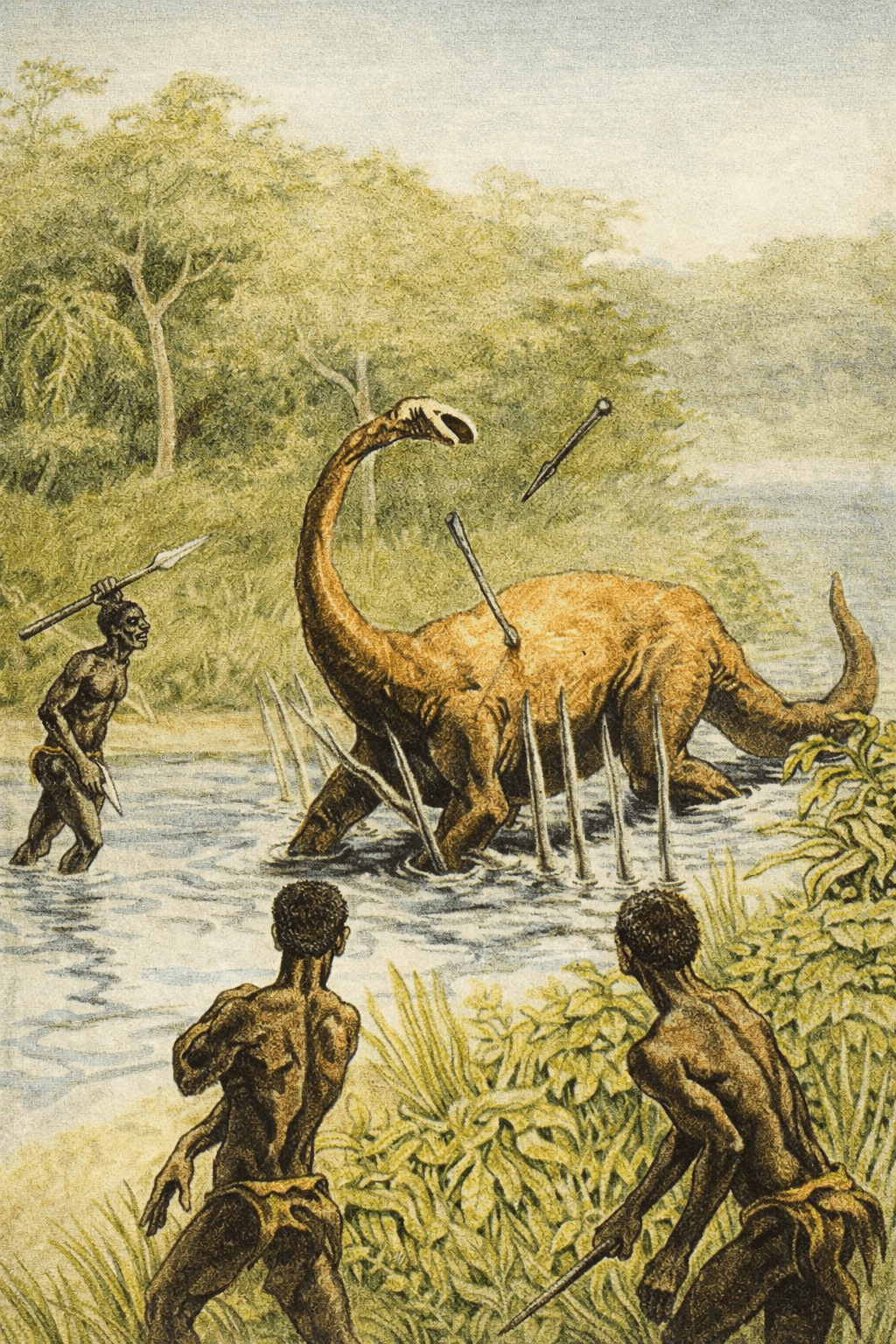
Classified expedition files document decades-long search for Mokele-mbembe, a living sauropod dinosaur reportedly surviving in Congo's remote swamplands.
Deep within the Likouala swamps of the Congo Basin, multiple expeditions have documented encounters with Mokele-mbembe - literally "one who stops the flow of rivers" in the local Lingala language. This creature, described as a long-necked, herbivorous dinosaur roughly the size of an elephant, has been reported by Pygmy tribes for generations. Roy Mackal's 1980-1988 expeditions collected over 30 eyewitness testimonies describing identical features: a brownish-gray sauropod with a snake-like neck, small head, and massive body. The beast allegedly inhabits deep river pools and becomes violently territorial when encountering hippopotamuses. Japanese film crews in 1988 captured unexplained sonar readings and surface disturbances at Lake Tele. Most intriguingly, local tribes demonstrate universal fear and reverence for the creature, refusing monetary rewards to approach its territory - behavior patterns typically reserved for genuinely dangerous wildlife.
Roy Mackal Expedition Documentation
Baka Pygmy Traditional Knowledge Documentation
Japanese Television Sonar Recordings
Congolese Government Wildlife Survey
"I saw the animal very clearly. It had a long neck like a snake, small head, and the body was very big like an elephant. The skin was brown-gray and smooth. It was eating plants from the water, not fish like crocodile."
Pascal Nyobe served as a translator and guide for multiple cryptozoology expeditions in the 1980s. As a native of the Likouala region with extensive knowledge of local wildlife, Nyobe claimed to have personally observed Mokele-mbembe at Lake Tele in 1983. His detailed description remained consistent across interviews with different researchers, and his familiarity with regional fauna made misidentification unlikely according to expedition leaders.
"Our fathers and grandfathers knew this animal. It lives in the deep pools where the water is black. We do not hunt it because it is very dangerous and not good to eat. The meat will make you sick."
Chief Boha led a Baka Pygmy village near the Sangha River and served as one of the primary sources for anthropologist Richard Greenwell's documentation of traditional Mokele-mbembe knowledge. As a tribal elder with decades of experience navigating the region's waterways, his testimony carried significant weight within his community. Boha claimed his grandfather had encountered the creature directly and passed down specific warnings about its territorial behavior.
SHOW 2 MORE WITNESS STATEMENTS
"I observed the animal for approximately twenty minutes. The head and neck were visible above the surface, moving slowly. The coloration was reddish-brown, and the estimated length was five to seven meters. This was unlike any known species in our regional fauna catalog."
Dr. Marcellin Agnagna worked as a biologist for the Congolese Ministry of Scientific Research and was conducting an official wildlife survey of Lake Tele when he reported his sighting in May 1983. With formal training in Central African zoology and years of field experience, Agnagna represented the only credentialed government scientist to claim a direct encounter with Mokele-mbembe. His official report to the ministry detailed the observation and noted the creature's unusual characteristics.
"We heard this tremendous splashing and saw something huge moving in the water. The neck was long and thick, definitely not a crocodile or hippo. It stayed submerged mostly, but we could see the massive body underneath."
Joseph Ellis served as a river guide and translator for Roy Mackal's 1988 expedition team. Born and raised along the Likouala River system, Ellis possessed extensive knowledge of local wildlife and had guided numerous scientific expeditions through the region's waterways. During the final day of Mackal's expedition, Ellis reported observing an unidentified large animal while the team was returning to base camp, providing one of the few Western-witnessed encounters documented during the formal expeditions.
Relict Sauropod Population
Cryptozoologist Roy Mackal proposed that Mokele-mbembe represents a surviving population of sauropod dinosaurs that escaped the Cretaceous extinction event by adapting to the Congo's stable swamp environment. The creature's described morphology - long neck, small head, massive body, herbivorous diet - matches Diplodocus or similar species perfectly.
The theory gains credibility from the region's geological stability and isolation for over 65 million years. Similar "living fossil" discoveries like the coelacanth fish prove large species can survive undetected in remote habitats.
However, critics argue that few confirmed dinosaur fossils have been found in Central Africa from the appropriate geological periods, and the energy requirements for maintaining a breeding population of such large creatures would be enormous.
Unknown Mammalian Species
Zoologist Bernard Heuvelmans suggested Mokele-mbembe might be an undiscovered semi-aquatic mammal rather than a reptile. The creature could represent a surviving member of an ancient mammalian lineage that developed sauropod-like characteristics through convergent evolution.
This theory explains the creature's apparent warm-blooded behavior and territorial aggression toward hippos, which would be unusual for a cold-blooded reptile. The thick, smooth skin described by witnesses could be mammalian rather than reptilian.
The main weakness is that no known mammalian evolutionary pathway leads to such extreme gigantism and neck elongation. Additionally, the creature's described plant-processing behavior doesn't match typical mammalian feeding patterns observed in the region.
Misidentified Known Species
Skeptical researchers propose that Mokele-mbembe sightings result from misidentification of known animals under poor visibility conditions. Crocodiles swimming with only their backs visible could create the illusion of a long-necked creature, while forest elephants crossing rivers might appear dinosaur-like from a distance.
The theory explains why no clear photographs exist despite decades of searching. Cultural transmission could have standardized witness descriptions, creating consistent but inaccurate testimony across different tribes.
This explanation struggles with the specific behavioral details provided by natives, particularly the creature's alleged plant-eating habits and territorial conflicts with hippos. Local tribes demonstrate sophisticated knowledge of regional wildlife and would likely distinguish between familiar and unknown species.
Cultural Mythology Manifestation
Anthropologist Robert Farris Thompson argued that Mokele-mbembe represents a shared cultural archetype rather than a biological entity. The creature embodies traditional concepts of natural power and serves as a guardian spirit for sacred locations throughout the Congo Basin.
This theory explains the universal reverence and fear shown by local tribes, who treat Mokele-mbembe encounters as spiritual rather than zoological experiences. The creature's name and attributes appear in multiple tribal mythologies with remarkable consistency.
Yet this interpretation fails to account for the specific physical descriptions provided by witnesses, who clearly distinguish between mythological spirits and actual wildlife. The pragmatic fear demonstrated by experienced hunters suggests encounters with a real, dangerous animal.
Giant Monitor Lizard Variant
Herpetologist William Gibbons proposed that Mokele-mbembe could be an undiscovered species of giant monitor lizard that has evolved semi-aquatic adaptations. Africa's monitor lizards can reach impressive sizes, and an isolated population might have developed unique characteristics.
This theory explains the creature's reptilian features while remaining within known evolutionary parameters. Monitor lizards are intelligent, territorial, and capable of the aggressive behavior described in witness accounts. The long neck could be an adaptation for breathing while mostly submerged.
The primary challenge is that no monitor lizard approaches the described size of Mokele-mbembe, which witnesses consistently report as elephant-sized or larger. Additionally, monitors are carnivorous, conflicting with the creature's alleged herbivorous diet that local tribes specifically emphasize.
The consistency of native testimonies across isolated tribes, combined with the vast unexplored ecosystem of the Congo Basin, makes dismissal premature. However, no physical evidence has been recovered despite multiple well-funded expeditions. The region's dense canopy cover and inaccessible terrain could conceivably hide surviving megafauna, as demonstrated by recent discoveries of new species. Sonar anomalies at Lake Tele remain unexplained, but extraordinary claims require extraordinary evidence.