The Fouke Monster: Arkansas's Bigfoot Terror
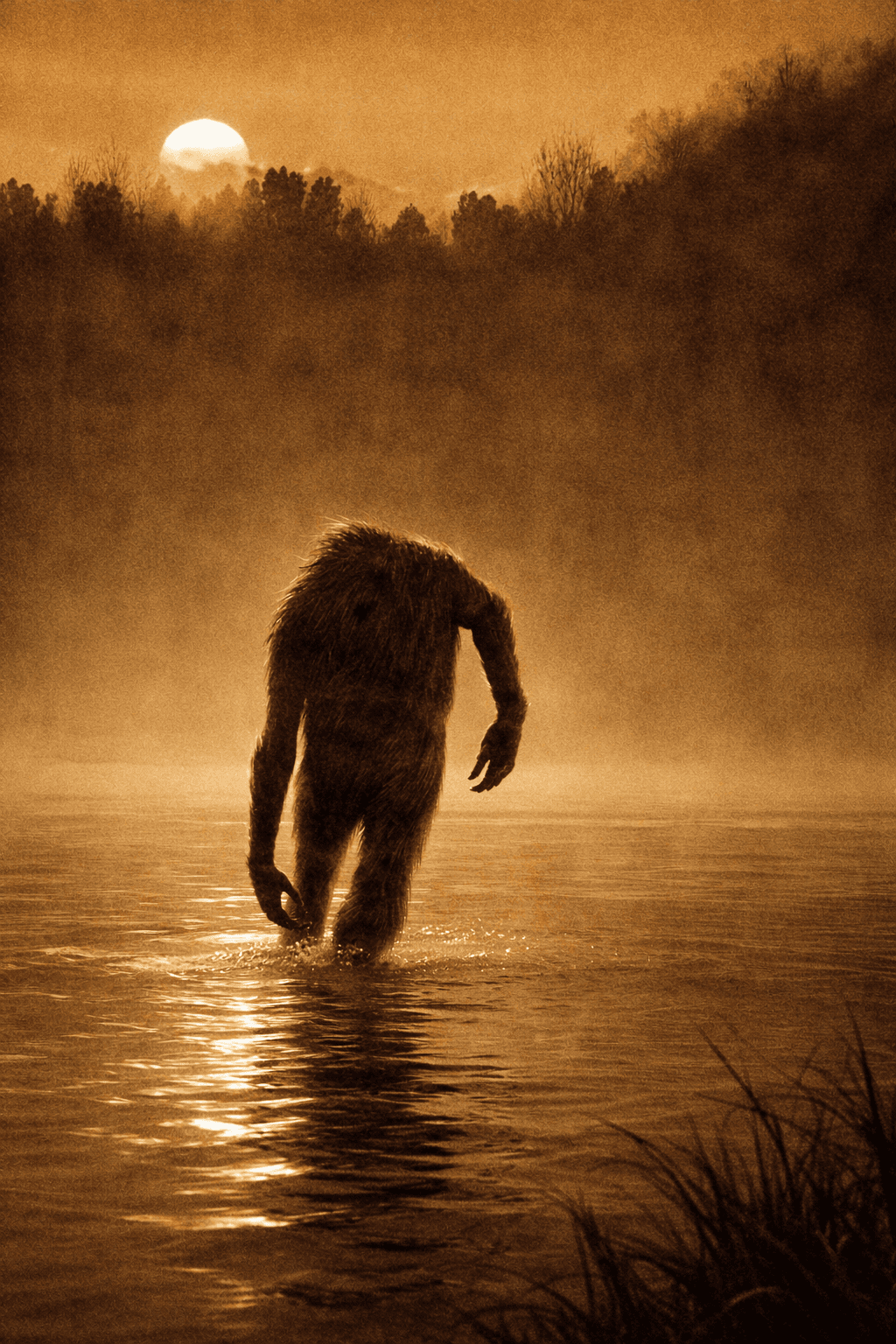
Seven-foot tall, hair-covered creature terrorized Fouke, Arkansas in early 1970s. Multiple family encounters spawned legendary documentary.
In the early morning hours of reportedly May 2, 1971, the Ford family of Fouke, Arkansas encountered something that would terrorize their community for years. A seven-foot tall, hair-covered creature with glowing red eyes attacked their home, leaving three-toed footprints and claw marks on their porch. The beast, weighing an estimated 300 pounds, emitted a horrible stench and moved with surprising speed through the dense Boggy Creek bottomlands.
The incident sparked a wave of similar sightings across Miller County. Witnesses described a creature standing upright like a man but covered in dark, matted hair with arms reaching nearly to the ground. The monster allegedly killed livestock, raided garbage cans, and left behind 14-inch footprints in the soft creek mud. Director Charles Pierce immortalized these events in his 1972 docudrama "The Legend of Boggy Creek," which became a drive-in phenomenon and cemented the Fouke Monster's place in cryptozoological history.
Miller County Sheriff's Department Incident Reports
Plaster Casts of Footprint Evidence
Documentary Film Footage and Interviews
Newspaper Reports from Texarkana Gazette
Hair Sample Analysis Results
"I grabbed my flashlight and gun and went to the back door. When I turned the light on him, he stood up. He must have been seven feet tall. He didn't seem afraid of the light. He just stood there looking at me."
Bobby Ford was a 25-year-old construction worker living with his wife and children in a mobile home outside Fouke when the creature attacked their property on May 2, 1971. Ford had lived in the area his entire life and was familiar with local wildlife, making his inability to identify the creature particularly significant. His detailed description of the encounter, given to both sheriff's deputies and later documentary filmmakers, remained consistent across multiple interviews spanning several years.
"It had three toes, and you could see where the claws were. The smell was terrible, like a combination of a skunk and a wet dog, but much worse. I'll never forget that smell."
Elizabeth Ford was Bobby Ford's wife and mother of their young children during the May 2, 1971 encounter. She witnessed the creature's retreat and discovered the three-toed footprints the following morning. As a lifelong rural Arkansas resident accustomed to wildlife, her inability to identify the creature and her detailed observations of its physical characteristics provided crucial corroborating testimony. Her account focused particularly on the creature's distinctive odor and the unusual footprint pattern left in their yard.
SHOW 2 MORE WITNESS STATEMENTS
"I've hunted these woods for thirty years, and I know every animal that lives in them. This was something I'd never seen before. It moved through the trees like it owned them, but it wasn't natural."
Smoky Crabtree was a local hunting guide and trapper who claimed multiple encounters with the Fouke Monster throughout the early 1970s. With decades of experience in the Arkansas bottomlands, Crabtree's knowledge of regional wildlife lent credibility to his testimonies. He operated a hunting camp near Boggy Creek and reported finding disturbed campsites and unusual tracks during the peak sighting period. Crabtree later authored a book about his experiences and became one of the case's most vocal witnesses.
"It was standing by our chicken coop, and when it saw our car lights, it just walked away on two legs like a person would. But it was huge, much bigger than any man."
Wilma Lawson was a local resident who encountered the creature with her husband while returning home late one evening in July 1971. As a farmer's wife familiar with predators that threatened livestock, her observation of the creature's bipedal gait and massive size provided important witness testimony independent of the Ford family's experience. The Lawsons discovered several dead chickens the following morning, with damage patterns that didn't match typical predator kills from bears, coyotes, or other known regional animals.
Relict Hominid Population
Cryptozoologists propose the Fouke Monster represents a surviving population of Gigantopithecus blacki, an extinct giant ape that lived in Asia until 300,000 years ago. Proponents like Loren Coleman suggest these creatures crossed the Bering land bridge during ice ages and adapted to North American forests.
The Arkansas bottomlands provide ideal habitat—dense vegetation, water sources, and minimal human intrusion until recent decades. Supporters point to consistent physical descriptions across decades and the creature's apparent intelligence in avoiding capture.
However, no Gigantopithecus fossils have been found in North America, and the creature's reported aggression toward humans contradicts typical great ape behavior. Could a breeding population remain hidden in modern Arkansas, or are witnesses misidentifying known animals?
Misidentified Black Bear
Wildlife biologists suggest many Fouke Monster sightings involve American black bears exhibiting unusual behavior. Bears can stand on hind legs reaching seven feet, and in poor lighting conditions, their dark fur and bipedal stance could create the reported silhouette.
Arkansas black bear populations were recovering in the 1970s after near-extinction, leading to increased human-bear encounters. Habitat encroachment forced bears into suburban areas, explaining property damage and livestock kills. Bears suffering from illness or injury might display more aggressive behavior than normal.
This theory explains the physical evidence but struggles with witness reports of three-toed tracks and the creature's reported speed and agility. Additionally, experienced hunters familiar with local wildlife insisted they encountered something unprecedented. Would seasoned outdoorsmen mistake a common bear for an unknown monster?
Hoax and Media Creation
Skeptics argue the Fouke Monster was largely manufactured for Charles Pierce's low-budget film. The timing of peak sightings coinciding with the movie's production and promotion suggests coordinated fabrication. Local residents may have embellished stories or created false evidence to attract tourism and media attention.
The plaster casts show possible tool marks, and some witnesses later recanted their stories. The creature's Hollywood-friendly characteristics—dramatic attacks, photogenic tracks, convenient elusiveness—mirror typical movie monster tropes rather than authentic wildlife encounters.
However, this theory cannot explain pre-1971 sightings documented in local newspapers or the genuine fear displayed by the Ford family during their initial encounter. If purely fictional, why did respectable community members risk ridicule by reporting similar experiences? The hoax theory addresses the evidence problems but struggles with the human psychology involved.
Government Military Experiment
Some researchers propose the Fouke Monster was a classified military experiment gone wrong. The Red River Army Depot lies within 50 miles of Fouke, and the 1970s saw extensive biological and chemical weapons research. The creature's reported aggression and unusual behavior could indicate a test subject that escaped containment.
Proponents cite the government's historical involvement in Project MKUltra and other secret programs involving human and animal subjects. The creature's apparent intelligence and elusiveness might reflect military training or enhancement. Official silence and lack of investigation could indicate a cover-up operation.
This theory relies heavily on speculation and lacks concrete evidence linking military facilities to the encounters. The timeline doesn't align with known weapons programs, and the creature's reported appearance doesn't match typical experimental scenarios. While government secrecy enables such theories, is there any real connection between Arkansas military installations and cryptid sightings?
Interdimensional Entity
Paranormal researchers suggest the Fouke Monster represents an interdimensional being that phases in and out of our reality. This theory, popularized by cryptozoologist John Keel, explains why no bodies or definitive physical evidence exists despite decades of encounters.
The Boggy Creek area allegedly sits on geological fault lines creating electromagnetic anomalies that facilitate dimensional crossings. Witnesses report electronic equipment malfunctioning and unusual atmospheric conditions during encounters. The creature's ability to appear and vanish without traces suggests non-physical origins.
While this theory addresses the evidence gap, it relies on unproven concepts from fringe physics. The interdimensional hypothesis cannot be tested scientifically and serves more as speculation than explanation. Native American legends of shape-shifting spirits in the region provide cultural precedent, but do paranormal explanations represent genuine investigation or failure to find conventional answers?
The Fouke Monster case presents compelling witness testimony from credible locals but lacks definitive physical evidence. Plaster casts of tracks show possible fabrication marks, while hair samples proved inconclusive. The creature's reported behavior—attacking homes, killing livestock—differs from typical Bigfoot encounters. Regional black bear populations could explain some sightings, but not the bipedal descriptions or extreme size estimates. The case remains Arkansas's most documented cryptid encounter, with too many consistent details across multiple witnesses to dismiss entirely, yet insufficient proof to verify.