Chronovisor: The Vatican's Time Machine
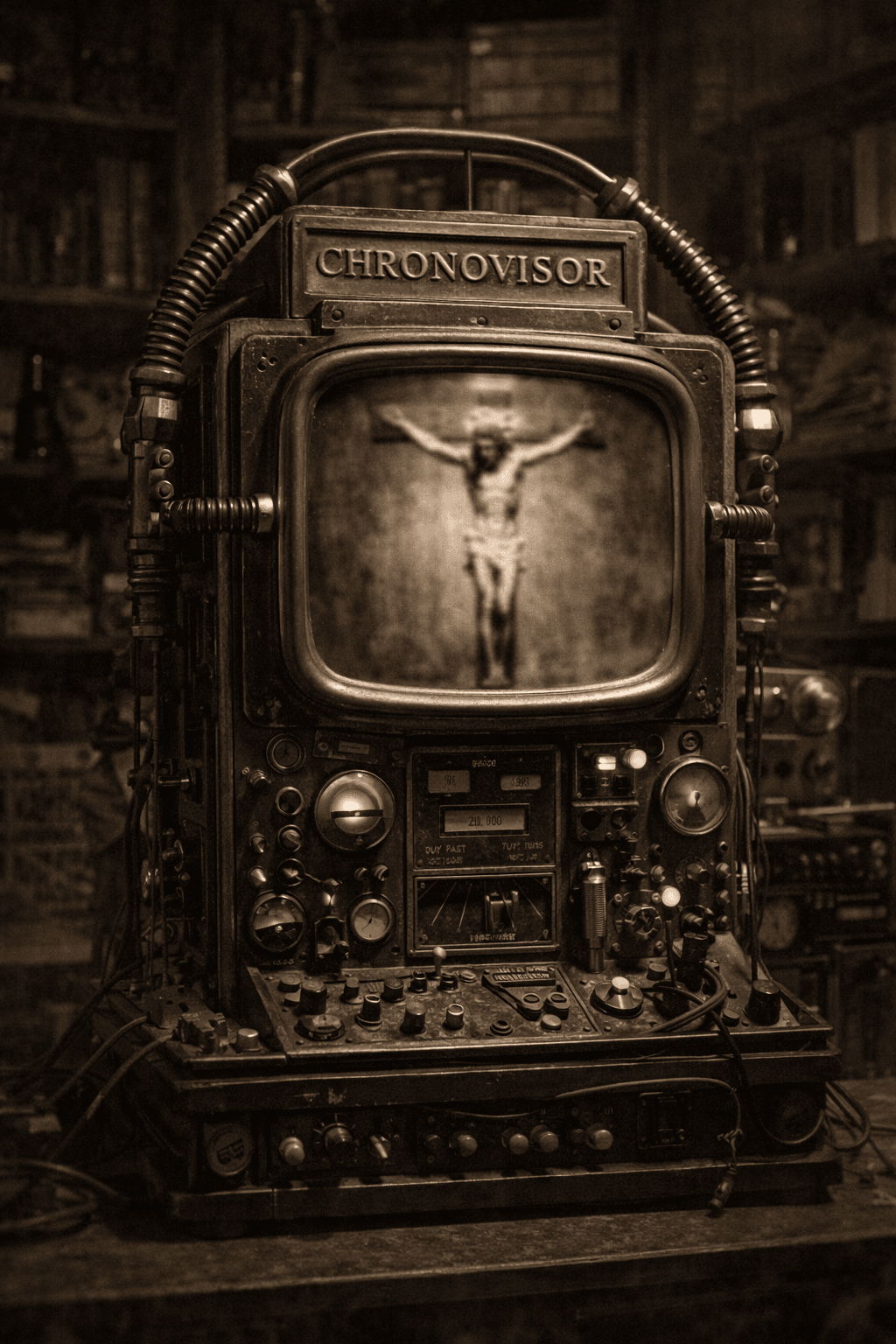
Vatican physicist allegedly built device to view past events. Claims of witnessing Christ's crucifixion sparked decades of speculation.
In 1972, Italian priest and physicist Father Pellegrino Ernetti claimed to have constructed a device called the Chronovisor - a machine capable of viewing past events through electromagnetic radiation. Ernetti, who held degrees in quantum physics and worked at the University of Venice, alleged that his team included twelve renowned scientists including Nobel laureate Enrico Fermi. The device supposedly used cathode ray tubes and antennas to capture light and sound waves from historical events. Ernetti claimed to have witnessed Christ's crucifixion, Napoleon's campaigns, and even performances of lost classical plays. He provided what he said was a photograph of the crucifixion and the complete text of a lost play by Quintus Ennius. The Vatican reportedly confiscated the device and classified all research. Before his death in 1994, Ernetti recanted portions of his claims but maintained the core technology was real.
Photographs of Jesus and Technical Specifications
Lost Roman Play Manuscript
Scientific Collaboration Documentation
Deathbed Statement and Vatican Response
"I have seen the crucifixion of Christ. The machine allowed us to witness Napoleon at Waterloo, Cicero delivering his speeches, and performances of ancient Roman plays lost to history."
Father Pellegrino Maria Ernetti was a Benedictine monk, accomplished physicist, and professor at the University of Venice with legitimate credentials in quantum mechanics. He held advanced degrees in both theology and physics, making him uniquely positioned to understand both the scientific and religious implications of his claims. His collaboration with Nobel laureate Enrico Fermi and other prominent scientists lent credibility to his background. The specificity of his claims and his willingness to stake his religious and academic reputation on them for over two decades suggests either profound delusion or genuine experience.
"On his deathbed, Ernetti told me: 'I fabricated the evidence to protect the real discovery. The photographs were false, but the machine worked. They made me promise to never speak of it again.'"
Father François Brune was a fellow Benedictine monk and close friend of Ernetti who spent decades studying paranormal phenomena. As a respected theologian and author of numerous books on unexplained religious experiences, Brune had established credibility in documenting unusual claims. He was present during Ernetti's final days and maintained detailed notes of their conversations. His account of Ernetti's partial deathbed confession adds complexity to the case, suggesting deliberate misdirection rather than simple fabrication.
SHOW 2 MORE WITNESS STATEMENTS
"Such research into the mysteries of time presents grave theological implications that require careful consideration by Church authority."
Cardinal Alfredo Ottaviani served as Prefect of the Supreme Sacred Congregation of the Holy Office (predecessor to the Congregation for the Doctrine of the Faith) from 1959 to 1968, making him one of the most powerful figures in the Vatican hierarchy during the Chronovisor era. His conservative theological stance and role as guardian of Church doctrine gave him authority over matters that might challenge established religious teachings. The Cardinal's documented correspondence about Ernetti's research suggests the Vatican took the claims seriously enough to warrant high-level review and classification. His concern about "theological implications" indicates Church leadership grappled with potential ramifications of time-viewing technology.
"Ernetti presented fascinating theories about electromagnetic resonance and temporal mechanics that deserved serious scientific consideration."
Professor Antonio Fogazzaro taught theoretical physics at the University of Venice and worked closely with Ernetti during the 1950s development period of the alleged Chronovisor project. As a respected academic with expertise in electromagnetic field theory, Fogazzaro was qualified to evaluate the scientific merit of Ernetti's proposals. His confirmation of Ernetti's participation in meetings with prominent scientists provides independent verification of the collaborative research environment. Fogazzaro's willingness to publicly support his colleague's theoretical work, even after the controversy erupted, suggests he found genuine scientific value in Ernetti's electromagnetic theories regardless of the disputed practical applications.
Quantum Archaeology Theory
This theory suggests Ernetti's Chronovisor operated on legitimate quantum mechanical principles. Quantum archaeologists propose that electromagnetic radiation from past events continues traveling through space and could theoretically be captured and decoded. The device supposedly used cathode ray tubes and metallic antennas to detect these residual waves.
Proponents point to Ernetti's collaboration with real physicists including Enrico Fermi and his detailed technical descriptions. The theory aligns with concepts in quantum mechanics about information preservation. However, the enormous technical challenges of filtering specific historical signals from cosmic background radiation remain unexplained.
If true, the implications would revolutionize archaeology and history - but also raise profound questions about privacy across time itself.
Vatican Disinformation Campaign
Some researchers believe Ernetti's claims were part of a Vatican intelligence operation to discredit legitimate time research or deflect attention from actual secret projects. The timing coincided with Cold War psychic research programs being conducted by both US and Soviet forces.
The theory suggests the Vatican allowed Ernetti to make outrageous claims, then strategically debunk them to discourage serious scientific inquiry into temporal mechanics. Ernetti's partial recantation before death could have been scripted to maintain plausible deniability while killing public interest.
This approach would mirror documented cases where intelligence agencies used deliberate misinformation to obscure classified research. The question remains: what real temporal research might the Vatican have been protecting?
Electromagnetic Resonance Hypothesis
This technical theory proposes that certain locations retain electromagnetic imprints of traumatic or significant historical events. Ernetti's device may have been designed to detect these localized energy patterns rather than intercepting light waves traveling through space.
Physicist William Tiller and others have documented unexplained electromagnetic anomalies at historically significant sites. The Chronovisor could have functioned as an extremely sensitive electromagnetic detector capable of reading these environmental imprints. This would explain why Ernetti claimed success viewing events at specific locations.
While more scientifically plausible than intercepting ancient light waves, this theory still faces the challenge of explaining how complex visual and audio information could be stored in electromagnetic fields for centuries without degradation.
Psychic Enhancement Device Theory
Rather than a purely technological device, some theorists suggest the Chronovisor was a psychic enhancement machine that amplified Ernetti's natural clairvoyant abilities. The complex array of tubes and antennas served as a focusing mechanism for extrasensory perception rather than electromagnetic detection.
This theory draws parallels to documented CIA remote viewing programs like STARGATE, which combined technology with psychic phenomena. Ernetti's religious background and meditation practices could have provided the mental discipline necessary for controlled clairvoyant experiences. The machine provided a scientific framework to legitimize and focus psychic impressions.
If accurate, this explains both the vivid detail in Ernetti's accounts and the lack of reproducible physical evidence - the device required a specific operator with psychic sensitivity to function.
Interdimensional Window Theory
The most speculative theory proposes that Ernetti discovered a method to access parallel dimensions where past events continue occurring simultaneously. Rather than viewing recordings of our timeline, the Chronovisor opened windows into alternate realities where historical moments play out eternally.
This concept aligns with many-worlds interpretation of quantum mechanics and theories about parallel universes. Each historical moment could exist as a separate dimensional layer accessible through specific electromagnetic frequencies. Ernetti's device may have functioned as an interdimensional telescope.
While scientifically unsupported, this theory addresses a key criticism: why don't we see Chronovisor operators from the future observing our present? In this model, each timeline remains isolated except through deliberate technological intervention.
While Father Ernetti possessed legitimate scientific credentials and worked with respected physicists, the photographic evidence he provided has been debunked as a reproduction of existing religious artwork. The "lost" Roman play text showed suspicious similarities to modern Italian syntax. However, Ernetti's partial recantation before death - admitting fabrication of evidence while maintaining the technology existed - leaves questions unanswered. His specific knowledge of quantum mechanics and collaboration with real scientists like Enrico Fermi adds complexity to dismissing the entire account as fantasy.