Spontaneous Human Combustion
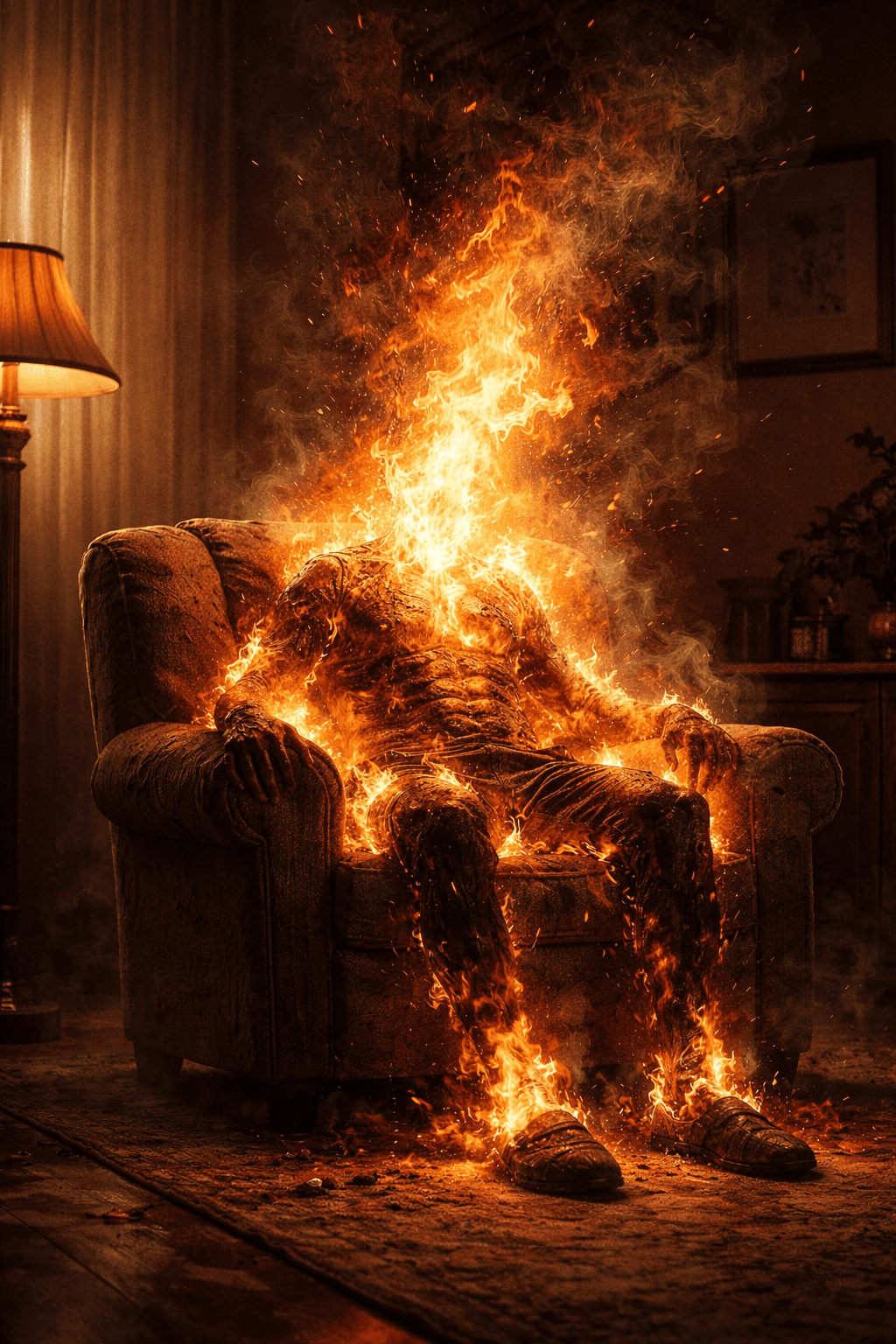
People burning to ash from within while surroundings remain untouched. Over 200 documented cases challenge conventional understanding of fire science.
On July 2, 1951, landlady Pansy Carpenter discovered tenant Mary Reeser reduced to ash in her St. Petersburg apartment. Only Reeser's left foot in a slipper and part of her backbone remained of the 67-year-old woman. The armchair she sat in was destroyed, yet newspapers just four feet away were unburned. The apartment's walls showed heat damage only three feet high.
FBI investigators and fire marshal experts found no external ignition source. The 3,000-degree heat required to cremate a human body should have destroyed the entire building, yet electric outlets nearby functioned normally. Over 200 similar cases have been documented worldwide since 1663, featuring the same impossible physics: complete cremation of human remains while immediate surroundings show minimal fire damage. Most victims are elderly, alone, and sedentary, often found near heating sources or with smoking materials.
FBI Laboratory Analysis of Mary Reeser Case
Coroner Wilton Krogman's Medical Assessment
Photographic Documentation of Damage Patterns
Temperature Analysis by Fire Marshal Officials
"I thought she had fallen asleep smoking, but when I opened the door, there was just a pile of ashes where Mary used to sit. Her foot was still there in the slipper, but everything else was just... gone."
Pansy Carpenter served as landlady of the rooming house where Mary Reeser rented an apartment. On the morning of July 2, 1951, she discovered the remains after noticing the apartment door was unusually warm to the touch. Carpenter had known Reeser for several months and described her as a quiet, reliable tenant who occasionally smoked cigarettes. Her immediate call to authorities preserved the crime scene and led to the extensive FBI investigation.
"I've been fighting fires for fifteen years, but I've never seen anything like this. The heat had to be tremendous to do what it did to that woman, but the room itself barely burned."
Robert Francis Brady was the first St. Petersburg Fire Department captain to respond to the Carpenter rooming house on July 2, 1951. With over fifteen years of firefighting experience, Brady had investigated numerous fatal fires throughout the Tampa Bay area. He immediately recognized the unusual nature of the damage patterns and requested additional investigation resources. Brady's testimony became crucial evidence in the FBI's analysis of the incident.
SHOW 2 MORE WITNESS STATEMENTS
"Never have I seen a human skull shrunk by intense heat. The opposite has always been my experience. What remains of this woman has been burned at a heat of perhaps 3,000 degrees, yet the apartment and everything in it remained virtually undamaged."
Dr. Wilton Krogman was a University of Pennsylvania anthropologist and the nation's leading expert on skeletal analysis and fire deaths. Called in by the FBI to examine the Reeser remains, Krogman had previously analyzed thousands of cremation cases and served as a consultant on fire investigations nationwide. His expertise in bone composition and heat effects on human remains made his bafflement particularly significant to investigators and the scientific community.
"In thirty years of fire investigation, I've never encountered a case where such complete destruction occurred in such a confined area. The physics just don't add up."
Cass Burgess served as Fire Marshal for St. Petersburg and had three decades of experience investigating fatal fires throughout Florida. He was responsible for determining the official cause of the Reeser fire and worked closely with FBI investigators during their analysis. Burgess had seen hundreds of fire deaths but found the extreme localization of heat damage unprecedented in his career. His official determination of accidental death came despite his inability to explain the unusual burning pattern.
The Wick Effect
Proposed by forensic scientist Dr. John DeHaan in the 1990s, this theory suggests human body fat acts as fuel while clothing serves as a wick. External ignition sources like cigarettes or fireplace sparks ignite clothing, which then burns slowly at low temperatures around 800°F. The melted human fat is absorbed by clothing and furniture, sustaining combustion for hours.
DeHaan demonstrated this process using pig carcasses wrapped in fabric, achieving similar destruction patterns. The theory explains why fires remain localized - without accelerants or high heat, flames don't spread to surrounding materials.
However, critics argue the wick effect requires continuous external airflow and fails to explain cases where victims' extremities remain intact while torsos are completely destroyed. The theory also struggles with incidents showing heat damage patterns inconsistent with slow, low-temperature burning.
Alcoholism and Body Chemistry
Dr. Gavin Thurston, a forensic pathologist, proposed that chronic alcoholism creates highly flammable body chemistry. He noted that many SHC victims were heavy drinkers, potentially creating acetone buildup in body tissues through ketosis. This theory suggests altered metabolism produces combustible compounds that lower the ignition threshold.
Supporters point to statistical correlation - an unusually high percentage of documented SHC cases involved individuals with known alcohol dependency. The theory also explains the intense heat generation needed for complete cremation, as alcohol-saturated tissues might burn at higher temperatures.
Yet this hypothesis faces significant challenges. Medical research shows that blood alcohol content would need to reach lethal levels before tissues become significantly flammable. Additionally, many well-documented cases involved non-drinkers, undermining the alcoholism connection. The theory remains unproven and largely rejected by mainstream forensic science.
Static Electricity Discharge
Some researchers propose that massive static electricity buildup in the human body could provide ignition energy sufficient for combustion. Dr. Robin Beach and other electrical engineers suggest that under specific atmospheric conditions, the body might accumulate thousands of volts of static charge, particularly in dry environments with synthetic clothing.
This theory attempts to explain the instantaneous ignition reported in some cases, where witnesses describe victims suddenly bursting into flames without external fire sources. Proponents argue that electrical discharge could ignite clothing while simultaneously affecting nervous system function, explaining why victims often don't attempt to escape.
However, electrical safety experts note that static discharge, while capable of igniting flammable vapors, lacks the sustained energy needed for complete human cremation. The theory also fails to address why static buildup would selectively affect certain individuals while leaving others unharmed in identical conditions.
Mitochondrial Malfunction
Dr. Kundu Kundu, a biochemist, theorized that cellular mitochondria malfunction could cause internal heat generation sufficient for spontaneous ignition. This hypothesis suggests that metabolic disorders affecting cellular energy production might create uncontrolled thermogenesis, essentially cooking the body from within.
The theory draws parallels to malignant hyperthermia, a rare condition where patients experience dangerous internal heating during surgery. Kundu proposed that similar genetic predisposition combined with environmental triggers could cause catastrophic cellular dysfunction, generating enough heat for tissue ignition.
Critics argue that mitochondrial dysfunction severe enough to cause combustion would kill the victim through hyperthermia long before ignition occurred. Additionally, internal heat generation wouldn't explain the localized burning patterns or why clothing ignites while nearby objects remain unaffected. The theory remains highly speculative without supporting clinical evidence.
Ball Lightning Phenomenon
Atmospheric physicist Dr. Mark Stenhoff proposed that ball lightning - rare, spherical electrical phenomena - might explain some SHC cases. Ball lightning can appear indoors, moves unpredictably, and carries enormous electrical energy capable of causing intense localized heating. Witnesses have reported glowing orbs appearing shortly before or during suspected SHC incidents.
This theory addresses the mystery of ignition source in cases where no external fire was present. Ball lightning's electromagnetic properties could theoretically generate sufficient heat for human combustion while dissipating quickly enough to avoid widespread fire damage. The phenomenon's rarity would explain why SHC cases are uncommon.
However, ball lightning itself remains poorly understood by science, making it problematic to invoke as an explanation for another mysterious phenomenon. Meteorologists note that ball lightning typically lasts only seconds, insufficient time for complete human cremation. The theory also doesn't explain why some victims show evidence of prolonged burning rather than instantaneous electrical damage.
The wick effect theory explains most cases: human fat acts as fuel while clothing serves as a wick, creating sustained low-temperature burning. However, this fails to account for the extreme localization of damage and absence of typical fire spread patterns. Some cases show impossible heat concentration that should have ignited surrounding materials. While deliberate fraud has been ruled out in documented cases, the physics remain problematic. Modern forensic analysis suggests a combination of factors including clothing materials, body composition, and environmental conditions, but no single theory explains all documented incidents.