Simulation Theory: The Digital Universe Hypothesis
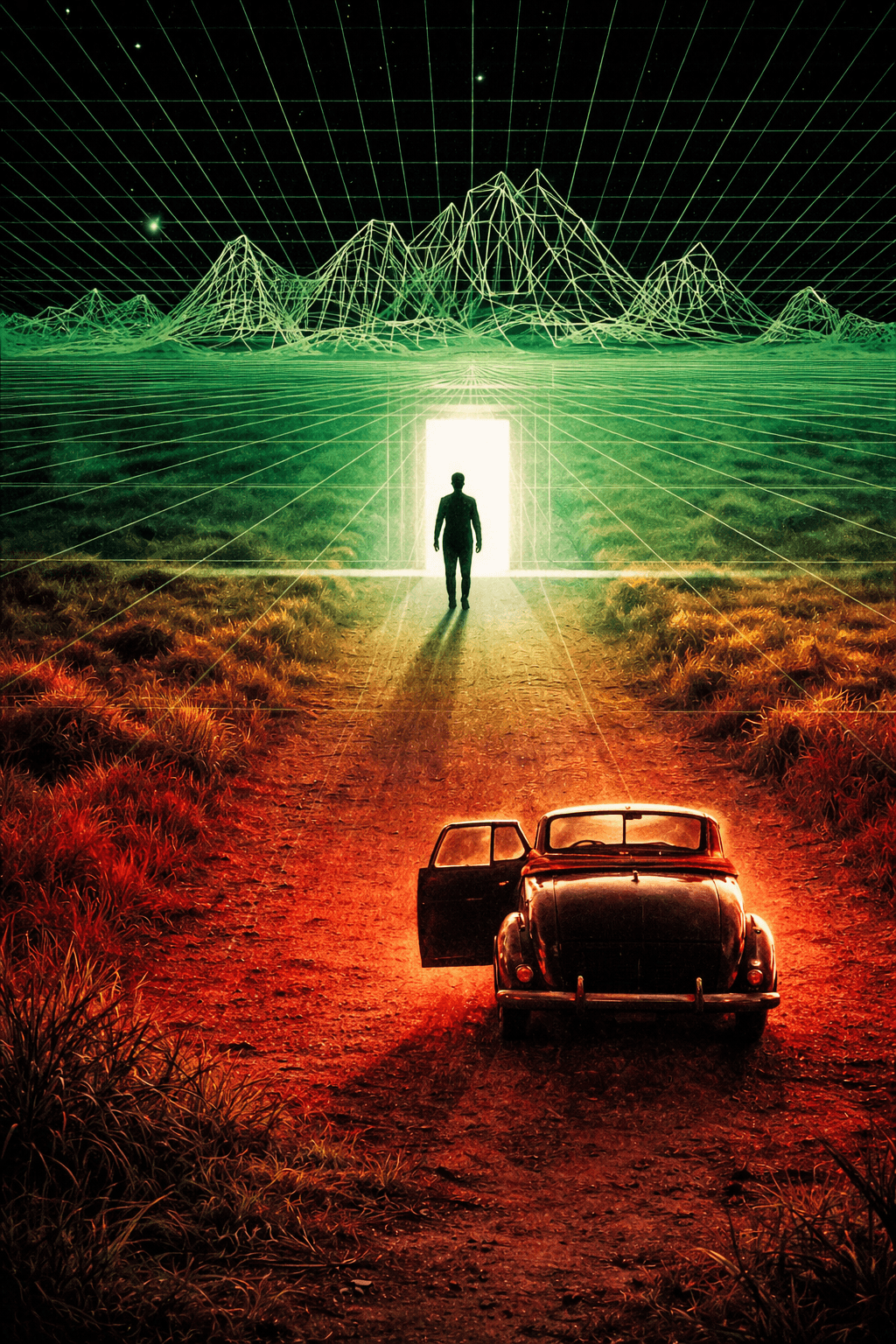
Mounting scientific evidence suggests our universe operates like a sophisticated computer program, questioning the nature of reality itself.
In 2003, philosopher Nick Bostrom published his groundbreaking simulation hypothesis, arguing that if advanced civilizations develop the computing power to run ancestor-simulations, we're statistically more likely to be living in one than in base reality. The evidence is compelling: our universe appears pixelated at the Planck length - the smallest possible unit of space-time measurement at 1.6 x 10^-35 meters, resembling the resolution limit of a cosmic computer screen. The Fermi Paradox adds weight - despite billions of potentially habitable planets, we've found no evidence of alien life, suggesting we might be the only "players" in this particular simulation. Most disturbing is quantum mechanics itself: particles exist in superposition until observed, much like video game environments that only render when a player looks at them. The double-slit experiment demonstrates that reality seems to "choose" its state based on observation, implying our universe conserves computational resources by not calculating unnecessary details.
Planck Length Pixelation
Double-Slit Quantum Behavior
Fine-Tuned Universal Constants
Quantum Entanglement Network Effects
"The odds that we're in base reality is one in billions."
Musk, CEO of Tesla and SpaceX with extensive background in computer science and physics, made this statement at the 2016 Code Conference. He argued that given the rapid advancement of video game technology from simple games like Pong to photorealistic virtual reality in just 40 years, any civilization would eventually develop indistinguishable simulation capabilities. His calculation suggests that with billions of advanced civilizations potentially running ancestor-simulations, the statistical probability of being "real" versus simulated approaches zero. Musk's technical expertise and influence have brought mainstream attention to simulation theory.
"I think the likelihood may be very high... It's not that the universe is an illusion. It's that there could be more universes than the one that made the one we live in."
Tyson, renowned astrophysicist and director of the Hayden Planetarium, expressed these views at the 2016 Isaac Asimov Memorial Debate on the possibility of living in a simulated universe. His scientific credibility and public platform have legitimized simulation theory discussions in academic circles. Tyson estimated a "better than 50-50" chance that our universe is artificial, citing the rapid advancement of computing power and the mathematical nature of physical laws as supporting evidence.
SHOW 1 MORE WITNESS STATEMENT
"Everything we see in physics, from quantum mechanics to relativity, has the hallmark of a programmed reality."
Terrile, a scientist at NASA's Jet Propulsion Laboratory, has spent years analyzing the computational aspects of quantum mechanics and cosmology. His expertise in both space science and computer modeling provides unique insight into how our universe might operate as a sophisticated simulation. Terrile points to specific evidence including the discrete nature of space-time, the speed of light as a processing limitation, and quantum mechanics as optimization techniques. His NASA credentials lend institutional weight to simulation theory discussions within the scientific community.
The Ancestor Simulation Hypothesis
Nick Bostrom's original 2003 proposal suggests that advanced civilizations with vast computational power would likely run detailed simulations of their ancestors for historical research, entertainment, or education. If such civilizations create millions of ancestor-simulations, the number of simulated beings would vastly outnumber "real" ones.
Bostrom argues we face a trilemma: either civilizations don't reach technological maturity, they lose interest in running ancestor-simulations, or we are almost certainly living in one. The statistical argument is compelling - if even one advanced civilization runs thousands of detailed historical simulations, simulated beings would outnumber real ones by millions to one.
However, this raises profound questions about free will and the purpose of our existence. If we're simulations, are our choices predetermined by code? Why would our simulators allow suffering to exist in their programs?
Quantum Computing Universe Theory
Physicist John Wheeler's "it from bit" hypothesis proposed that reality emerges from binary information processing, a concept that predated modern simulation theory by decades. Today's quantum physicists like Seth Lloyd argue our universe behaves exactly like a massive quantum computer processing information at the Planck scale.
The universe appears to have computational limits - the speed of light acts like a processing speed limit, preventing information from traveling faster than the system can handle. Quantum superposition resembles how computers store multiple possible states until calculation is required. Even more intriguing, the holographic principle suggests all information in a volume of space can be encoded on its two-dimensional boundary, much like data compression.
This theory faces the challenge of explaining who or what built this cosmic computer. Natural quantum computing might explain these phenomena without requiring artificial simulation creators.
The Rendering Optimization Hypothesis
Quantum mechanics exhibits behaviors strikingly similar to computational optimization techniques used in video games and virtual reality. Particles exist in probabilistic superposition until "observed" - remarkably similar to how video games only render detailed graphics when a player is looking at a specific area to conserve processing power.
The double-slit experiment demonstrates this perfectly: photons behave as waves when unobserved but collapse to particles when measured. This suggests reality might conserve computational resources by not calculating precise states until observation forces a definitive outcome. Even quantum entanglement resembles networked computing, where separated particles maintain instantaneous correlation regardless of distance.
Critics argue this anthropomorphizes quantum mechanics, projecting familiar computer concepts onto natural phenomena. However, the mathematical similarities between quantum field equations and information processing algorithms remain difficult to dismiss as mere coincidence.
The Fermi Paradox Resolution
The Fermi Paradox - the apparent contradiction between high probability of extraterrestrial life and complete lack of evidence for it - finds elegant explanation in simulation theory. If we're living in an ancestor-simulation focused on human history, there would be no need to simulate alien civilizations that never contacted Earth.
This theory suggests our simulation might be anthropocentric by design, created specifically to study human development without the computational expense of simulating an entire galaxy filled with alien species. The vast empty cosmos we observe could be low-resolution background scenery, much like distant mountains in video games that appear detailed but contain no interactive elements.
However, this raises questions about why our simulators would include billions of galaxies we can observe through telescopes. Perhaps these distant structures are procedurally generated, created algorithmically as we develop technology to observe them, explaining why the universe appears to expand as our observational capabilities improve.
Mathematical Universe Hypothesis
MIT cosmologist Max Tegmark proposes that our physical reality is literally a mathematical structure - not merely described by mathematics, but actually made of mathematics. This Mathematical Universe Hypothesis (MUH) suggests that if mathematics is computation, then we are living inside a vast calculation.
Tegmark argues that the "unreasonable effectiveness of mathematics" in describing physical laws isn't coincidental - mathematics IS the underlying reality. Every equation in physics, from Newton's laws to Einstein's relativity to quantum mechanics, represents the actual code running our universe. The fine-tuning of physical constants resembles carefully chosen parameters in a sophisticated program.
This theory elegantly explains why the universe appears mathematical in nature, but struggles with the "measure problem" - determining which mathematical structures should exist and why we find ourselves in this particular one. It also doesn't address whether this mathematical reality emerged naturally or was designed by conscious programmers.
While we cannot definitively prove we live in a simulation, the evidence is remarkably consistent with this possibility. The Planck length limitation suggests a fundamental resolution to reality, quantum mechanics behaves like computational optimization, and the Fermi Paradox fits perfectly with a single-civilization simulation. However, the hypothesis faces criticism for being unfalsifiable - we cannot test our way out of a perfect simulation. Recent discoveries in quantum computing and digital physics continue to support the computational nature of reality, but alternative explanations for these phenomena exist. The simulation hypothesis remains one of the most compelling explanations for the mysterious fine-tuning and mathematical precision of our universe.