The Dyatlov Pass Incident
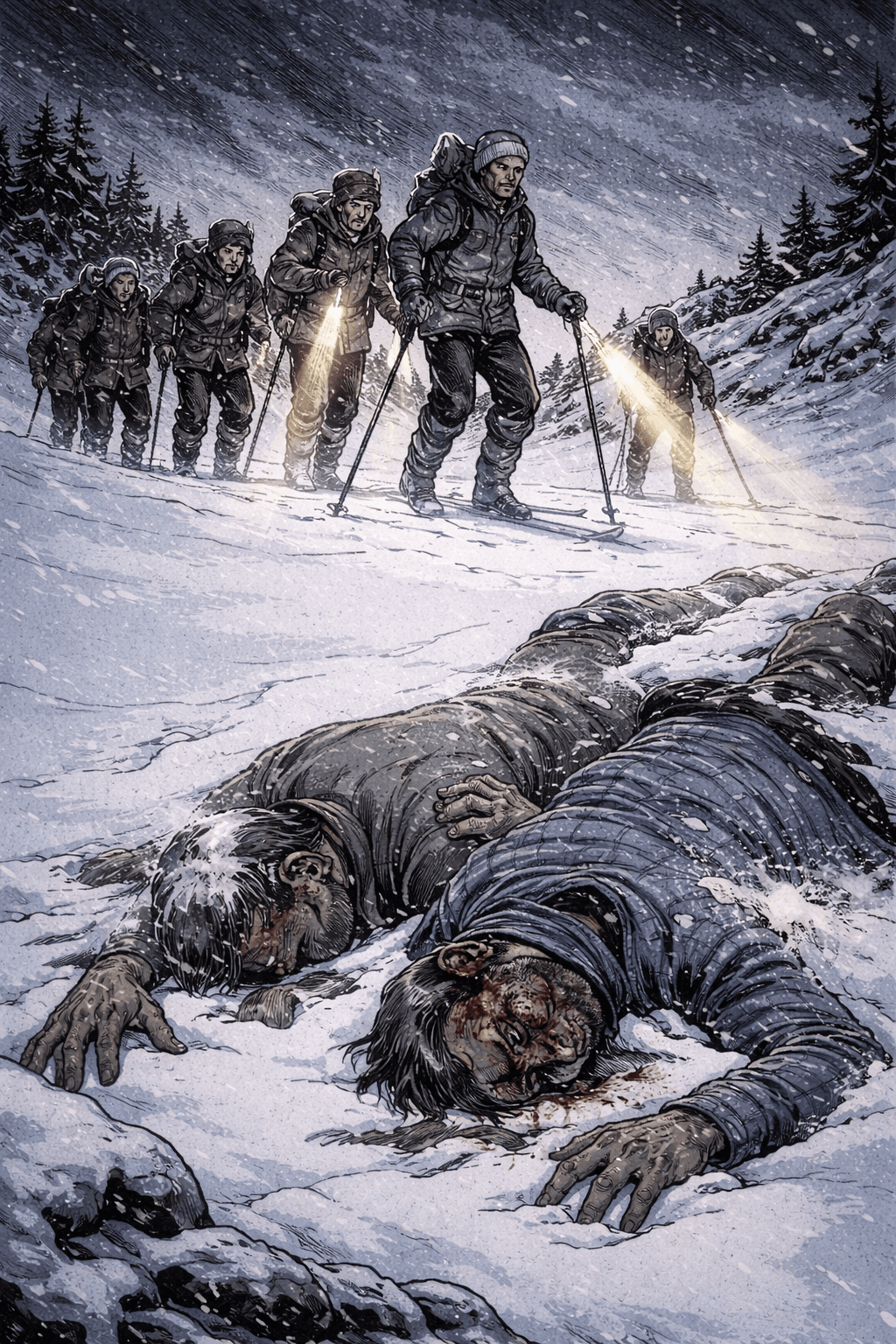
Nine experienced hikers died mysteriously in the Ural Mountains under circumstances that defy conventional explanation. Soviet authorities classified the area for three years.
On February 2, 1959, nine experienced hikers led by Igor Dyatlov disappeared in the northern Ural Mountains. When search teams found their camp three weeks later, they discovered the tent had been cut open from the inside, with the hikers fleeing barefoot into -30°F temperatures. The bodies, recovered over several months, showed inexplicable injuries - some had massive internal trauma with no external wounds, while others had missing eyes and tongues. Most disturbing was the radiation detected on several victims' clothing. Soviet authorities immediately classified the area for three years and sealed the case files, citing only a "compelling natural force" as the cause of death. The incident occurred during the height of the Cold War, when the Soviet Union was conducting nuclear weapons testing in the region.
Radiation-Contaminated Clothing
Tent Cut From Inside
Autopsy Reports
Orange Light Sightings
The Figure in the Trees
Frame 34 - The Final Exposure
"We saw these fireballs flying through the sky towards the area where the Dyatlov group was camping. They were bright orange and moved in ways that aircraft cannot move."
Yuri Koptelov was leading another student hiking expedition approximately 50 kilometers south of the Dyatlov group on February 1-2, 1959. He and his team of hikers from the Sverdlovsk Pedagogical Institute witnessed unusual lights in the sky on the night of the incident. Koptelov was an experienced outdoorsman familiar with aircraft and natural phenomena, making his testimony particularly significant. He reported the sighting to authorities during the initial search efforts and later provided detailed testimony to Soviet investigators.
"The weather conditions were severe but not unprecedented. However, I observed unusual atmospheric disturbances that night, including electromagnetic anomalies that interfered with our equipment."
Colonel Ortyukov was stationed at a military weather monitoring post approximately 30 kilometers from the incident site. As a trained meteorological observer with 15 years of experience in the region, he was responsible for tracking weather patterns for military operations. His weather station recorded unusual electromagnetic readings during the night of February 1-2, 1959. His testimony was classified for decades due to the sensitive nature of the military installation where he worked.
SHOW 2 MORE WITNESS STATEMENTS
"In my professional experience, I have never encountered injuries of this nature. The force required to cause such internal damage without external trauma is beyond normal explanation."
Dr. Vozrozhdenny was the chief forensic pathologist who conducted autopsies on all nine victims. With over 20 years of experience examining trauma victims, including war casualties, he found the injuries unlike anything in his professional experience. The combination of massive internal damage with minimal external wounds particularly puzzled him. His official reports documented radiation contamination on clothing and the unusual nature of soft tissue loss on some victims, findings that contributed to the case's mysterious status.
"Yes, it was a fireball and there was silence, and then when it went up and reached the summit sparks went off and there was a roar. Not a cannonade, but a rumble like explosion... Our tent was here facing the student's tent, and there are two peaks and at night the person on duty woke us up... hurry up look! When we got out, it was in the middle between the peaks. When it hit, sparks flew out and a hum—such a dull hum and a prolonged hum—and then everything stopped."
Nuclear Weapons Testing Accident
The radiation on clothing and classified area status suggest the hikers encountered fallout from a secret weapons test. The Soviet Union was actively testing nuclear devices in the region. The massive internal trauma could result from pressure waves or radioactive exposure. The government classified the area for three years to conceal military operations.
Katabatic Wind Phenomenon
Sudden downdraft winds reaching 150+ mph could have created panic, forcing the hikers to cut their way out of the tent. The infrasound frequencies generated by these winds cause disorientation and fear. Recent computer modeling shows the mountain's shape creates perfect conditions for catastrophic wind events that could explain the abandonment of camp.
Avalanche with Cover-up
A delayed slab avalanche occurred hours after the hikers cut their tent and fled. The massive chest trauma matches avalanche injuries. Swiss researchers using modern snow science demonstrated how a delayed avalanche could have struck the tent site. The government classification was to hide the inadequate rescue response during Cold War tensions.
Military Parachute Mine Test
Declassified documents reveal the Soviet military was testing FAE (fuel-air explosive) parachute mines in the region. These weapons create massive pressure waves without shrapnel, explaining the internal injuries without external wounds. The orange orbs reported by other hikers match flare illumination used in night weapons testing.
Infrasound Panic Theory
Low-frequency sound waves generated by wind over the mountain ridge created psychological terror and physical discomfort. Infrasound below 20 Hz causes anxiety, disorientation, and panic in humans. The hikers fled in psychological distress and died of exposure. The orange lights were unrelated military aircraft or atmospheric phenomena coinciding with the incident.
Menk Attack Theory
The indigenous Mansi people warned the hikers not to travel to Kholat Syakhl—the "Dead Mountain"—because it was territory of the Menk, a creature from Mansi folklore described as an 8-foot-tall, hair-covered humanoid capable of outrunning horses and ripping bears apart with bare hands. Weeks before the incident, a Mansi herder reported something killed several of his reindeer nearby, leaving bodies with strange internal injuries. The hikers' own newspaper, created at camp, included a "Science" section joking about snowmen in the Northern Urals. Soviet investigator Lev Ivanov concluded the fatal injuries "could not have been caused by human beings, because the force of the blows had been too strong." In 2014, Discovery Channel's documentary Russian Yeti: The Killer Lives argued one of the recovered photographs showed a large figure stalking the group.
While the radiation evidence and classified military activity in the region suggest possible weapons testing involvement, no smoking gun has emerged after 60+ years. The severe internal injuries without external trauma remain medically unexplained, and the immediate area classification indicates Soviet authorities knew more than they revealed.
Recent Russian investigations have focused on katabatic winds and avalanche theories, but these explanations still don't account for all the physical evidence—particularly the radiation readings, the missing soft tissue, and the injuries that Soviet investigator Vozrozhdenny said "could not have been caused by human beings."
The Menk theory adds another layer: the Mansi people's warnings about their territory, the creature sightings in the region, and the mysterious photographs—including the so-called "Figure in the Trees" showing what appears to be a dark humanoid stalking the group, and Frame 34's luminous orbs that were conveniently excluded from the official case file. Whether natural phenomenon, military cover-up, or something unexplained entirely—the Dyatlov Pass refuses to surrender its secrets.
Official Verdict (1959): Death caused by "an unknown compelling force which the hikers were unable to overcome."