The Voynich Manuscript: Medieval Codex or Elaborate Hoax?
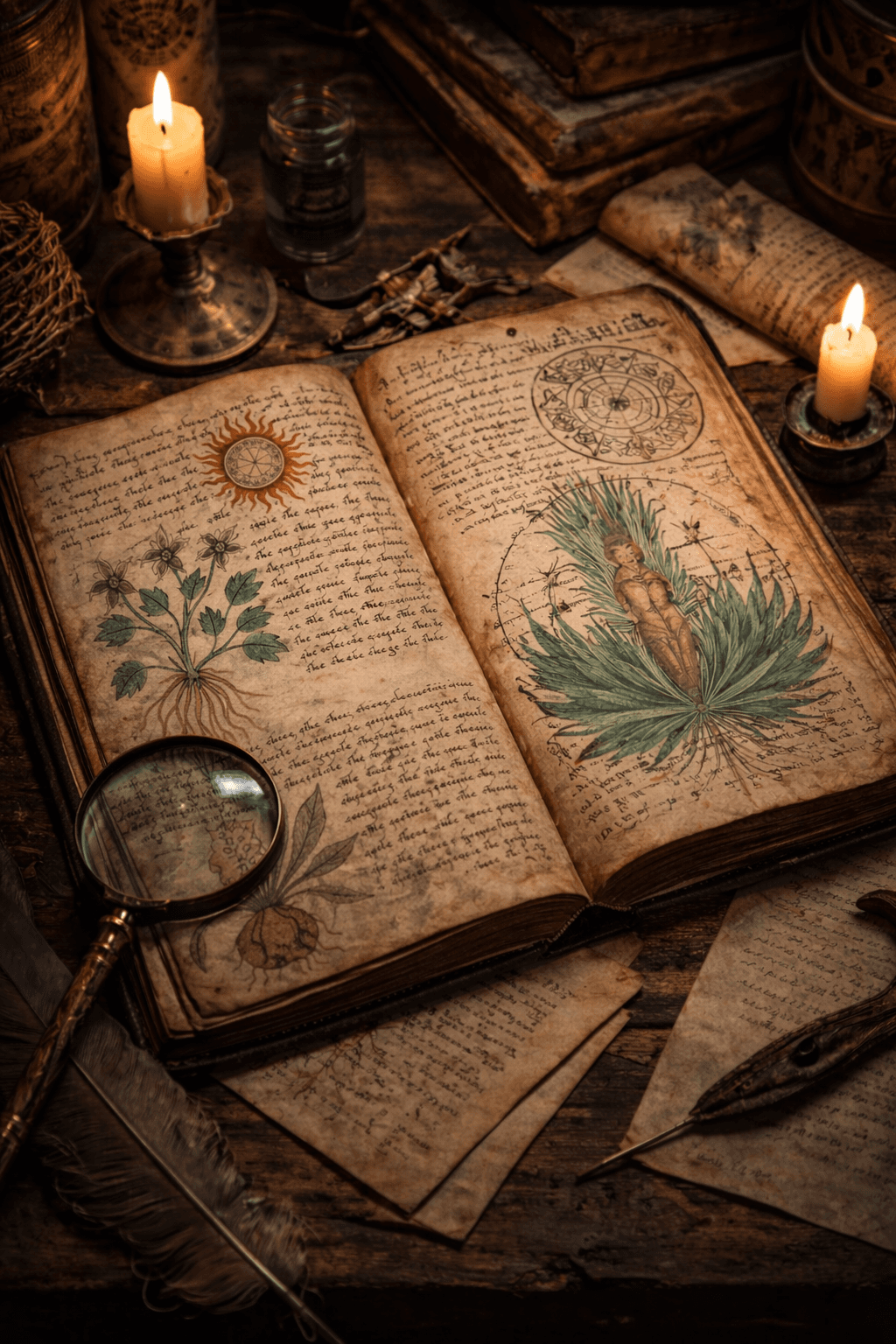
A 15th-century illustrated codex written in an unknown language and script that has defied all attempts at decipherment for over a century.
In 1912, rare book dealer Wilfrid Voynich acquired a mysterious medieval manuscript from the Jesuit College at Frascati near Rome. The 240-page vellum codex contains over 35,000 words written in an unknown script and language, accompanied by bizarre illustrations of unidentifiable plants, astronomical diagrams, and nude women in green pools. Carbon dating places its creation between 1404-1438 CE. Despite efforts by World War II codebreakers, linguists, and computer scientists, the manuscript's meaning remains completely unknown. The Yale University Beinecke Library has housed it since 1969, making it freely available online. Some scholars believe it's an authentic medieval text in a lost language, while others argue it's an elaborate Renaissance-era hoax designed to fool buyers.
Carbon Dating Analysis and Vellum Composition
NSA and Military Cryptanalysis Attempts
Botanical Illustrations Analysis
Artificial Intelligence Pattern Analysis
"I came across a most remarkable collection of precious painted books and manuscripts. One manuscript in particular attracted my attention... I found that it was written entirely in cipher."
Wilfrid Voynich was a Polish-Lithuanian revolutionary turned rare book dealer who discovered the manuscript in 1912 at the Jesuit College at Frascati, near Rome. As an experienced bibliophile and former political prisoner, Voynich recognized the manuscript's unusual nature immediately. His acquisition of the codex launched over a century of decipherment attempts. He spent years trying to decode it himself before sharing it with scholars worldwide.
"The Voynich Manuscript appears to be a meaningless sequence of arbitrary symbols put together according to some system."
William Friedman was America's foremost cryptographer and director of research for the U.S. Army's Signal Intelligence Service. Having broken Japanese diplomatic codes and helped develop modern cryptanalysis, his assessment carried enormous weight. Friedman studied the manuscript for over 20 years with his First Study Group, applying every known decryption technique. His conclusion that it might be an elaborate hoax influenced generations of researchers and remains one of the most authoritative opinions on record.
SHOW 2 MORE WITNESS STATEMENTS
"Every time I thought I had a solution, it would fall apart when I tried to extend it."
Robert Brumbaugh was a medieval philosophy professor at Yale University who gained access to the manuscript when it arrived at the Beinecke Library in 1969. As both a medieval scholar and amateur cryptographer, he was uniquely positioned to understand both the historical context and linguistic puzzles. Brumbaugh published several papers proposing partial solutions, including claims to have decoded astronomical passages. His frustration reflected the experience of countless researchers who found tantalizing patterns that ultimately led nowhere.
"I believe I have found the language and deciphered some of the text. It's not a cipher or code - it's a real language."
Stephen Bax was a professor of Applied Linguistics at the University of Bedfordshire who claimed breakthrough progress in 2014. Unlike cryptographers who assumed the text was encoded, Bax approached it as a natural language that could be learned through conventional linguistic analysis. He focused on proper nouns and plant names, claiming to identify words like "TAURUS" and "CENTAUREA." His work generated international media attention, though other linguists have been unable to verify his translations or replicate his methodology.
Lost Proto-Romance Language
Linguist Stephen Bax proposed in 2014 that the manuscript represents an extinct proto-Romance language from medieval Europe. He claimed to identify several words including "TAURUS" and "CENTAUREA" by comparing illustrations with their supposed textual labels.
Bax's approach focused on proper nouns and plant names, arguing that these would remain consistent across languages. He published tentative translations of 14 characters and 17 words, suggesting the text discusses herbal medicine and astronomy.
However, other linguists have failed to replicate Bax's results, and his proposed translations remain unverified. Critics argue that his methodology allows for too much interpretive flexibility, potentially seeing patterns where none exist.
Renaissance Hoax by Edward Kelley
Skeptics propose that 16th-century occultist Edward Kelley created the manuscript as an elaborate forgery to sell to Holy Roman Emperor Rudolf II for 600 gold ducats. Kelley was known for creating fake alchemical texts and had both motive and opportunity.
This theory explains the manuscript's linguistic anomalies and resistance to decipherment - it was never meant to be read, only to appear mystical and valuable. The consistent scribal hand and systematic approach suggest a single creator working methodically.
Yet carbon dating places the vellum decades before Kelley's birth, and the medieval Latin annotations appear authentic. If this is a hoax, it required remarkable foresight to use appropriately aged materials and medieval writing conventions.
Encrypted Medical Text
Computer scientists Greg Kondrak and Bradley Hauer used AI analysis in 2017 to suggest the manuscript is encrypted Hebrew describing herbal remedies and medical knowledge. Their algorithm identified Hebrew as the most likely source language with 97% confidence.
Their analysis of the opening line produced: "She made recommendations to the priest, man of the house and me and people." The herbal illustrations and apparent pharmaceutical content support this medical interpretation.
However, Hebrew scholars have rejected most of their proposed translations as grammatically incorrect. The AI may be finding statistical patterns without actual linguistic meaning, highlighting the danger of algorithmic false positives in historical analysis.
Meaningless Constructed Script
Researcher Gordon Rugg demonstrated in 2004 that the manuscript's statistical properties could be replicated using a Cardan grille - a medieval encryption device with holes cut in a sheet. This method could produce meaningless text that appears to have linguistic structure.
Rugg showed that a Renaissance forger could create the entire manuscript in three months using this technique. The resulting text would exhibit the same word frequency patterns and repetitive structures found in the Voynich Manuscript.
This theory elegantly explains why no decipherment succeeds - there's nothing to decode. However, it doesn't account for the manuscript's sophisticated botanical illustrations or the apparent systematic organization of different sections, suggesting underlying knowledge structure.
Aztec-Nahuatl Herbal Manual
Botanist Arthur Tucker and IT specialist Rexford Talbert argue the manuscript represents Nahuatl, the Aztec language, describing New World plants brought to Europe. They identify illustrations as American species unknown in medieval Europe.
Their 2013 analysis claims to recognize plants like sunflower, jalap, and sweet potato, suggesting the manuscript documents Aztec medical knowledge. The bathing women could represent temazcal sweat lodge ceremonies, while astronomical sections might record Mesoamerican calendar systems.
Critics note that carbon dating predates Columbus by decades, requiring either pre-Columbian contact or later additions to medieval vellum. The linguistic evidence for Nahuatl remains highly disputed among scholars.
The Voynich Manuscript presents a genuine medieval artifact whose contents remain completely undeciphered. While the vellum and ink are authentically 15th century, the text could represent anything from a lost language to an elaborate constructed script. Recent AI analysis has identified possible patterns, but no verified translation exists. The manuscript's resistance to decipherment after 110 years suggests either remarkable cryptographic sophistication or a meaningless cipher designed to appear meaningful.