The Patterson-Gimlin Film: America's Most Famous Cryptid Evidence
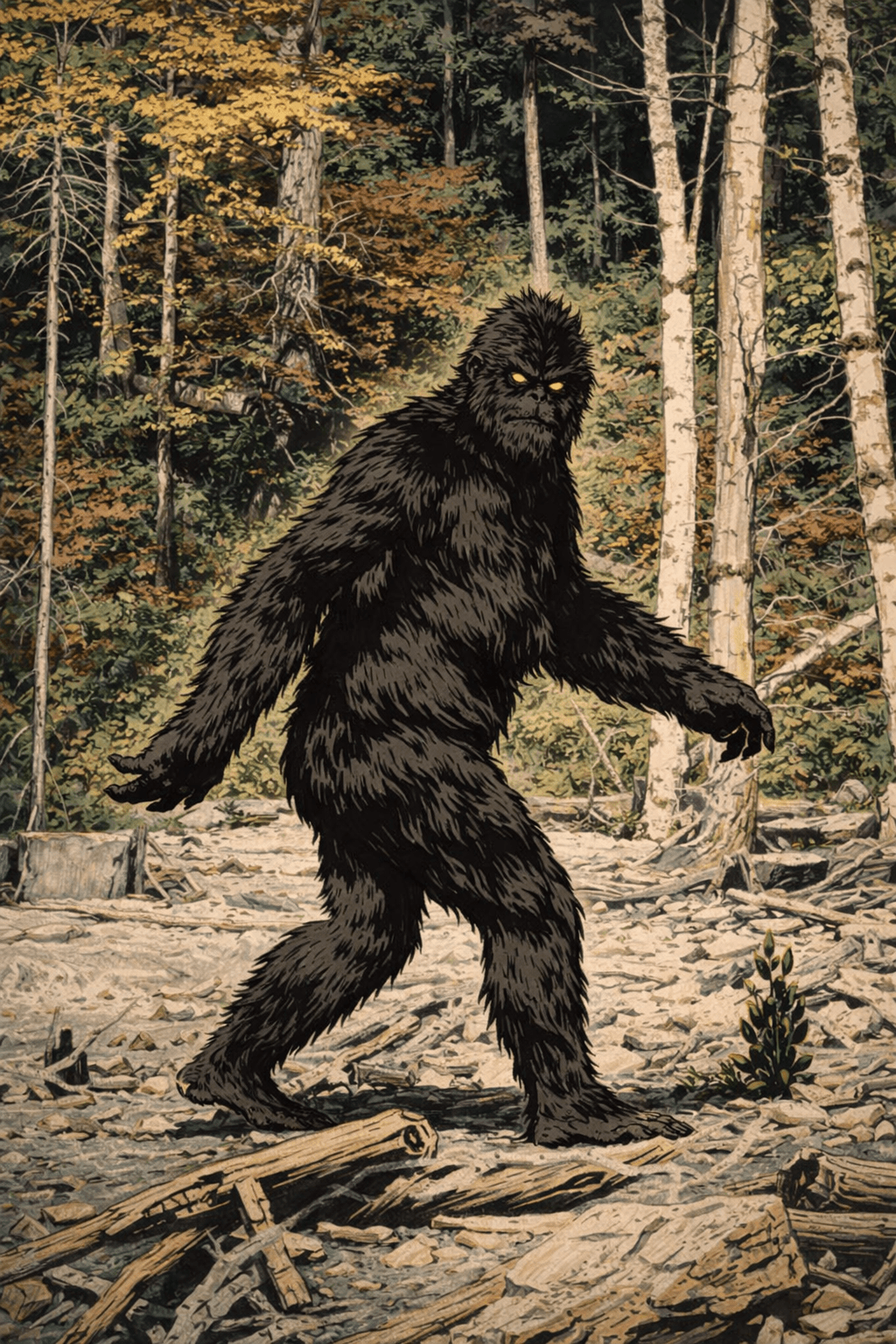
Two cowboys captured 59 seconds of film showing an alleged Bigfoot creature walking through a clearing. The footage remains hotly debated after 55+ years.
On October 20, 1967, Roger Patterson and Bob Gimlin were horseback riding through the remote Bluff Creek area when they allegedly encountered a seven-foot-tall, hair-covered bipedal creature. Patterson quickly grabbed his 16mm camera and filmed 59 seconds of footage showing the being walking away through a clearing. The creature, dubbed "Patty" by researchers, appears to turn and look directly at the camera before disappearing into the forest. The film shows distinctive anatomical features including prominent breasts, long arms, and a distinctive gait pattern. Despite decades of analysis by Hollywood special effects experts, anthropologists, and digital enhancement specialists, no definitive proof of fakery has emerged. The footage remains the most analyzed piece of cryptid evidence in history, yet continues to divide experts between those who believe it shows an unknown primate species and skeptics convinced it's an elaborate hoax.
Original 16mm Film Footage
Plaster Footprint Casts
Biomechanical Gait Analysis
Hollywood Special Effects Assessment
Digital Film Enhancement Results
Site Investigation Report
"It was about seven feet tall, covered in dark brown hair, and walked upright like a man but with a much different gait. When it turned to look at me, I could see its face clearly - it wasn't human."
Patterson was a former rodeo rider and aspiring documentary filmmaker who had been researching Bigfoot sightings in the Pacific Northwest. He was approximately 80 feet from the creature when he filmed the encounter, having borrowed the 16mm camera specifically for Bigfoot research. Patterson had recently read about Bigfoot tracks found in the Bluff Creek area and convinced his friend Bob Gimlin to accompany him on the expedition. He was heavily in debt at the time and had previously outlined plans for a Bigfoot documentary, which later fueled skepticism about his motives.
"I was watching Roger trying to get that camera out of his saddlebag when my horse reared up. That's when I saw it - this big, hairy creature walking along the creek. I've never seen anything like it in my life."
Gimlin was an experienced outdoorsman and horse trainer who initially accompanied Patterson reluctantly, skeptical about Bigfoot's existence. He was positioned about 150 feet away when the encounter occurred and helped Patterson document footprints at the scene immediately afterward. Unlike Patterson, Gimlin had no financial interest in Bigfoot research and maintained a low profile for decades following the incident. His consistent testimony over 50+ years, despite offers to recant for money, has impressed even some skeptics.
SHOW 3 MORE WITNESS STATEMENTS
"The film shows anatomical and biomechanical details that would be extremely difficult to fake. The proportions, gait, and muscle movements are consistent with a large primate, not a human in a costume."
Dr. Krantz was a respected anthropologist at Washington State University who became one of the few mainstream scientists to publicly support the film's authenticity. He conducted extensive anatomical analysis of the creature's proportions and gait patterns, concluding that the biomechanics were non-human. His academic reputation suffered due to his Bigfoot research, but he maintained his position until his death in 2002. Krantz's detailed measurements of stride length, limb ratios, and center of gravity calculations provided scientific credibility to Patterson's claims and influenced subsequent biomechanical studies.
"I've investigated hundreds of Bigfoot reports, and the Patterson film remains the most compelling piece of evidence. The detail visible in modern digital enhancement is remarkable."
Green was a Canadian journalist who became one of North America's leading Bigfoot researchers after investigating the Patterson-Gimlin film shortly after it was shot. He interviewed both men extensively and visited the Bluff Creek site within weeks of the encounter. Green documented footprint casts and corroborated many details of their account through independent investigation. His journalistic background and methodical approach to evidence collection lent credibility to early Bigfoot research. He spent over 40 years investigating cryptid reports and maintained detailed databases of sightings across the Pacific Northwest.
"When I developed that film, I couldn't believe what I was seeing. Roger was excited, but I thought it had to be some kind of joke until I examined it frame by frame."
DeAtley was the Universal Studios film technician who processed Patterson's original 16mm footage immediately after the encounter. As a professional with access to Hollywood special effects, his initial reaction carried significant weight in early authenticity debates. He examined the film under laboratory conditions and noted details that weren't visible during normal viewing speed. DeAtley later participated in several documentary interviews about the technical aspects of the footage and confirmed that no obvious editing or manipulation was present in the original film stock he processed.
Authentic Unknown Primate Documentation
The film captures a genuine unknown species of North American great ape. Supporters point to the creature's anatomical proportions, natural gait, and muscle definition visible in digital enhancement. The 16mm film grain and camera limitations of 1967 make sophisticated fakery nearly impossible. Anthropologist Dr. Grover Krantz argued the stride length and biomechanics are consistent with a large bipedal primate, not a human in costume.
Elaborate Hoax for Financial Gain
Patterson and Gimlin orchestrated an elaborate costume hoax to profit from Bigfoot interest. Patterson was heavily in debt and had previous plans for a Bigfoot documentary. The remote location provided perfect conditions for deception, and the brief 59-second duration conveniently limits detailed analysis. Hollywood makeup artist John Chambers was rumored to have created the costume, though he denied involvement until his death.
Misidentified Human in Costume
The figure represents a tall human wearing a primitive ape costume available in the 1960s. The bulky appearance and awkward gait are consistent with someone wearing an ill-fitting suit over regular clothing. Film grain and distance obscure details that would reveal the deception. The creature's human-like proportions when digitally measured suggest a person of approximately 6'6" height rather than a genuine cryptid.
Advanced Military Psychological Operation
The film was part of a classified military disinformation campaign designed to keep civilians away from sensitive logging areas used for covert operations or weapons testing. The remote Bluff Creek location was near restricted government land. Creating cryptid legends would effectively discourage civilian exploration while providing plausible cover for unusual activity. Patterson's background and the convenient timing suggest possible intelligence connections.
Surviving Gigantopithecus Population
The creature represents a surviving population of Gigantopithecus, an extinct giant ape that lived in Asia until 300,000 years ago. Land bridge migrations during ice ages could have brought small populations to North America. The film shows characteristics consistent with reconstructed Gigantopithecus anatomy including massive size, ape-like proportions, and forest habitat preference. Fossil evidence supports the existence of such creatures in recent geological time.
Interdimensional or Paranormal Entity
Bigfoot represents an interdimensional being that occasionally manifests in our reality, explaining the lack of physical remains or clear photographic evidence. The Pacific Northwest's high electromagnetic activity and indigenous spiritual traditions support theories of dimensional rifts in the region. The creature's ability to vanish without trace and the camera malfunctions reported by many researchers suggest paranormal rather than biological origins.
Undiscovered Hominid Species
The film documents a relict hominid population that survived in isolated North American forests. Recent discoveries of Homo floresiensis and Denisovans prove unknown human species survived longer than previously believed. The creature's bipedal locomotion and facial features suggest hominid rather than ape characteristics. Genetic isolation in Pacific Northwest forests could preserve small breeding populations undetected by modern science until Patterson's accidental encounter.
The Patterson-Gimlin film represents one of cryptozoology's most enduring mysteries. Advanced digital analysis has revealed anatomical details consistent with an unknown primate, including muscle definition and natural movement patterns difficult to replicate with 1960s costume technology. However, no corroborating physical evidence like DNA samples or skeletal remains has ever been recovered. The financial motivations of the filmmakers and technological limitations of period analysis equipment complicate definitive conclusions. While the footage has never been conclusively debunked, extraordinary claims require extraordinary evidence that remains elusive after five decades of investigation.