The Hollow Moon: Earth's Artificial Satellite
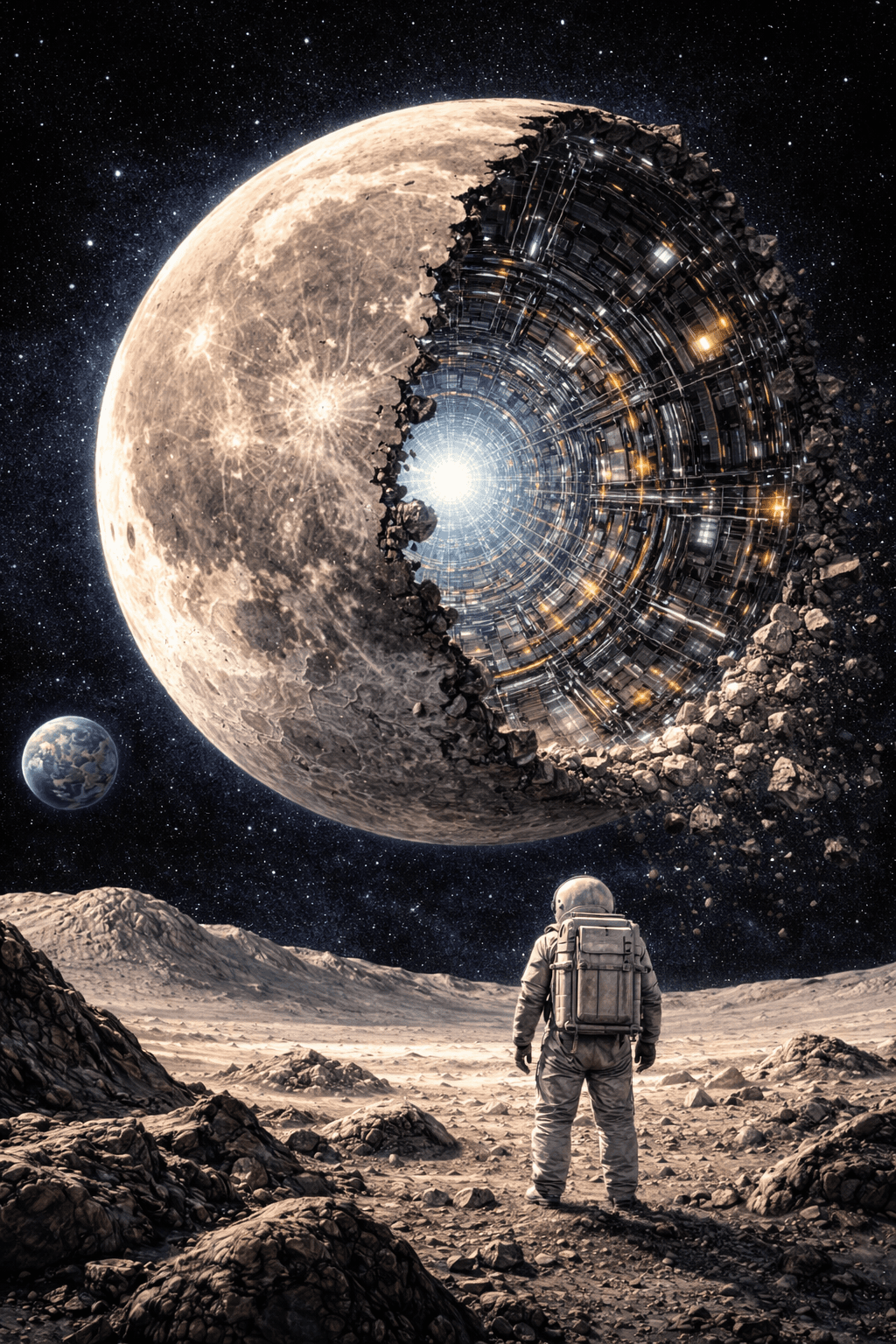
Evidence suggests Earth's Moon may be an artificial hollow structure rather than a natural celestial body.
During Apollo missions between 1969-1977, seismic experiments revealed anomalous data suggesting the Moon may be hollow or contain vast internal cavities. When lunar modules crashed into the surface, the Moon "rang like a bell" for hours, producing vibrations lasting up to four hours - behavior inconsistent with a solid rocky body. The Moon's unusually low density (3.34 g/cm³ compared to Earth's 5.52 g/cm³) and perfectly circular orbit have puzzled scientists for decades. Additional anomalies include the Moon's identical apparent size to the Sun during eclipses, despite vastly different distances, and its synchronous rotation keeping one face permanently hidden. Some researchers propose the Moon is an artificial construct - possibly an ancient spaceship, observation post, or manufactured satellite. NASA data from these missions remains partially classified, fueling speculation about what authorities discovered but chose not to reveal publicly.
Apollo Seismic Data
Density Anomaly Calculations
Mass Concentration Maps
Orbital Mechanics Anomalies
"The lunar Orbiter experiments had found that the gravity field of the Moon was quite different from that of a uniform sphere - it had mascons, mass concentrations. This was a phenomenon not seen elsewhere."
Dr. Solomon served as Principal Investigator for NASA's MESSENGER mission and Director of the Lamont-Doherty Earth Observatory at Columbia University. His expertise in planetary geophysics and gravitational field analysis lends significant credibility to observations about lunar anomalies. As a leading researcher in comparative planetology, Solomon's acknowledgment of the Moon's unique gravitational properties highlights how unusual these characteristics are compared to other celestial bodies. His statement was made during congressional testimony about lunar research findings, emphasizing the scientific significance of the mascon discoveries.
"It would seem that the Moon is more like a hollow than a homogeneous sphere."
Dr. MacDonald was a distinguished geophysicist at UCLA and NASA advisor who analyzed early Apollo seismic data. His background included extensive research in earthquake seismology and planetary interior structure, making him uniquely qualified to interpret the unusual lunar seismic responses. MacDonald's statement came during a 1962 presentation to the American Astronomical Society, years before Apollo missions would provide confirming evidence. His prediction that seismic studies would reveal hollow characteristics proved remarkably prescient when Apollo experiments later detected the prolonged "ringing" effects that supported his theoretical framework.
SHOW 2 MORE WITNESS STATEMENTS
"We cannot help but come to the conclusion that the Moon is an artificial Earth satellite put into orbit around the Earth by some intelligent beings unknown to ourselves."
Dr. Vasin was a Soviet mathematician and space researcher at the Academy of Sciences who co-authored the controversial 1970 paper proposing the artificial Moon theory. Working alongside Alexander Shcherbakov, Vasin analyzed orbital mechanics and lunar physical properties that seemed inconsistent with natural formation. His academic credentials in celestial mechanics and mathematical modeling provided scientific rigor to what many dismissed as speculation. The timing of their publication, coinciding with Apollo discoveries, generated significant debate in the international scientific community and influenced a generation of alternative researchers examining lunar anomalies.
"A natural satellite cannot be a hollow object."
Carl Sagan, the renowned astronomer and Cornell University professor, made this statement while discussing the hollow Moon theory during a 1973 academic conference. Despite being a skeptic of the artificial Moon hypothesis, Sagan's comment inadvertently highlighted the central paradox: if the Apollo seismic data suggested hollow characteristics, how could the Moon be natural? His expertise in planetary formation and evolution made him a authoritative voice in debates about lunar origins. Sagan's later writings acknowledged that certain lunar properties remained "puzzling" and deserved continued scientific investigation, even while maintaining conventional formation theories.
Artificial Spaceship Theory
Proposed by Soviet scientists Mikhail Vasin and Alexander Shcherbakov in 1970, this theory suggests the Moon is an artificial construct - possibly an ancient interstellar ark or observation station. They argued the Moon's unusual orbital characteristics, low density, and seismic properties indicate engineered construction rather than natural formation.
The theory gained traction when Apollo data revealed the Moon's interior produces metallic ringing sounds and contains mass concentrations (mascons) in perfectly circular patterns. Proponents argue no natural process could create such precise geometric anomalies.
However, critics point out that massive construction of this scale would require technology far beyond current human capabilities, and no definitive evidence of artificial structures has been confirmed. The theory raises profound questions: if true, who built it, when, and why position it so precisely around Earth?
Ancient Alien Outpost
UFO researchers propose the Moon serves as an extraterrestrial monitoring station, explaining centuries of unexplained lunar phenomena and UFO sightings. This theory suggests advanced beings hollowed out a natural satellite or constructed an artificial one to observe Earth's development.
Evidence includes NASA astronaut reports of mysterious lights, structures, and geometric shapes on the lunar surface that don't appear in official photographs. The theory explains why the Moon's far side remains permanently hidden - potentially concealing alien installations or technology.
Skeptics argue most "anomalous" lunar observations result from photographic artifacts, lighting conditions, or misidentified geological features. Yet the theory addresses why certain Apollo mission transcripts were classified and why no nation has established permanent lunar bases despite decades of technological advancement. If extraterrestrials monitor Earth from the Moon, would establishing human colonies threaten their operations?
Natural Hollow Formation
Some geologists propose the Moon naturally developed hollow chambers through ancient volcanic activity and bombardment events. This theory suggests massive lava tubes and impact-created caverns could create resonance chambers explaining the seismic anomalies observed during Apollo missions.
Unlike other celestial bodies, the Moon lacks tectonic activity and atmospheric weathering, potentially preserving vast underground spaces formed billions of years ago. Computer models indicate impact excavation from asteroids and comets could create interconnected cavern systems.
While this explains some anomalies through natural processes, it fails to address the Moon's suspiciously perfect orbit and density calculations. Critics argue that even extensive cave systems wouldn't produce the uniform low density observed across the entire lunar body. The theory raises questions about why similar hollow formations aren't detected in other moons and planets with comparable geological histories.
Planetary Defense System
Advanced theorists suggest the Moon functions as an ancient planetary shield, artificially positioned to protect Earth from asteroid impacts and cosmic threats. This theory proposes prehistoric civilizations or extraterrestrial benefactors created or modified the Moon as Earth's guardian.
Evidence includes the Moon's statistically improbable size and position, which creates perfect solar eclipses and stabilizes Earth's axial tilt. The mass concentration anomalies could represent internal machinery or structural supports for defensive systems.
Proponents argue Earth's unique stability among known planets results from the Moon's protective influence, enabling complex life to evolve. Without lunar tidal forces and orbital stabilization, Earth might resemble Mars - a barren world unable to sustain advanced ecosystems.
Critics maintain natural processes adequately explain lunar formation and orbital mechanics. Yet the theory addresses fundamental questions: why does Earth alone possess such a disproportionately large, perfectly positioned satellite? Could our planet's habitability depend on artificial intervention?
Time Capsule Hypothesis
This theory proposes the Moon serves as a massive repository containing records of Earth's history or advanced civilizations. Researchers suggest its hollow interior could house libraries, genetic banks, or technological archives preserved for future discovery.
The hypothesis explains why the Moon's composition differs significantly from Earth despite supposedly forming from terrestrial material during a giant impact. If artificially constructed, the Moon could contain compressed historical data spanning millions of years.
Advocates point to unexplained magnetic anomalies and metallic signatures detected by orbital surveys as evidence of internal technology or data storage systems. The Moon's tidally locked rotation ensures one hemisphere remains permanently protected from cosmic radiation and micrometeorite damage.
Skeptics argue no evidence supports vast internal structures or technological systems. However, the theory raises intriguing possibilities: if humanity eventually develops deep lunar excavation capabilities, what might we discover beneath the surface? Could the Moon contain answers to fundamental questions about Earth's past and humanity's origins?
While Apollo seismic data did reveal unusual properties, mainstream science provides conventional explanations for observed anomalies. The "ringing" effect likely results from the Moon's dry, fractured interior amplifying vibrations rather than indicating hollowness. However, significant gaps remain in our understanding of lunar formation and interior structure. The statistical improbability of certain orbital characteristics continues to intrigue researchers. Until more comprehensive lunar exploration occurs, including deep core sampling and advanced seismic mapping, the hollow Moon theory remains an intriguing possibility that challenges our assumptions about natural satellite formation and the history of our solar system.