The JAL 1628 Incident: Commercial Pilot's UFO Encounter Over Alaska
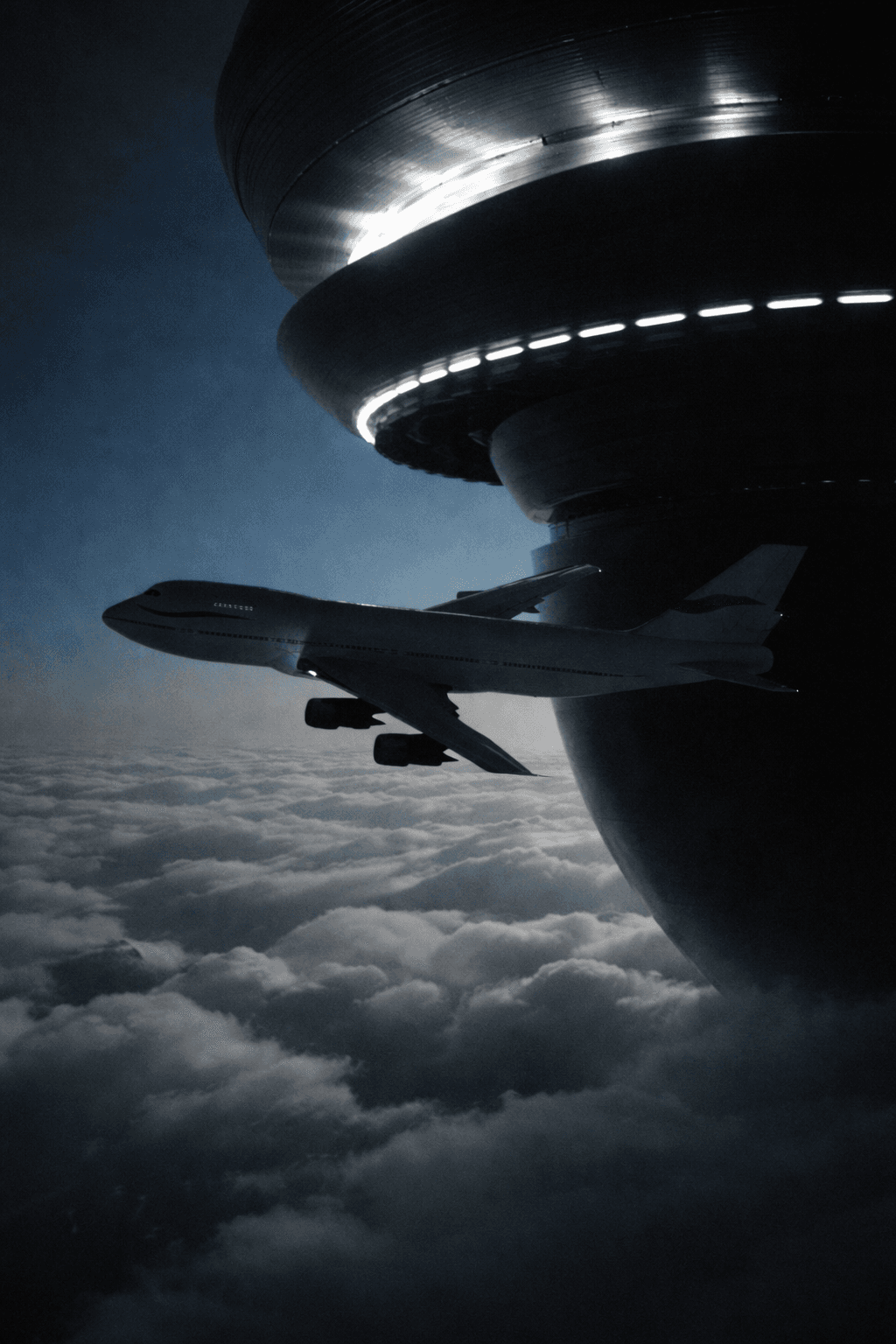
Japan Air Lines cargo pilot reported massive UFO encounter over Alaska, tracked by military radar and investigated by FAA.
On November 17, 1986, Captain Kenju Terauchi piloting Japan Air Lines Flight 1628 reported an extraordinary encounter with unidentified aircraft over Alaska. The cargo flight from Paris to Tokyo was carrying Beaujolais wine when Terauchi observed two "walnut-shaped" objects with rows of glowing lights approximately 2,000 feet in front of his Boeing 747. The objects reportedly emitted such intense heat that Terauchi could "feel it on my face." Minutes later, an enormous "mothership" appeared - described as twice the size of an aircraft carrier with a "pale white light." Anchorage Air Route Traffic Control Center tracked anomalous radar returns during the encounter. The Federal Aviation Administration launched a formal investigation, while United Airlines Flight 69 was diverted to search for the objects but found nothing. The case gained international attention and remains one of the most credible pilot UFO reports on record.
FAA Division Chief John Callahan's Official Testimony
Anchorage Air Route Traffic Control Radar Data
Captain Terauchi's Official Flight Report Documentation
United Airlines Flight 69 Search Mission Records
Elmendorf Air Force Base Weather Data Analysis
"It was a very big one, two times bigger than an aircraft carrier. The lights were pale white, just like a cigarette ash. It had a silhouette of a gigantic spaceship. We were not afraid. We were just surprised."
Captain Kenju Terauchi, a veteran Japan Air Lines pilot with 29 years of flight experience and over 10,000 flight hours, was commanding JAL Flight 1628 during the November 17, 1986 encounter. Flying the Boeing 747-200F cargo aircraft at 35,000 feet, Terauchi had the clearest view of the objects and provided the most detailed descriptions throughout the 50-minute encounter. His extensive aviation background and familiarity with conventional aircraft made him qualified to distinguish between known and unknown aerial phenomena.
"I saw the lights, but I could not see the shapes clearly like the captain."
Co-pilot Takanori Tamefuji was the second officer aboard JAL Flight 1628 and occupied the right seat of the Boeing 747 cockpit during the encounter. With several years of commercial aviation experience, Tamefuji confirmed observing unusual lights ahead of the aircraft but provided less detailed descriptions than Captain Terauchi. His position in the cockpit afforded a different viewing angle, which may explain the variance in observation detail. His testimony supported the presence of anomalous lights while remaining cautious about their exact nature.
SHOW 2 MORE WITNESS STATEMENTS
"I was not concentrating on identifying the object, but I did see some lights."
Flight Engineer Yoshio Tsukuda was responsible for monitoring the Boeing 747's systems and occupied the flight engineer's station behind the pilots during the November 17, 1986 encounter. His primary focus remained on aircraft operations and system monitoring rather than external observation. Tsukuda confirmed seeing unusual lights but provided minimal detail about their appearance or behavior. As an experienced flight engineer, his acknowledgment of anomalous lights adds credibility to the crew's collective testimony while maintaining professional objectivity.
"I saw the target on radar, and it was in the same position as the JAL pilot reported. The target was not moving at all, and the JAL flight was in orbit around it."
Paul Steucke was the air traffic controller on duty at Anchorage Air Route Traffic Control Center during the JAL 1628 incident on November 17, 1986. With several years of radar operation experience, Steucke tracked both JAL Flight 1628 and the anomalous radar returns throughout the encounter. He coordinated the diversion of United Airlines Flight 69 to investigate the objects and maintained communication with Captain Terauchi during the event. His radar confirmation provided independent verification of objects in the vicinity of the Japanese cargo flight.
Extraterrestrial Spacecraft
UFO researchers propose that Captain Terauchi encountered genuine extraterrestrial vehicles conducting surveillance or scientific operations over Alaska. Proponents like Dr. Richard Haines of the National Aviation Reporting Center on Anomalous Phenomena argue the objects displayed impossible flight characteristics - silent hovering, instantaneous acceleration, and formation flying beyond current technology.
The mothership description matches patterns in other UFO cases, suggesting a hierarchical craft system. The remote Alaskan location provides ideal conditions for covert observation of human aviation activities. The intense heat radiation reported by Terauchi could indicate exotic propulsion systems.
However, this theory struggles with the Fermi Paradox - why would advanced beings reveal themselves to a cargo pilot but avoid official contact? Critics also note the lack of physical evidence and the convenient timing during a period of increased UFO media attention.
Military Black Project
Defense analysts suggest Flight 1628 inadvertently encountered classified U.S. military aircraft during testing operations over Alaska. The 1980s marked the height of stealth technology development, with programs like the F-117 and B-2 bomber requiring extensive remote testing. Alaska's vast airspace and military installations make it ideal for black project operations.
The walnut-shaped objects could represent unconventional aircraft designs exploring exotic propulsion systems. The radar invisibility reported intermittently aligns with early stealth capabilities. Military air traffic controllers might have been aware of the exercise, explaining the casual response to Terauchi's reports.
This theory faces challenges from the extreme size of the reported mothership and the heat radiation effects. Even experimental aircraft wouldn't generate such intense thermal signatures. The declassification of contemporary black projects has revealed no craft matching Terauchi's descriptions, though the most sensitive programs remain classified.
Atmospheric Plasma Phenomenon
Atmospheric physicists propose that Terauchi observed rare plasma formations created by specific meteorological conditions over Alaska. The temperature inversion present that night could have generated ball lightning or other electromagnetic phenomena. Jupiter and Mars were visible that evening, potentially creating planetary light refraction.
Dr. Philip Klass, a prominent UFO skeptic, argued that ice crystals in the atmosphere combined with aircraft navigation lights created the illusion of nearby objects. The heat sensation could result from psychological stress or cockpit heating system fluctuations. Radar returns might represent false echoes from atmospheric ducting.
While atmospheric phenomena explain some aspects, this theory struggles with the structured appearance and intelligent movement patterns reported by Terauchi. The duration and consistency of the encounter over 50 minutes also challenges simple atmospheric explanations. Critics note that experienced pilots regularly fly in similar conditions without such dramatic encounters.
Psychological Misidentification
Aviation psychologists suggest Captain Terauchi experienced a complex visual illusion triggered by fatigue, expectation, and environmental factors. Long-haul flights create cognitive stress that can lead to misidentification of routine phenomena. Terauchi had previously reported UFO sightings, indicating predisposition toward such interpretations.
The bright planetary lights of Jupiter and Mars, combined with aircraft strobe lights and ground reflections, could create the illusion of nearby objects. Confirmation bias might have led Terauchi to interpret ambiguous radar data as supporting his visual observations. His co-pilot and flight engineer saw only vague lights, suggesting the detailed descriptions originated from psychological elaboration.
This theory explains the subjective nature of the primary testimony and the lack of physical evidence. However, it fails to account for the independent radar confirmations and the specific technical details in Terauchi's account. The immediate reporting also contradicts typical patterns of psychological UFO cases that develop over time.
Soviet Aircraft Intrusion
Cold War intelligence experts theorized that Flight 1628 encountered Soviet reconnaissance aircraft conducting surveillance near Alaska during the height of U.S.-USSR tensions. The timing in 1986 coincided with increased Soviet air activity following the Chernobyl incident and heightened nuclear alert status.
The formation flying pattern and electronic countermeasures capabilities could explain both the visual sighting and intermittent radar detection. Soviet aircraft were known to test U.S. air defense responses by approaching Alaskan airspace. The government secrecy surrounding the incident might reflect classified intelligence about Soviet capabilities.
The enormous mothership description potentially matches experimental Soviet cargo aircraft or aerial refueling platforms. However, this theory faces significant challenges from the impossible flight characteristics and heat radiation effects that exceed any known Soviet technology of the era. Post-Cold War document releases have revealed no Soviet operations matching this incident timeline and location.
Captain Terauchi's account gains credibility from his 29 years of flight experience, corroborating radar data from Anchorage control, and the FAA's serious investigation. However, the case remains controversial. Skeptics note that only Terauchi clearly observed the objects while his co-pilot and flight engineer saw ambiguous lights. Some researchers suggest the encounter involved experimental military aircraft or atmospheric phenomena. The temperature inversion conditions present that night could have created optical illusions. Nonetheless, the combination of visual testimony from an experienced pilot, radar confirmation, and official investigation makes this one of the most compelling commercial aviation UFO cases.