The Buzzer: Russia's Mysterious UVB-76 Signal
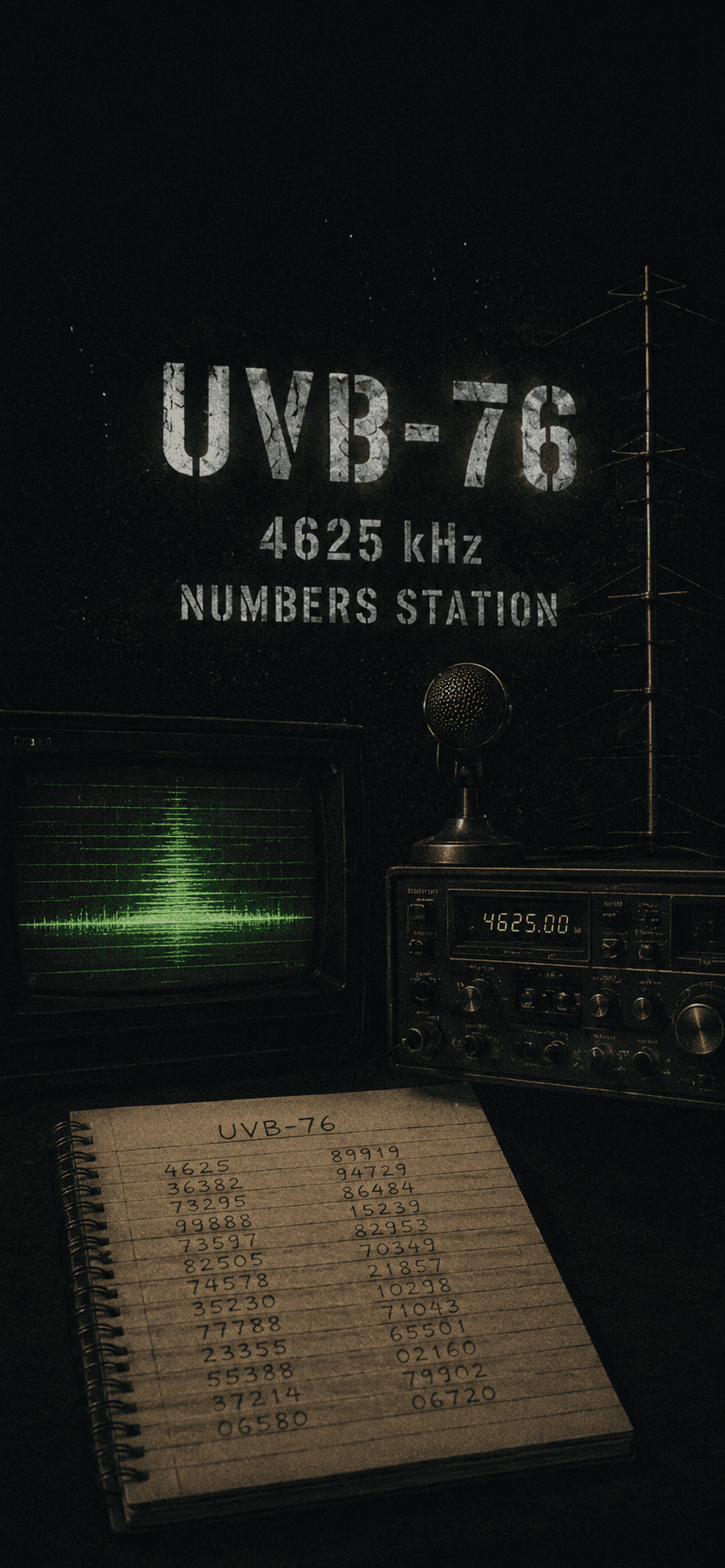
A Russian shortwave radio station broadcasts mysterious buzzing sounds and coded messages 24/7 since the 1970s. Military installations, spy communications, or something else entirely?
UVB-76, known as "The Buzzer," is one of the world's most enigmatic radio transmissions. Broadcasting continuously on 4625 kHz since the 1970s, this Russian shortwave station emits a monotonous buzzing sound interrupted occasionally by cryptic voice messages in Russian. The signal originates from a military facility near Povarovo, Russia, though its exact purpose remains classified.
Radio enthusiasts worldwide monitor The Buzzer obsessively, documenting every anomaly. In 2010, the transmission briefly went silent before resuming from a new location. Voice messages are rare but chilling - typically Russian names, numbers, and military call signs spoken in emotionless tones. During major geopolitical events, activity increases dramatically.
While most experts believe it's a numbers station used for military communications, theories range from nuclear dead man's switches to psychological warfare experiments. The station's relentless broadcast continues today, maintaining its secrets behind layers of Russian military classification.
Voice Message Transcripts and Audio Analysis
Frequency Spectrum Analysis from International Telecommunication Union
Radio Monitoring Logs from Numbers Stations Research Community
2010 Signal Interruption and Facility Relocation Documentation
Satellite Imagery of Transmission Facilities
Ary Boender has described UVB-76 as a kind of Cold War "heartbeat" that never stopped — a station whose every buzz, voice message, and technical anomaly his community documents because they suspect it is more important than Russian authorities acknowledge.
Ary Boender operates the Numbers & Oddities website and has monitored numbers stations including UVB-76 for many years from the Netherlands. As one of the leading civilian researchers of numbers stations, he maintains detailed logs and coordinates with radio enthusiasts globally to track signal behavior. His decades of personal monitoring experience make him one of the few civilians with comprehensive knowledge of the station's operational patterns.
Simon Mason has described the 2010 UVB-76 silence as deeply unsettling — after decades of constant buzzing, the frequency suddenly went empty, and the resumption of the signal accompanied by faint background voices was, in his account, striking and significant for the monitoring community.
Simon Mason is associated with the Enigma 2000 numbers stations research group and has monitored UVB-76 from the United Kingdom. He was among the radio enthusiasts who documented the 2010 interruption event and subsequent signal changes. His technical expertise and observations during this pivotal event provide valuable firsthand context about the station's most significant operational change.
SHOW 2 MORE WITNESS STATEMENTS
Among the long-term shortwave listening community, a recurring observation is that UVB-76 does not feel like a forgotten automated system — listeners describe a sense that the signal is being actively maintained, with subtle variations in transmission patterns that some believe correlate with periods of international tension.
This description reflects general sentiment shared by long-term amateur radio operators in the international shortwave listening community who have monitored UVB-76 for decades. Their collective logging procedures and observations provide community-level insight into the station's operational patterns and apparent responsiveness to world events, though individual interpretations vary.
Reports from European broadcast monitoring observers indicated that during the 2008 Russia-Georgia conflict, UVB-76's voice message frequency reportedly increased, with more transmissions noted in a short window than in preceding periods — consistent with the broader pattern that the station appears responsive to Russian military activities.
This observation reflects reporting circulated within the European telecommunications and shortwave monitoring community, where technicians track international radio services as part of spectrum management or hobbyist activity. Monitoring during periods of Russian military involvement in international conflicts has produced anecdotal documentation of changes in UVB-76's transmission characteristics, though these reports are informal and not officially compiled.
Military Command Network
The most widely accepted theory positions UVB-76 as part of Russia's strategic military communication network. Radio intelligence experts believe the constant buzzing serves as a channel marker, keeping the frequency active and ready for priority military messages.
This theory explains the rare voice transmissions containing Russian military call signs and coded numbers. The 2010 relocation from Povarovo to another facility suggests active maintenance and operational importance. Former Soviet radio operators have suggested similar systems existed during the Cold War for emergency communications.
However, questions remain about why such a system would broadcast so openly on shortwave frequencies monitored worldwide. Modern military forces typically use encrypted digital communications, making this analog approach seem deliberately antiquated or serving a specific strategic purpose that requires public detectability.
Nuclear Dead Man's Switch
A darker theory suggests UVB-76 functions as Russia's nuclear dead man's switch - an automated system designed to detect if Moscow has been destroyed in a nuclear attack. According to this hypothesis, if the signal ever stops broadcasting, it could trigger automated retaliation systems.
This theory gained attention during the 2010 silence, when The Buzzer went dark briefly before resuming from a new location. The interruption generated widespread speculation among intelligence-watchers monitoring the signal. The constant buzzing would serve as a "heartbeat" confirming Russian command structure remains intact.
Critics argue this system would be too vulnerable to technical failures or jamming to serve such a critical function. Yet the theory persists among observers who point to similar concepts in Soviet-era strategic doctrine, where maintaining continuous communication signals was considered essential for nuclear deterrence stability.
Psychological Operations Experiment
Some researchers propose UVB-76 represents a long-term psychological warfare experiment designed to create uncertainty and obsession among Western intelligence services. The deliberately mysterious nature of the transmissions consumes resources as analysts attempt to decode meaningless signals.
This theory explains why the station broadcasts openly rather than using secure channels. The global community of radio enthusiasts monitoring every buzz and voice message demonstrates the signal's success in capturing attention. Soviet-era psychological operations doctrine described tactics of creating false intelligence trails to distract adversaries.
The weakness in this theory lies in the enormous resources required to maintain such an elaborate deception for decades. Russian military communications are already sufficiently encrypted and secure, making an additional layer of misdirection potentially unnecessary unless it serves multiple operational purposes beyond simple psychological manipulation.
Atmospheric Research Station
A lesser-known theory positions UVB-76 as part of Russia's atmospheric and ionospheric research program. The constant signal transmission allows scientists to study radio wave propagation, atmospheric interference, and communication reliability across different weather conditions and solar activity cycles.
This scientific explanation accounts for the signal's consistency and technical precision. The 4625 kHz frequency falls within an optimal range for studying atmospheric effects on radio transmission. Voice messages could be periodic calibration tests or data collection markers rather than coded military communications.
However, this theory struggles to explain the military-style call signs in voice transmissions and the facility's obvious connection to Russian defense infrastructure. Pure atmospheric research would typically use more varied transmission patterns and frequencies, rather than the monotonous buzzing pattern that has characterized UVB-76 for decades.
Emergency Broadcast Infrastructure
Military communication experts suggest UVB-76 serves as backup emergency broadcast infrastructure for Russian civilian and military coordination during national crises. The system maintains constant readiness to override normal broadcasting with critical information during emergencies or wartime scenarios.
This theory explains the signal's persistence and reliability - qualities essential for emergency communication systems. The 2010 facility relocation demonstrated the system's ability to maintain operations even when primary equipment fails. Voice message increases during international tensions support the emergency readiness hypothesis.
Yet critics note that modern emergency broadcast systems typically use multiple frequencies and digital encoding for better coverage and security. The single-frequency analog approach seems inadequate for comprehensive national emergency communications, unless UVB-76 represents just one component of a larger, undisclosed emergency broadcast network operating across multiple classified frequencies.
The Buzzer is definitely real and broadcasting, but its true purpose remains hidden behind Russian military secrecy. While the numbers station theory is most plausible, the occasional voice messages and strategic timing of transmissions suggest deeper significance. The 2010 location change and increased activity during international crises indicate active operational status rather than automated system malfunction. Without insider access or declassified documents, the complete truth about UVB-76's mission may never be revealed.