The Washington National UFO Incident
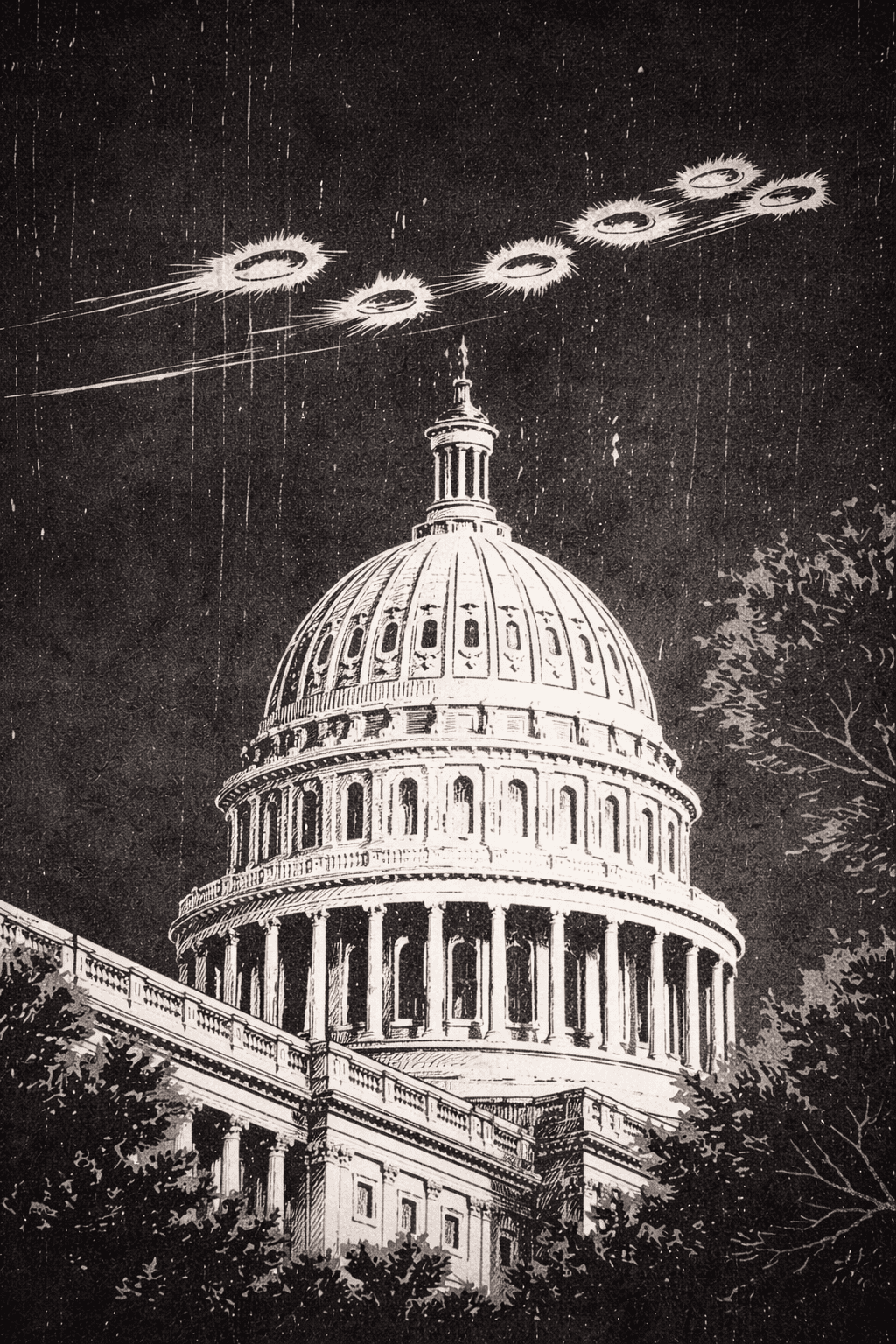
Multiple radar contacts and visual sightings over Washington D.C. prompted military scrambles and national headlines during two consecutive weekends.
On July 19 and 26, 1952, Washington National Airport's radar operators detected multiple unidentified objects moving at extraordinary speeds over the nation's capital. Air traffic controllers Harry Barnes and Edward Nugent watched as targets appeared on their screens, moving at speeds up to 7,200 mph before stopping abruptly. The objects appeared over sensitive areas including the White House and Capitol Building. Military radar at Andrews Air Force Base confirmed the contacts. F-94 Interceptor jets were scrambled both nights, with pilots reporting visual contact with bright lights that seemed to play "cat and mouse" with the aircraft. The incidents made front-page headlines nationwide and prompted the largest press conference in Air Force history up to that point, with officials attributing the events to temperature inversions.
Washington National Airport Radar Logs
Military Intercept Pilot Reports
Andrews Air Force Base Radar Confirmations
White House Communication Records
"The objects were solid, metallic objects. They were not mirages or temperature inversions. I've been tracking aircraft for over ten years, and I know what I saw on those radar screens."
Barnes served as senior air traffic controller at Washington National Airport with over a decade of radar experience. As the primary controller during both incident nights, he tracked multiple objects moving at impossible speeds before stopping abruptly over restricted airspace. His testimony became central to the Air Force investigation, though he publicly disputed their temperature inversion conclusion until his death in 1982. Barnes' credibility was never questioned by investigators or colleagues.
"Four bright lights surrounded my aircraft. When I tried to close in, they would speed away at tremendous velocity, much faster than our jets."
Patterson piloted an F-94 Starfire interceptor scrambled from New Castle Air Force Base during the July 26 incident. A Korean War veteran with combat flight experience, he described objects that outperformed any known aircraft of 1952. His encounter lasted approximately 14 minutes, with his radar operator Lieutenant John Holcomb confirming the contacts on aircraft instruments. Patterson's official flight report became part of the permanent Project Blue Book record.
SHOW 2 MORE WITNESS STATEMENTS
"I've never seen anything like it. These weren't normal aircraft - they moved too fast and could stop instantly. The radar returns were the strongest I'd ever seen."
Nugent worked as an air traffic controller at Washington National Airport under senior controller Harry Barnes. On duty during the initial July 19 incident, he was among the first to notice unusual radar contacts appearing over the White House. His independent observations corroborated Barnes' reports and helped establish the timeline of events. Nugent continued working in air traffic control for three decades, maintaining that the Washington incident was unlike any weather phenomena he encountered.
"The lights were brilliant white, brighter than any aircraft lights I'd seen. They seemed to respond to our presence, almost like they were watching us."
McHugo piloted the second F-94 interceptor launched during the July 26 incident, with radar operator Sergeant Leland Gunter. A veteran pilot with extensive night flying experience, he described objects that exhibited apparent intelligent control and awareness of the military aircraft. His encounter occurred approximately 20 minutes after Lieutenant Patterson's initial contact. McHugo's report emphasized the objects' unusual luminosity and deliberate evasive maneuvers, characteristics that impressed investigating Air Force intelligence officers.
Atmospheric Inversion Phenomena
The official Air Force explanation centers on temperature inversions - atmospheric conditions where warm air sits above cooler air, creating false radar returns and visual mirages. Captain Roy James and other meteorologists argued that the unusual heat wave affecting Washington in July 1952 created perfect conditions for such inversions.
This theory explains the radar contacts as ground targets being reflected upward, creating the illusion of aerial objects. The visual sightings would be light refraction from ground sources appearing as aerial phenomena. Weather data from both nights shows the necessary atmospheric conditions existed.
However, critics note that experienced controllers like Harry Barnes claimed familiarity with inversion effects and insisted these contacts were different. Why would seasoned professionals mistake routine weather phenomena for something extraordinary, especially during the heightened security climate of 1952?
Experimental Military Aircraft
Some researchers propose the objects were classified U.S. military aircraft being tested over Washington. The extreme speeds and maneuverability described match theoretical capabilities of experimental jet designs being developed in 1952. The timing coincides with accelerated military aviation research following the Korean War outbreak.
This theory would explain why the objects seemed to evade interceptors - they were friendly aircraft with superior performance. The subsequent cover-up would protect classified technology rather than hide alien contact. Military personnel would be briefed to deny knowledge, creating the appearance of a temperature inversion explanation.
Yet this raises troubling questions about unauthorized flights over the White House and Capitol. Would the military really test experimental aircraft over such sensitive areas without warning air traffic control? The security breach implications make this theory problematic.
Soviet Reconnaissance Technology
Given the intense Cold War atmosphere of 1952, some intelligence analysts suggested the objects might represent advanced Soviet surveillance technology. The timing coincides with escalating tensions and the recent Soviet nuclear tests. The objects' apparent interest in government buildings supports a reconnaissance mission theory.
This explanation would account for the immediate military response and subsequent official dismissal - acknowledging foreign aircraft over Washington would represent a massive security failure. The objects' superior speed and maneuverability might indicate Soviet technological breakthroughs unknown to U.S. intelligence.
However, declassified Soviet documents show no evidence of such advanced capabilities in 1952. The USSR was still recovering from World War II devastation, making exotic aircraft development unlikely. Additionally, the flight patterns described seem more exploratory than strategic, inconsistent with military reconnaissance objectives.
Mass Hysteria and Misidentification
Psychologists and sociologists point to the cultural climate of 1952 - UFO reports had surged following Kenneth Arnold's 1947 sighting, creating heightened public awareness. The Washington incident occurred during peak flying saucer media coverage, potentially priming witnesses to interpret ordinary phenomena as extraordinary.
This theory suggests that suggestion and expectation caused experienced personnel to misinterpret routine radar contacts and celestial objects. The group psychology of the radar room may have reinforced initial misidentifications, creating a cascade of false confirmations. Media attention then amplified these misperceptions into a national incident.
Yet this explanation struggles with the technical expertise of witnesses like air traffic controllers and military radar operators. These professionals were trained to distinguish between normal and abnormal contacts. Why would their collective judgment fail so dramatically during a routine shift?
Extraterrestrial Surveillance
UFO researchers argue the Washington incident represents deliberate alien surveillance of Earth's most powerful government. The objects' focus on the White House and Capitol suggests intelligence-gathering rather than random visitation. The timing coincides with the nuclear age - potentially triggering alien interest in human technological development.
Proponents note the objects' impossible flight characteristics - instantaneous acceleration, right-angle turns, and speeds beyond any 1952 aircraft capabilities. The cat-and-mouse behavior with interceptors implies intelligent control rather than atmospheric phenomena. Multiple witness testimonies provide corroboration across different locations and time periods.
Skeptics counter that extraordinary claims require extraordinary evidence, and radar contacts plus visual sightings, while compelling, don't conclusively prove extraterrestrial origin. The lack of physical evidence and alternative explanations for the observed phenomena make this theory, while intriguing, ultimately unprovable with available data.
While the official temperature inversion explanation addresses some radar anomalies, it fails to account for visual confirmations by experienced pilots and controllers, simultaneous radar contacts at multiple installations, and the objects' apparent intelligent behavior. The rushed press conference and dismissive tone suggest possible damage control. However, atmospheric phenomena can create convincing false targets, and the Cold War paranoia of 1952 may have amplified normal occurrences into extraordinary events.