The Lake Champlain Serpent: America's Oldest Monster
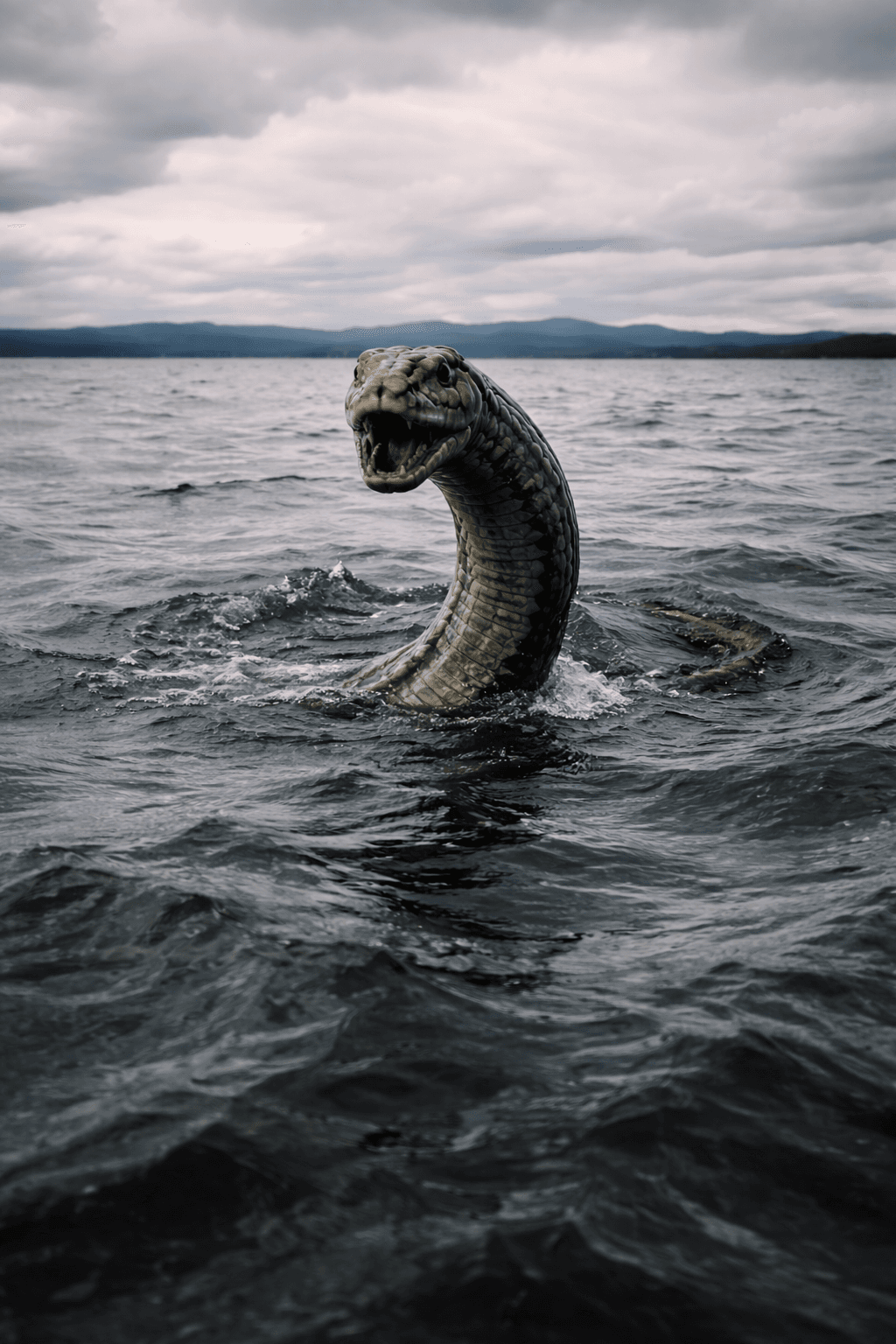
A massive aquatic creature has been reported in Lake Champlain for over 400 years, making it America's most documented lake monster.
Lake Champlain harbors one of North America's oldest and most consistently reported cryptids. Samuel de Champlain himself documented a massive serpentine creature in 1609, describing a 20-foot long beast with a horse-like head. The sightings haven't stopped. Over 300 documented encounters span four centuries, from Native American legends to modern eyewitness accounts. The creature, affectionately dubbed "Champ," typically appears as a dark, humped form moving through the water, with estimates ranging from 25 to 187 feet long. Unlike many cryptid cases, Champ enjoys unusual official recognition - Vermont and New York both passed resolutions protecting the creature from harm. The lake's unique ecosystem, connected to the Atlantic Ocean until 10,000 years ago, could theoretically support large aquatic life. Joseph Zarzynski's extensive database documents consistent behavioral patterns across centuries of sightings.
The Sandra Mansi Photograph Analysis
Vermont Fish & Wildlife Incident Reports
University Research Team Behavioral Analysis
Sonar Contact — Garmin Capture by Scott Thurber
Sonar Contact — Champ Search Echo Scan
"I saw this thing in the water. It was a head and neck sticking up. I was in such shock I couldn't believe it. I grabbed my camera and took one picture."
Sandra Mansi was vacationing with her family at Lake Champlain in July 1977 when she witnessed and photographed what became the most famous Champ evidence. A Connecticut resident with no prior interest in lake monsters, Mansi was adamant about what she observed but initially hesitant to report it publicly. Her delayed reporting (four years later) and subsequent cooperation with investigators, despite receiving no financial benefit, has led many researchers to consider her testimony credible. The family was simply enjoying a lakeside picnic when the encounter occurred.
"I've been on this lake for over 30 years and I've never seen anything like it. It was definitely not a boat, not a log, not anything I could identify. It was moving under its own power against the current."
Sheriff Richard Marsh of Clinton County, New York, was conducting a routine patrol on Lake Champlain in August 1992 when he observed an large unknown object moving through the water near Plattsburgh Bay. As a law enforcement officer familiar with all types of lake traffic and debris, Marsh's professional training in observation and his reputation in the community lent significant weight to his testimony. He estimated the object at over 30 feet in length with a distinctive undulating movement pattern that defied conventional explanation.
SHOW 2 MORE WITNESS STATEMENTS
"This thing came up maybe 150 feet from our boat. It had to be 40 feet long with humps along its back. When it went under, it created a whirlpool that rocked our 20-foot boat."
Alex Korchmar was fishing for salmon with his partner in September 2009 near Crown Point when they encountered what he described as the most frightening experience of his 25-year fishing career on Lake Champlain. As a commercial fisherman intimately familiar with lake conditions, wildlife, and water phenomena, Korchmar's detailed knowledge of normal lake activity made his inability to identify the creature particularly significant. He immediately contacted the Coast Guard auxiliary and later cooperated with investigators despite concerns about ridicule from fellow fishermen.
"As a biology student, I'm trained to observe and identify aquatic life. This was unlike anything in my textbooks. The head was distinctly serpentine with visible eyes that seemed to be watching us before it submerged."
Jennifer Davis was conducting water quality research for her marine biology thesis from the University of Vermont in June 2006 when she and two fellow students observed an unknown creature near Burlington Bay. Her academic background in aquatic biology and familiarity with Lake Champlain's native species made her testimony particularly valuable to investigators. Davis initially debated whether to report the sighting, concerned about potential impact on her academic credibility, but ultimately decided the scientific value outweighed personal concerns about ridicule.
Surviving Plesiosaur Population
The most popular theory suggests Champ represents a surviving plesiosaur - marine reptiles thought extinct for 66 million years. Proponents like cryptozoologist Roy Mackal argue Lake Champlain's ancient connection to the Atlantic Ocean could have trapped a breeding population when sea levels receded.
The lake's maximum depth of 400 feet and abundant fish populations could theoretically support large aquatic predators. Witness descriptions of long necks, small heads, and flipper-like appendages align with plesiosaur anatomy. However, the theory faces significant challenges.
Critics point out that no plesiosaur fossils exist from the required timeframe, and the lake froze completely during ice ages. A breeding population would require multiple individuals, making detection more likely. Could these creatures possess unknown behavioral adaptations for survival, or does the consistency of sightings point to misidentification of known species?
Relic Population of Primitive Whale
Marine biologist Dr. Roy Mackal and others propose Champ could be a zeuglodon - an extinct primitive whale with an elongated, serpentine body structure. These archaeocetes lived 40 million years ago but possessed characteristics matching many Champ descriptions: segmented appearance, undulating swimming motion, and substantial size.
Unlike rigid reptiles, zeuglodons were warm-blooded mammals capable of surviving colder waters. Their 50-70 foot length matches larger Champ sightings, and their flexible spines would create the multi-humped appearance frequently reported. The theory addresses some plesiosaur theory weaknesses regarding cold-water survival.
However, zeuglodons were ocean dwellers requiring saltwater environments. Lake Champlain is freshwater, and these creatures went extinct millions of years ago. Would such an ancient lineage leave no trace in the fossil record? The theory raises questions about whether unknown evolutionary branches could persist in isolated environments.
Giant Sturgeon Misidentification
Skeptics propose most Champ sightings result from misidentified lake sturgeon (*Acipenser fulvescens*), North America's largest freshwater fish. These ancient fish can reach 8 feet long, live over 100 years, and surface to gulp air - behaviors that could create monster-like appearances to startled observers.
Sturgeon possess armored scutes along their backs creating a humped profile when surfacing. Their prehistoric appearance and tendency to swim in groups could generate reports of massive serpentine creatures. Dr. Benjamin Radford argues most lake monster sightings worldwide involve sturgeon misidentification combined with psychological factors like pareidolia.
While sturgeon explain some encounters, this theory struggles with size discrepancies. Witnesses consistently report creatures 25+ feet long - nearly three times maximum sturgeon size. Could multiple sturgeon swimming together create illusions of single massive creatures, or do the most credible sightings involve something genuinely unknown?
Submarine Geological Activity
A fascinating alternative theory suggests underwater seismic activity creates the Champ phenomenon. Lake Champlain sits on active geological fault lines, and Dr. Elizabeth von Muggenthaler's research into elephant infrasound led her to investigate similar low-frequency emissions from the lake.
Submarines gas releases, underwater landslides, or methane bubble columns could create temporary surface disturbances resembling living creatures. The lake's unique bathymetry includes underwater cliffs and caverns where geological processes might generate mysterious movements and sounds. This would explain the creature's apparent ability to vanish instantly.
The theory accounts for sporadic sightings and lack of physical evidence, but struggles to explain consistent biological descriptions across centuries. Witnesses report deliberate movement patterns, eye contact, and creature behaviors incompatible with geological phenomena. Could geological activity work in conjunction with misidentification of known animals, or do the most compelling encounters require biological explanations?
Cultural Memory and Folklore Perpetuation
Anthropologists suggest the Champ phenomenon represents cultural memory preservation rather than biological reality. Native American Abenaki traditions describe Tatoskok, a horned serpent dwelling in the lake, predating European contact by centuries. These stories may have primed subsequent generations to interpret ambiguous sightings through a "monster" lens.
Psychologist Dr. Joe Nickell argues expectation bias, combined with the lake's tourism industry, creates a feedback loop encouraging monster reports. Witnesses unconsciously conform their descriptions to established Champ mythology, explaining the consistency skeptics find suspicious. The 1977 Sandra Mansi photograph sparked renewed interest, potentially influencing subsequent sighting descriptions.
However, this theory doesn't explain why some witnesses initially resist monster explanations or report sightings reluctantly. Many credible observers, including scientists and law enforcement, had no prior monster expectations. Could cultural programming really override trained observation skills, or does genuine anomalous phenomena inspire the persistent folklore across multiple cultures?
The Champ phenomenon presents compelling consistency across four centuries of reports. Over 300 documented sightings from credible witnesses including police officers, scientists, and longtime residents create a substantial body of testimony. The lake's depth (400+ feet) and connection to ancient waterways provide plausible habitat. However, no definitive physical evidence has emerged despite extensive investigation. The Sandra Mansi photograph from 1977 remains the most compelling visual evidence, though experts remain divided on its authenticity. While hoaxes and misidentification explain some cases, the sheer volume and consistency of reports suggests an unknown phenomenon deserves continued scientific attention.